Computing Dot Product: (\nabla\times \mathbf{v})\cdot d\mathbf{a}

Click For Summary

Homework Help Overview

The discussion revolves around computing the dot product of the curl of a vector field and a differential area vector in the context of vector calculus, specifically relating to Stokes' theorem.

Discussion Character

  • Conceptual clarification, Assumption checking

Approaches and Questions Raised

  • The original poster attempts to compute the dot product directly but questions the omission of terms involving x in the integral. Other participants explore the reasoning behind this omission and the implications of the surface being in the z-y plane.

Discussion Status

Participants are engaged in clarifying the reasoning behind the author's approach and the assumptions made regarding the surface integral. There is a recognition of differing perspectives on how the problem could have been presented, but no consensus has been reached on the best method of explanation.

Contextual Notes

There is an emphasis on the importance of understanding the context of the surface integral and the conditions under which certain terms can be disregarded. The original question and the author's approach are under scrutiny regarding clarity and completeness.

Saladsamurai
Messages
3,009
Reaction score
7
I cannot seem to figure out how to compute this dot product?!

If [itex](\nabla\times \mathbf{v})=(4z^2-2x)\hat{i}+2z\hat{k}[/itex] and [itex]d\mathbf{a}=dydz\hat{i}[/itex]

Then shouldn't the DOT PODUCT be:

[itex](\nabla\times \mathbf{v})\cdot d\mathbf{a}=(4z^2-2x)\hat{i}*dydz\hat{i}=(4z^2-2x)dydz[/itex] ?

But the book says its just [itex]4z^2dydz[/itex]

What am I doing wrong here??

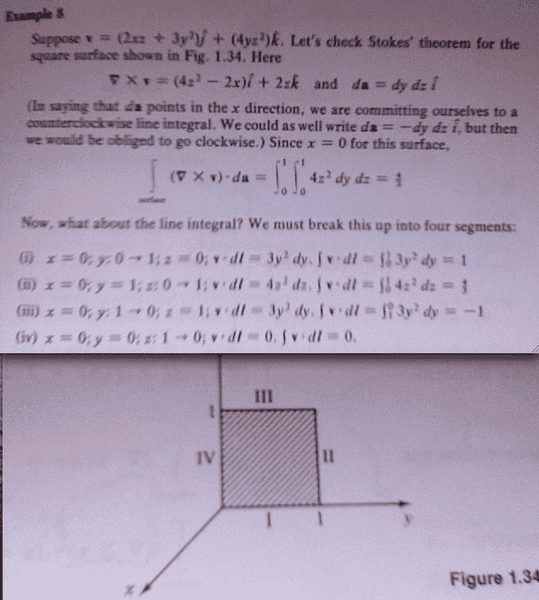
Here is the original question:
Picture1-20.png
 
Physics news on Phys.org
Wait... I think I see what he did. Since the square lies in the z-y plane only, when the integral is carried out, anything with an x in it will vanish anyway. So he just did not bother.

I really hate the way this guy does his math. :mad:
 
He did bother. He said "Since x=0 for this surface" right before he wrote out the integral.

Look at it this way: If authors had to spell out every step along the way they wouldn't be able to get past introductory algebra, let alone discuss Stokes' theorem. Authors have to omit obvious intermediate steps. Some authors see things as obvious that the novice doesn't. This, IMO, is not one of those cases. If the author had failed to say "Since x=0 ..." you would have had a better case.
 
Point taken. But mind you, my malcontent is not a result of his omitting obvious steps. He could have just computed the dot product, ran the integrals, and left to to the reader to figure out why all of the x terms dropped out.

Different strokes for different folks. I've just never seen it done this way before :smile:
 

Similar threads

Replies
3
Views
2K
  • · Replies 13 ·
Replies
13
Views
4K
  • · Replies 9 ·
Replies
9
Views
2K
  • · Replies 3 ·
Replies
3
Views
2K
  • · Replies 5 ·
Replies
5
Views
1K
  • · Replies 9 ·
Replies
9
Views
2K
  • · Replies 3 ·
Replies
3
Views
2K
  • · Replies 6 ·
Replies
6
Views
3K
Replies
3
Views
1K
  • · Replies 4 ·
Replies
4
Views
2K