Graduate Conditional phase shift for Grover's algorithm

Click For Summary
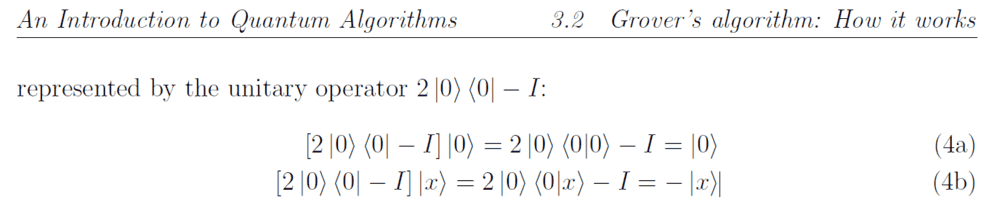
The discussion revolves around understanding the conditional phase shift in Grover's algorithm, specifically the representation of the unitary operator 2|0><0| - I. The deduction for equation 4a is clarified, showing that applying this operator to |0> simplifies to |0>. However, there is confusion regarding equation 4b, particularly the author's treatment of I|0> and I|x>, which appears to be a misunderstanding. It is suggested that the author may be addressing cases separately, with |x=0> in 4a and |x≠0> in 4b, where |0> and |x> are orthogonal. The conversation highlights the complexities of the equations and indicates that the project may contain errors or typos.
Francis
Messages
2
Reaction score
1
TL;DR
Dear fellas, I am reading a quantum physics tutorial to understand Grover's algorithm and I am stuck with a (very simple) deduction.
I have the pdf attached page 23 at the top.
I am trying to understand the following deduction:
"The conditional phase shift can be represented by the unitary operator 2|0> <0| - I:"
1609892386212.png
for eq. 4a) I was expecting to be:

[2 |0><0| - I] |0> =
2 |0> <0|0> - I|0> = 2|0> - |0> =
|0>

as for eq. 4b I can't understand it at all. Why does the author considers I|0> = I and I|x> = I? What am I missing?
 

Attachments

  • Like
Likes vanhees71
Physics news on Phys.org
Just a lot of typos. As to 4b), I think the author just treats the case where ##x=0## separately since it isn't picking up the minus sign.
 
  • Like
Likes Francis and vanhees71
It seems that this a student project.

It looks like ##\left| x \right>## has has been split into two cases: ##\left| x= 0 \right>## in (4a); ##\left| x \neq 0\right> ## with ##\left| 0 \right>## and ##\left| x \right>## orthogonal to each other in (4b),

@Haborix relied with similar comments while I was typing.
 
  • Like
Likes Francis and vanhees71
Insights auto threads is broken atm, so I'm manually creating these for new Insight articles. Towards the end of the first lecture for the Qiskit Global Summer School 2025, Foundations of Quantum Mechanics, Olivia Lanes (Global Lead, Content and Education IBM) stated... Source: https://www.physicsforums.com/insights/quantum-entanglement-is-a-kinematic-fact-not-a-dynamical-effect/ by @RUTA

Similar threads

Replies
4
Views
2K
  • · Replies 9 ·
Replies
9
Views
3K
  • · Replies 1 ·
Replies
1
Views
2K
  • · Replies 1 ·
Replies
1
Views
1K
  • · Replies 4 ·
Replies
4
Views
647
Replies
4
Views
4K
  • · Replies 3 ·
Replies
3
Views
2K
  • · Replies 0 ·
Replies
0
Views
2K
  • · Replies 0 ·
Replies
0
Views
951
  • · Replies 5 ·
Replies
5
Views
3K