Abigale
- 53
- 0
Hi,
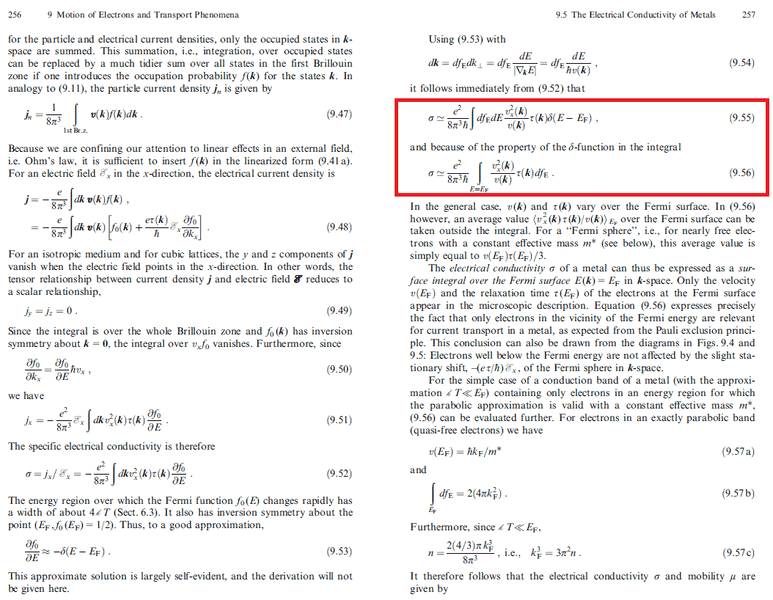
I am reading "An Introduction of Solid State Physics" from Ibach Lüth and don't understand the integration process.
They write $$\sigma=\frac{e^2}{8\pi^3 \hbar}
\int df_{E}dE \frac{v^2_x(\bf{k})}{v(\bf{k})} \tau(\bf{k}) \delta(E-E_F)
$$
$$
= \int_{E=E_F}^{}df_{E} \frac{v^2_x(\bf{k})}{v(\bf{k})} \tau(\bf{k})
$$
But why does ## k ## NOT become ##k_F## after the Integration of the Delta-function?
I would think that the integral becomes immedately after the dE-integration:
$$
= \int_{E=E_F}^{}df_{E} \frac{v^2_x(\bf{k_F})}{v(\bf{k_F})} \tau(\bf{k_F})
$$
THX
Abbi
I also add the pages
I am reading "An Introduction of Solid State Physics" from Ibach Lüth and don't understand the integration process.
They write $$\sigma=\frac{e^2}{8\pi^3 \hbar}
\int df_{E}dE \frac{v^2_x(\bf{k})}{v(\bf{k})} \tau(\bf{k}) \delta(E-E_F)
$$
$$
= \int_{E=E_F}^{}df_{E} \frac{v^2_x(\bf{k})}{v(\bf{k})} \tau(\bf{k})
$$
But why does ## k ## NOT become ##k_F## after the Integration of the Delta-function?
I would think that the integral becomes immedately after the dE-integration:
$$
= \int_{E=E_F}^{}df_{E} \frac{v^2_x(\bf{k_F})}{v(\bf{k_F})} \tau(\bf{k_F})
$$
THX
Abbi
I also add the pages
Attachments

Last edited: