Confused about solving RC circuits with nodal analysis

Click For Summary
The discussion centers on the confusion surrounding the sign of the term C(dv/dt) in nodal analysis for RC circuits. It clarifies that the current is assumed to be leaving the node, which is consistent with the direction of current flow from the v(t) node to the capacitor. The importance of maintaining a consistent current direction—either all entering or all leaving the node—is emphasized to avoid incorrect results, such as infinite voltage. The explanation resolves the confusion regarding the positive sign of C(dv/dt) by reinforcing the assumption of current direction in nodal analysis. Overall, the clarification helps in understanding the application of nodal analysis in solving RC circuits correctly.
timnswede
Messages
100
Reaction score
0
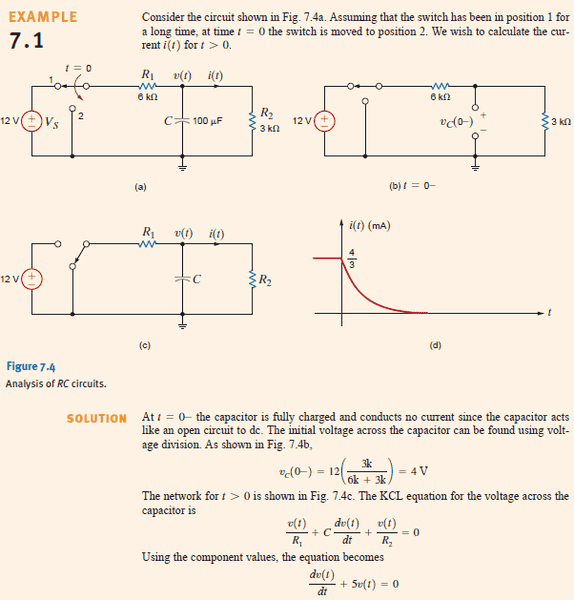
Problem is in the picture below.
5HtQaDd.png


The problem is already solved, but I am confused as to why C(dv/dt) is positive and not negative, since the current is coming out of the capacitor and towards the point v(t), which is not away from v(t) like the solution shows. But if I solve the problem with the negative sign there I get an infinite voltage which obviously makes no sense. Can someone explain why we assume it's going away, unlike what would be done if it was a given current source?
 
Physics news on Phys.org
In nodal analysis when one sums the currents and sets the result to zero, the sum is either that all currents are assumed to be coming into the node, or that all currents are leaving the node. There's no mix of directions.

In this case the assumption is that all currents are leaving the node, as can be verified by the terms for the resistors. So the assumed current direction is from the v(t) node to the capacitor.
 
gneill said:
In nodal analysis when one sums the currents and sets the result to zero, the sum is either that all currents are assumed to be coming into the node, or that all currents are leaving the node. There's no mix of directions.

In this case the assumption is that all currents are leaving the node, as can be verified by the terms for the resistors. So the assumed current direction is from the v(t) node to the capacitor.
OK, that makes sense, thank you for clarifying.
 
The book claims the answer is that all the magnitudes are the same because "the gravitational force on the penguin is the same". I'm having trouble understanding this. I thought the buoyant force was equal to the weight of the fluid displaced. Weight depends on mass which depends on density. Therefore, due to the differing densities the buoyant force will be different in each case? Is this incorrect?

Similar threads

  • · Replies 12 ·
Replies
12
Views
2K
  • · Replies 4 ·
Replies
4
Views
2K
  • · Replies 3 ·
Replies
3
Views
2K
Replies
19
Views
4K
  • · Replies 11 ·
Replies
11
Views
5K
  • · Replies 21 ·
Replies
21
Views
1K
  • · Replies 7 ·
Replies
7
Views
8K
  • · Replies 5 ·
Replies
5
Views
7K
  • · Replies 4 ·
Replies
4
Views
2K
Replies
20
Views
4K