Confused about solving RC circuits with nodal analysis

Click For Summary
SUMMARY

The discussion clarifies the application of nodal analysis in solving RC circuits, specifically addressing the direction of current flow from a capacitor. It establishes that in nodal analysis, all currents are assumed to be leaving the node, which is critical for correctly applying Kirchhoff's Current Law (KCL). The confusion arose from the interpretation of the current direction, but the consensus is that the current from the capacitor is indeed considered to be leaving the node towards the voltage point v(t). This understanding is essential to avoid erroneous calculations, such as obtaining infinite voltage.

PREREQUISITES
  • Understanding of nodal analysis in electrical circuits
  • Familiarity with Kirchhoff's Current Law (KCL)
  • Basic knowledge of RC circuit components
  • Ability to interpret circuit diagrams
NEXT STEPS
  • Study the principles of Kirchhoff's Current Law (KCL) in depth
  • Learn about the behavior of capacitors in RC circuits
  • Explore examples of nodal analysis with varying current directions
  • Investigate common mistakes in nodal analysis and how to avoid them
USEFUL FOR

Electrical engineering students, circuit designers, and anyone involved in analyzing or solving RC circuits using nodal analysis.

timnswede
Messages
100
Reaction score
0
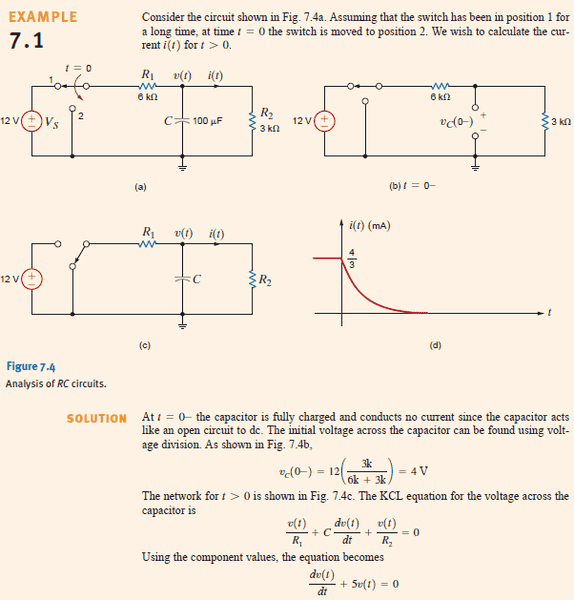
Problem is in the picture below.
5HtQaDd.png


The problem is already solved, but I am confused as to why C(dv/dt) is positive and not negative, since the current is coming out of the capacitor and towards the point v(t), which is not away from v(t) like the solution shows. But if I solve the problem with the negative sign there I get an infinite voltage which obviously makes no sense. Can someone explain why we assume it's going away, unlike what would be done if it was a given current source?
 
Physics news on Phys.org
In nodal analysis when one sums the currents and sets the result to zero, the sum is either that all currents are assumed to be coming into the node, or that all currents are leaving the node. There's no mix of directions.

In this case the assumption is that all currents are leaving the node, as can be verified by the terms for the resistors. So the assumed current direction is from the v(t) node to the capacitor.
 
gneill said:
In nodal analysis when one sums the currents and sets the result to zero, the sum is either that all currents are assumed to be coming into the node, or that all currents are leaving the node. There's no mix of directions.

In this case the assumption is that all currents are leaving the node, as can be verified by the terms for the resistors. So the assumed current direction is from the v(t) node to the capacitor.
OK, that makes sense, thank you for clarifying.
 

Similar threads

  • · Replies 12 ·
Replies
12
Views
2K
  • · Replies 4 ·
Replies
4
Views
2K
  • · Replies 3 ·
Replies
3
Views
2K
Replies
19
Views
5K
  • · Replies 11 ·
Replies
11
Views
5K
  • · Replies 21 ·
Replies
21
Views
1K
  • · Replies 7 ·
Replies
7
Views
8K
  • · Replies 5 ·
Replies
5
Views
7K
  • · Replies 4 ·
Replies
4
Views
2K
Replies
20
Views
4K