MHB Confused by Spherical Wedge Graphing on z-y Plane

Click For Summary
The discussion centers on the confusion regarding the graphing of a spherical wedge on the z-y plane in a solutions manual. It highlights that while part (a) of the problem is straightforward with a triple integral, part (b) raises questions about the placement of the lines forming angles φ1 and φ2. The lines are actually cones with a fixed angle to the z-axis, and their representation on the z-y plane is primarily for illustrative purposes. The clarification emphasizes that these angles can be oriented in various directions, not limited to the z-y plane. Understanding this graphical representation is crucial for accurately interpreting the spherical wedge in the context of the problem.
Dethrone
Messages
716
Reaction score
0
View attachment 4461

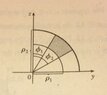
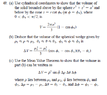
Part (a) is easy to do by setting up a triple integral, but for part (b), I was a bit confused by the diagram provided by the solutions manual:
View attachment 4462

Why is the spherical wedge (shaded) graphed on the z-y axis? In the most general case, shouldn't the two lines that form angle $\phi_1$ and $\phi_2$ be arbitrarily placed (such that $\phi < \pi /2$) and not necessarily lying on the z-y plane? Since it is to my understanding that $\phi$ is measured from the positive z-axis in any direction away from it, or did they draw it on the z-y plane for illustrative purposes?
 

Attachments
  • Spherical Wedge.PNG
    Spherical Wedge.PNG
    12.6 KB · Views: 105
  • photo(2).JPG
    photo(2).JPG
    7.9 KB · Views: 108
Last edited:
Physics news on Phys.org
Hey Rido! (Smile)

You're quite right. Those lines represent cones that have a fixed angle with the z axis.
Indeed, it's for illustrative purposes that only the intersection with the z-y-plane has been drawn. (Wasntme)
 
There are probably loads of proofs of this online, but I do not want to cheat. Here is my attempt: Convexity says that $$f(\lambda a + (1-\lambda)b) \leq \lambda f(a) + (1-\lambda) f(b)$$ $$f(b + \lambda(a-b)) \leq f(b) + \lambda (f(a) - f(b))$$ We know from the intermediate value theorem that there exists a ##c \in (b,a)## such that $$\frac{f(a) - f(b)}{a-b} = f'(c).$$ Hence $$f(b + \lambda(a-b)) \leq f(b) + \lambda (a - b) f'(c))$$ $$\frac{f(b + \lambda(a-b)) - f(b)}{\lambda(a-b)}...

Similar threads

Replies
3
Views
2K
  • · Replies 7 ·
Replies
7
Views
5K
  • · Replies 1 ·
Replies
1
Views
3K
  • · Replies 2 ·
Replies
2
Views
1K
  • · Replies 2 ·
Replies
2
Views
1K
  • · Replies 7 ·
Replies
7
Views
5K
  • · Replies 14 ·
Replies
14
Views
5K
  • · Replies 4 ·
Replies
4
Views
4K
  • · Replies 26 ·
Replies
26
Views
6K
Replies
2
Views
13K