Confused - Materials question regarding c/a ratio

Click For Summary
SUMMARY

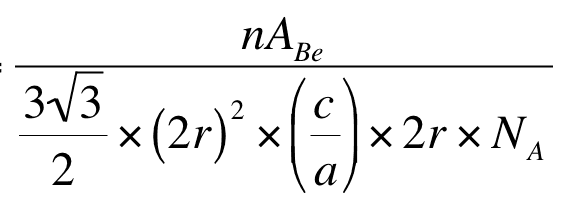
The discussion centers on calculating the c/a ratio for Beryllium (Be), a hexagonal close-packed (HCP) metal with an atomic weight of 9 g mol-1, an atomic radius of 0.112 nm, and a density of 1850 kg m-3. The calculation involves the relationship a2c = a3 * (c/a) = (2r)3 * (c/a), where 2r represents the atomic radius. The confusion arises from understanding how the c/a ratio is derived from these equations, particularly the inclusion of two 2r values.

PREREQUISITES
  • Understanding of hexagonal close-packed (HCP) crystal structures
  • Familiarity with atomic weight and density calculations
  • Basic knowledge of Avogadro's number and its application in material science
  • Proficiency in algebraic manipulation of equations
NEXT STEPS
  • Study the derivation of c/a ratios in HCP structures
  • Learn about the properties and applications of Beryllium in materials science
  • Explore the significance of atomic radius in crystal lattice calculations
  • Investigate the role of density in determining material properties
USEFUL FOR

Students studying materials science, particularly those preparing for exams in crystallography and solid-state physics, as well as educators seeking to clarify concepts related to HCP metals.

Rajveer97
Messages
6
Reaction score
0
Poster has been reminded to post schoolwork in the Homework Help forums
Hi everyone, first time poster here, I'm studying for a Materials exam, one of my weakest subjects and this question is causing me a lot of pain:

Beryllium (Be) is a HCP metal with an atomic weight of 9 g mol-1 , an atomic radius of 0.112nm and a density of 1850 kg m-3 . Calculate its c/a ratio given that Avogadro’s number is 6.02×10²³ mole-1 .

Here's the working after some basic steps
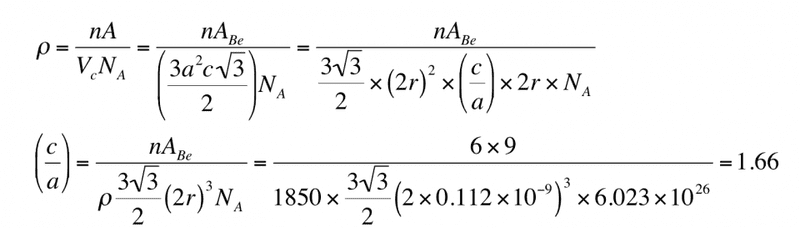
upload_2016-7-7_17-6-34.png

The thing that I don't understand is how this
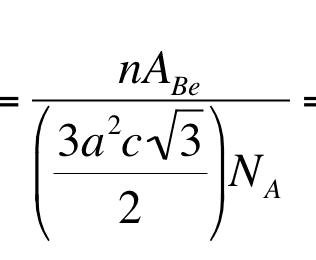
upload_2016-7-7_17-7-56.png

becomes this
upload_2016-7-7_17-7-31.png

How are there two 2r there now? Where is the (c/a) coming from? I just can think through that, how does one get to that? Any help would be greatly appreciated I'm really stuck!
Thanks
 
Physics news on Phys.org
Hi,
as far as I see
$$a^2c=a^3\cdot \frac{c}{a}=\left ( 2r \right )^3\cdot \frac{c}{a}$$
 
  • Like
Likes   Reactions: Rajveer97
Irene Kaminkowa said:
Hi,
as far as I see
$$a^2c=a^3\cdot \frac{c}{a}=\left ( 2r \right )^3\cdot \frac{c}{a}$$

That seems to be the only possible answer, thanks! :)
 

Similar threads

  • · Replies 2 ·
Replies
2
Views
4K
  • · Replies 5 ·
Replies
5
Views
10K
Replies
5
Views
2K
  • · Replies 5 ·
Replies
5
Views
2K
  • · Replies 3 ·
Replies
3
Views
2K
  • · Replies 2 ·
Replies
2
Views
2K
  • · Replies 1 ·
Replies
1
Views
6K
  • · Replies 6 ·
Replies
6
Views
2K
  • · Replies 13 ·
Replies
13
Views
2K
Replies
2
Views
2K