MHB Confused: Seeking Help on Problem Solution

  • Thread starter Thread starter Albert Einstein1
  • Start date Start date
  • Tags Tags
    Confused
Click For Summary
SUMMARY

The discussion centers on a mathematical problem involving the inequality $x^2(x^2 - 2) \leq -x^2$. The participant expresses uncertainty about their solution and seeks validation of their reasoning. The consensus indicates that the initial bounding provided by the participant is incorrect, while the second part of their reasoning is confirmed as correct. This highlights the importance of precise mathematical reasoning in problem-solving.

PREREQUISITES
  • Understanding of polynomial inequalities
  • Familiarity with algebraic manipulation
  • Knowledge of mathematical bounding techniques
  • Basic proficiency in calculus concepts
NEXT STEPS
  • Study polynomial inequality solving techniques
  • Learn about bounding methods in algebra
  • Explore advanced algebraic manipulation strategies
  • Review calculus fundamentals related to inequalities
USEFUL FOR

Students, educators, and anyone involved in mathematics who seeks to improve their problem-solving skills and understanding of polynomial inequalities.

Albert Einstein1
Messages
3
Reaction score
0
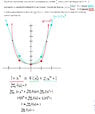
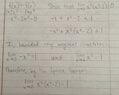
I am not entirely sure if I solved this problem correctly. Please let me know if my reasoning is flawed. Thank you and I appreciate your help greatly.
 

Attachments

  • C81A8208-41D5-4B0B-8574-30C16FD7F3C3.jpeg
    C81A8208-41D5-4B0B-8574-30C16FD7F3C3.jpeg
    42 KB · Views: 127
  • 50D89683-48F0-4EC5-9C90-EB3D3BB43619.jpeg
    50D89683-48F0-4EC5-9C90-EB3D3BB43619.jpeg
    285.8 KB · Views: 136
Physics news on Phys.org
Albert Einstein said:
I am not entirely sure if I solved this problem correctly. Please let me know if my reasoning is flawed. Thank you and I appreciate your help greatly.
 

Attachments

  • 1CC00144-1DF9-4A5D-95B4-E3D42947A0F3.jpeg
    1CC00144-1DF9-4A5D-95B4-E3D42947A0F3.jpeg
    110.5 KB · Views: 120
In the first, post your "bounding" is wrong. $x^2(x^2- 2)$ is less than or equal to $-x^2$.

For the second, yes, that is correct.
 
Relativistic Momentum, Mass, and Energy Momentum and mass (...), the classic equations for conserving momentum and energy are not adequate for the analysis of high-speed collisions. (...) The momentum of a particle moving with velocity ##v## is given by $$p=\cfrac{mv}{\sqrt{1-(v^2/c^2)}}\qquad{R-10}$$ ENERGY In relativistic mechanics, as in classic mechanics, the net force on a particle is equal to the time rate of change of the momentum of the particle. Considering one-dimensional...

Similar threads

  • · Replies 3 ·
Replies
3
Views
1K
  • · Replies 2 ·
Replies
2
Views
643
  • · Replies 4 ·
Replies
4
Views
1K
Replies
4
Views
2K
  • · Replies 1 ·
Replies
1
Views
1K
  • · Replies 10 ·
Replies
10
Views
2K
  • · Replies 6 ·
Replies
6
Views
2K
  • · Replies 4 ·
Replies
4
Views
2K
  • · Replies 7 ·
Replies
7
Views
3K
  • · Replies 4 ·
Replies
4
Views
1K