Confusion in variation derivative

Click For Summary
SUMMARY

The discussion focuses on the derivation of Hamilton's generalized principle from D'Alembert's principle, specifically addressing the justification of the equation ## \frac{d}{dt} \delta r_i = \delta [\frac{d}{dt}r_i] ##. The participants clarify that the variation operator ## \delta ## acts similarly to a differential operator, allowing for the differentiation of variations in time-dependent variables without introducing additional independent variations. The conclusion emphasizes that the derivative of a sum is the sum of the derivatives, validating the relationship between the variation of a function and its derivative.

PREREQUISITES
  • Understanding of Hamiltonian mechanics
  • Familiarity with D'Alembert's principle
  • Knowledge of functional derivatives
  • Basic concepts of differential calculus
NEXT STEPS
  • Study Hamilton's equations in detail
  • Explore the role of functional derivatives in physics
  • Learn about the application of variation principles in classical mechanics
  • Investigate the similarities between classical and quantum mechanics regarding operator behavior
USEFUL FOR

Physicists, mathematicians, and students studying classical mechanics, particularly those interested in variational principles and their applications in theoretical physics.

weezy
Messages
92
Reaction score
5
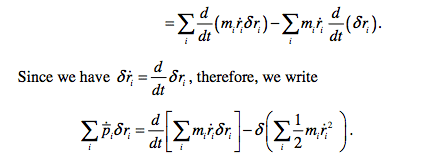
This link shows us how to derive Hamilton's generalised principle starting from D'Alembert's principle. While I had no trouble understanding the derivation I am stuck on this particular step.
Screen Shot 2017-07-22 at 7.19.53 PM.png

I can't justify why ## \frac{d}{dt} \delta r_i = \delta [\frac{d}{dt}r_i] ##. This is because if I consider ##\delta \dot r_i## to be spatial variation in velocity of a particle as I shift my origin keeping time constant, doesn't it stay the same i.e. doesn't ##\delta \dot r_i = 0##?

Also if I assume that throughout a large section of the path ##\delta r_i = Constant## don't I get ## \frac{d}{dt} \delta r_i = 0 ? ##

Is this supposed to have a non-zero value or are we simply playing with 0's here?

Edit : If I assume ## \delta ## to act like an operator on ## r ## I don't see a problem arising as we've done in Quantum mechanics for commuting operators by interchanging their order. Can we say the same for this?
 
Physics news on Phys.org
This is technically an assumed constraint and not a derived result. But it follows from the understanding of what the functional differential is doing.
You are introducing a variation in the time dependent variable: r_i \to \tilde{r}_i = r_i + \delta r_i. We understand that we are to extend the time derivative without introducing additional independent variations so that \dot{r}_i \to \tilde{\dot{r}}_i = \dot{\tilde{r}_i}. It is implied that the functional variation behaves just like a standard differential in that it is a local linear deviation from the previous value.

The action here of \delta on r is the same as the action of d on an independent vector variable. If you had a function of a vector: f(\mathbf{x}) then its variation is
df(\mathbf{x}) = \lim_{h\to 0}\frac{ f(\mathbf{x} + h \mathbf{dx})-f(\mathbf{x})}{h} = \frac{df}{d\mathbf{x}}[\mathbf{dx}]

Here the total derivative\frac{df}{\mathbf{dx}} of f is a linear mapping from the differential vector \mathbf{dx} to the range of f. The differential \mathbf{dx}=\langle dx_1, dx_2,dx_3\cdots\rangle is an independent auxiliary (vector) variable representing a local linear coordinate with origin at the point indicated by the original vector \mathbf{x}. You can say that the differential operator d maps the original independent vector variable to this auxiliary variable but keep in mind that it is an independent variation. While we are at it you can think of the vector as a function from its component index into the reals. x(1) = x_1, x(2)=x_2, etc. The non-trivial action of the differential is effected by its action on functions of \mathbf{x}.

Now consider a continuously indexed "vector" i.e. a continuous function r(t) thinking of t as the index. To avoid confusing the same kind of differential of a function, i.e. dr(t) = \dot{r}(t)dt we use the different differential notation: \delta r to indicate (in the function space where r lives) an independent variation of the choice of function r(t) \to r(t) + \delta r(t).

The fact that the derivative of the variation is the variation of the derivative is no more mysterious than the fact that for the \mathbf{x} example the variation in the difference of successive components is the difference in the variation of successive components:
\Delta: \mathbf{x} \mapsto x_2 - x_1
and thus
d\Delta \mathbf{x} = \Delta d\mathbf{x} = dx_2 - dx_1

But the short answer is that the "justification" comes down to the fact that the derivative of a sum is the sum of the derivatives and we are (independently) varying the function additively: r\mapsto r+ \delta r.
 
  • Like
Likes   Reactions: weezy

Similar threads

  • · Replies 3 ·
Replies
3
Views
1K
  • · Replies 1 ·
Replies
1
Views
1K
  • · Replies 7 ·
Replies
7
Views
1K
  • · Replies 5 ·
Replies
5
Views
2K
  • · Replies 4 ·
Replies
4
Views
2K
  • · Replies 5 ·
Replies
5
Views
2K
  • · Replies 2 ·
Replies
2
Views
1K
  • · Replies 2 ·
Replies
2
Views
1K
  • · Replies 0 ·
Replies
0
Views
567
  • · Replies 19 ·
Replies
19
Views
2K