Congruence Class Proofs: Tips and Examples

  • Context: MHB 
  • Thread starter Thread starter Joe20
  • Start date Start date
  • Tags Tags
    Class Proof
Click For Summary
SUMMARY

The discussion focuses on congruence class proofs within the context of modular arithmetic, specifically in the ring $\mathbb{Z}_{3}$. Key insights include the simplification of expressions by representing elements as $[a] = 3n + a$ and $[b] = 3m + b$, leading to the conclusion that for $[a]^2 + [b]^2 = 0$, both $a$ and $b$ must equal 0. The participants emphasize the importance of considering cases and recognizing that the results of squaring in $\mathbb{Z}_{3}$ yield only $[0]$ or $[1]$. This leads to a streamlined approach to proving congruences.

PREREQUISITES
  • Understanding of modular arithmetic, specifically $\mathbb{Z}_{3}$
  • Familiarity with congruence classes and their properties
  • Basic algebraic manipulation involving polynomials
  • Knowledge of mathematical proofs and counterexamples
NEXT STEPS
  • Study the properties of $\mathbb{Z}_{n}$ for various values of n
  • Learn about polynomial congruences and their applications
  • Explore the concept of equivalence relations in mathematics
  • Investigate the use of counterexamples in mathematical proofs
USEFUL FOR

Students and educators in mathematics, particularly those focusing on abstract algebra and number theory, as well as anyone interested in enhancing their proof-writing skills in modular arithmetic.

Joe20
Messages
53
Reaction score
1
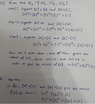
Hi, I have tried the question as attached. I am not sure if I am correct. You help is greatly appreciated. Thanks in advance!
 

Attachments

  • 2222.png
    2222.png
    6 KB · Views: 135
  • Untitled.png
    Untitled.png
    37.6 KB · Views: 139
Physics news on Phys.org
Hi Alexis87,

I like the idea to examine each of the cases. A few were left out - e.g., $[a]==[2]$ - and I don't know if that was intentional on your part or not. It may be a little neater to note that the result of squaring in $\mathbb{Z}_{3}$ can only be $[0]$ or $[1]$, in which case there are only three possibilities to check. Your counterexample looks good.
 
I would consider it simpler to write the first number as [a]= 3n+ a and the second as = 3m+ b where a and b are one of 0, 1, or 2. Then $[a]^2+ ^2= (3n+a)^2+ (3m+ b)^2= 9n^2+ 6an+ a^2+ 9m^2+ 6bm+ b^2= 3(3n^3+3m^3+ 2an+ 2bm)+ a^2+ b^2= 0$.

So we must have a and b less than 3 and $a^2+ b^2= 0$. From that, a= 0, b= 0 so that [a]= = 0.
 
HallsofIvy said:
I would consider it simpler to write the first number as [a]= 3n+ a and the second as = 3m+ b where a and b are one of 0, 1, or 2. Then $[a]^2+ ^2= (3n+a)^2+ (3m+ b)^2= 9n^2+ 6an+ a^2+ 9m^2+ 6bm+ b^2= 3(3n^3+3m^3+ 2an+ 2bm)+ a^2+ b^2= 0$.

So we must have a and b less than 3 and $a^2+ b^2= 0$. From that, a= 0, b= 0 so that [a]= = 0.


Hi HallsofIvy,

may I ask what's the purpose of showing this expression:
=3(3n3+3m3+2an+2bm)+a2+b2=0 ?

Is there any thing we can interpret from this equation?

So for "So we must have a and b less than 3" does it mean that because it is Z subscript 3?
 
The purpose is to realize that $3(3n^3+ 3m^3+ 2an+ 2bn)$ is a multiple of 3 and so can be ignored "modulo 3". That is why I can say "We must have a and b positive integers less than 3 such that $a^2+ b^2= 0$.
 

Similar threads

  • · Replies 17 ·
Replies
17
Views
2K
Replies
1
Views
1K
Replies
2
Views
2K
  • · Replies 2 ·
Replies
2
Views
1K
  • · Replies 2 ·
Replies
2
Views
2K
  • · Replies 12 ·
Replies
12
Views
751
  • · Replies 17 ·
Replies
17
Views
2K
Replies
4
Views
2K
  • · Replies 2 ·
Replies
2
Views
2K
  • · Replies 3 ·
Replies
3
Views
2K