Why is \( c'' \) an Upper Bound for \( U \cap [a, b] \) in Theorem 3.47?

  • Context: MHB 
  • Thread starter Thread starter Math Amateur
  • Start date Start date
  • Tags Tags
    intervals Theorem
Click For Summary
SUMMARY

The discussion centers on the proof of Theorem 3.47 from Karl R. Stromberg's "An Introduction to Classical Real Analysis," specifically addressing why \( c'' \) serves as an upper bound for \( U \cap [a, b] \). The proof demonstrates that if \( U \cap V \cap [a, b] = \emptyset \), then \( [c'', c] \cap (U \cap [a, b]) = \emptyset \), which contradicts the definition of \( c \). This establishes that \( c'' < c \) confirms \( c'' \) as an upper bound for the intersection of \( U \) and the interval \([a, b]\).

PREREQUISITES
  • Understanding of real analysis concepts, particularly limits and continuity.
  • Familiarity with the definitions of upper bounds and intersections in set theory.
  • Knowledge of the notation and terminology used in mathematical proofs.
  • Basic comprehension of the structure and content of Theorem 3.47 from Stromberg's book.
NEXT STEPS
  • Review the definitions of upper bounds and their implications in real analysis.
  • Study the proof techniques used in Theorem 3.47 for deeper insight.
  • Explore related theorems in classical real analysis that involve upper bounds and intersections.
  • Practice problems involving the application of limits and continuity in real analysis contexts.
USEFUL FOR

Students of real analysis, mathematicians seeking clarity on upper bounds in set intersections, and anyone studying Theorem 3.47 in Stromberg's text will benefit from this discussion.

Math Amateur
Gold Member
MHB
Messages
3,920
Reaction score
48
I am reading Karl R. Stromberg's book: "An Introduction to Classical Real Analysis". ... ...

I am focused on Chapter 3: Limits and Continuity ... ...

I need further help in order to fully understand the proof of Theorem 3.47 on page 107 ... ... Theorem 3.47 and its proof read as follows:

View attachment 9155In the third paragraph of the above proof by Stromberg we read the following:

" ... ... But $$U \cap V \cap [a, b] \ \subset \ U \cap V \cap S = \emptyset$$, and so $$c''$$ is an upper bound for $$U \cap [a, b]$$ ... ... " My question is as follows:

Can someone please demonstrate rigorously how/why ...

$$U \cap V \cap [a, b] \ \subset \ U \cap V \cap S = \emptyset \Longrightarrow c''$$ is an upper bound for $$U \cap [a, b]$$ ...
Help will be appreciated ...

Peter
 

Attachments
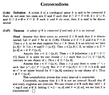
  • Stromberg - Theorem 3.47 ... .png
    Stromberg - Theorem 3.47 ... .png
    33.5 KB · Views: 139
Last edited:
Physics news on Phys.org
Hi Peter,

By the definition of $c$, $[p,c]\cap\left(U\cap [a,b]\right)\neq\emptyset$ for all $p<c.$ However, $c''<c$ and, by the choice for $c''$, $$[c'',c]\cap\left(U\cap [a,b]\right)\subset U\cap V\cap [a,b]=\emptyset.$$ Hence, $[c'',c]\cap\left(U\cap [a,b]\right)=\emptyset,$ contradicting the definition of $c$.
 
GJA said:
Hi Peter,

By the definition of $c$, $[p,c]\cap\left(U\cap [a,b]\right)\neq\emptyset$ for all $p<c.$ However, $c''<c$ and, by the choice for $c''$, $$[c'',c]\cap\left(U\cap [a,b]\right)\subset U\cap V\cap [a,b]=\emptyset.$$ Hence, $[c'',c]\cap\left(U\cap [a,b]\right)=\emptyset,$ contradicting the definition of $c$.
Thanks for your reply, GJA ...

It was most helpful ...

Peter
 

Similar threads

Replies
2
Views
2K
Replies
2
Views
2K
  • · Replies 5 ·
Replies
5
Views
3K
  • · Replies 6 ·
Replies
6
Views
2K
Replies
2
Views
2K
  • · Replies 7 ·
Replies
7
Views
2K
Replies
5
Views
2K
  • · Replies 8 ·
Replies
8
Views
3K
  • · Replies 4 ·
Replies
4
Views
5K
  • · Replies 5 ·
Replies
5
Views
2K