Composition of Two Continuous Functions .... Browder, Proposition 3.12

Click For Summary

Discussion Overview

The discussion centers around understanding Proposition 3.12 from Andrew Browder's "Mathematical Analysis: An Introduction," specifically the proof related to the composition of continuous functions and the properties of inverse images. Participants are exploring the implications of certain set equations and their proofs within the context of continuous functions.

Discussion Character

  • Technical explanation
  • Mathematical reasoning
  • Debate/contested

Main Points Raised

  • Peter seeks clarification on why the equation ##f^{ -1 } (U) \cap f^{ -1 } (J) = f^{ -1 } (U)## holds true, given that ##f(I) \subset J##.
  • Some participants suggest that the equation ##A \cap B = A## implies ##A \subseteq B##, and they explore the implications of this in the context of the proof.
  • There is a discussion about the validity of the equation ##f^{-1}(U\cap J) = f^{-1}(U) \cap f^{-1}(J)##, with references to general set theory principles.
  • One participant outlines a formal proof for the equation ##f^{-1} (A \cap B) = f^{-1} (A) \cap f^{-1} (B)##, demonstrating the proof elementwise.
  • Another participant confirms the correctness of the proof provided by Peter, while also noting that the property does not hold for the function itself, where ##f(A\cap B) \subseteq f(A) \cap f(B)## but not necessarily the reverse.

Areas of Agreement / Disagreement

Participants generally agree on the validity of the set equations discussed, particularly the proof of the equation involving inverse images. However, there is an acknowledgment that the properties of functions do not mirror those of sets, indicating a nuanced understanding of the topic.

Contextual Notes

The discussion involves assumptions about the properties of continuous functions and set operations that may not be universally applicable without further context or definitions. The exploration of these properties is contingent on the specific functions and sets involved.

Math Amateur
Gold Member
MHB
Messages
3,920
Reaction score
48
TL;DR
I need help with an aspect of Andrew Browder's proof that the composition of two continuous functions is continuous ...
I am reading Andrew Browder's book: "Mathematical Analysis: An Introduction" ... ...

I am currently reading Chapter 3: Continuous Functions on Intervals and am currently focused on Section 3.1 Limits and Continuity ... ...

I need some help in understanding the proof of Proposition 3.12 ...Proposition 3.12 and its proof read as follows:
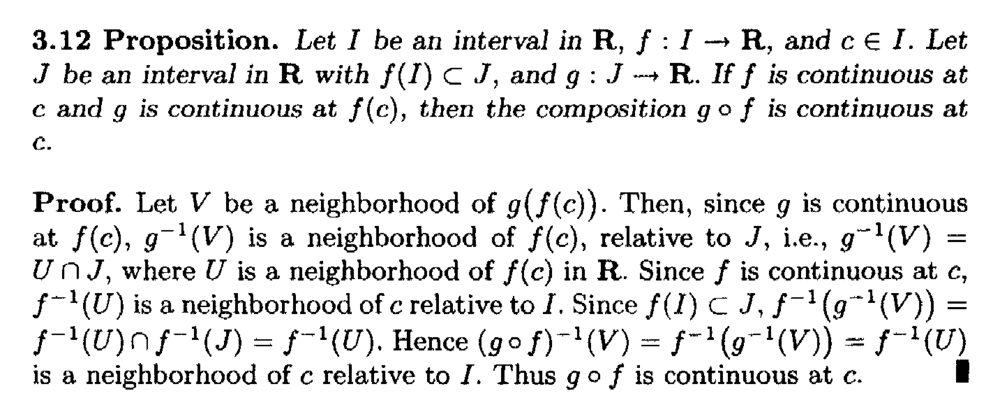
Browder - Proposition 3.12 ... .png
In the above proof by Browder we read the following:

" ... ... Since ##f(I) \subset J##, ##f^{ -1 } ( g^{ -1 }(V) ) = f^{ -1 } (U) \cap f^{ -1 } (J) = f^{ -1 } (U)## ... ... "My question is as follows:

Can someone please explain exactly why/how ##f^{ -1 } (U) \cap f^{ -1 } (J) = f^{ -1 } (U)## ... ...
Help will be much appreciated ...

Peter
 
Physics news on Phys.org
You have an equation of the type ##A \cap B = A##. If you draw a Venn diagram, you will see that this is equivalent to ##A \subseteq B##. Now ##I \subseteq f^{-1}(J)## but ##I## is all we have, so ##I=f^{-1}(J)##.

More interesting is why ##f^{-1}(U\cap J) =f^{-1}(U) \cap f^{-1}(J)##. Can you tell why this is true?
 
  • Like
Likes   Reactions: Math Amateur
fresh_42 said:
You have an equation of the type ##A \cap B = A##. If you draw a Venn diagram, you will see that this is equivalent to ##A \subseteq B##. Now ##I \subseteq f^{-1}(J)## but ##I## is all we have, so ##I=f^{-1}(J)##.

More interesting is why ##f^{-1}(U\cap J) =f^{-1}(U) \cap f^{-1}(J)##. Can you tell why this is true?
Thanks fresh_42 ... can now see why ##f^{ -1 } (U) \cap f^{ -1 } (J) = f^{ -1 } (U)## ... ...

As for ##f^{-1}(U\cap J) =f^{-1}(U) \cap f^{-1}(J)## ... I know this is true for any sets U and J (See Topology by Munkres, Exercise 2(c) page 20 ...) ... but I think you are asking me to give a sense of why it is true ... but I have not yet got any ideas regarding this ...

Thanks again for your help ...

Peter
 
Such equations are often shown elementwise: choose an arbitrary element $x\in f^{-1}(A\cap B)$ and show that it is in ##f^{-1}(A)## and in ##f^{-1}(B)##, too. For the other direction, choose an element ##x\in f^{-1}(A)\cap f^{-1}(B)## and show that it is an element of ## f^{-1}(A\cap B)##. As long as it is true for an arbitrary element, as long is it true for all elements.
 
fresh_42 said:
Such equations are often shown elementwise: choose an arbitrary element $x\in f^{-1}(A\cap B)$ and show that it is in ##f^{-1}(A)## and in ##f^{-1}(B)##, too. For the other direction, choose an element ##x\in f^{-1}(A)\cap f^{-1}(B)## and show that it is an element of ## f^{-1}(A\cap B)##. As long as it is true for an arbitrary element, as long is it true for all elements.
Oh ... so you were asking for a formal proof ...

That, I think would proceed as follows:

To prove ... ##f^{-1} (A \cap B) =f^{-1} (A) \cap f^{-1} (B)##

Now ... ##x \in f^{-1}(A \cap B)##

##\Longrightarrow f(x) \in A \cap B##

##\Longrightarrow f(x) \in A## and ##f(x) \in B##

##\Longrightarrow x \in f^{-1} (A)## and ##x \in f^{-1} (B)##

##\Longrightarrow x \in f^{-1} (A) \cap f^{-1} (B)##

So ... we have ##f^{-1} (A \cap B) \subset f^{-1} (A) \cap f^{-1} (B)## ... ... ... ... ... (1)Now ... ##x \in f^{-1} (A) \cap f^{-1} (B)##

##\Longrightarrow x \in f^{-1} (A)## and ##x \in f^{-1} (B)##

##\Longrightarrow f(x) \in A## and ##f(x) \in B##

##\Longrightarrow f(x) \in A \cap B##

##\Longrightarrow x \in f^{-1}(A \cap B)##

So ... we have ##f^{-1} (A) \cap f^{-1} (B) \subset f^{-1} (A \cap B)## ... ... ... ... ... (2)

Now ... (1) and (2) imply ##f^{-1} (A \cap B) =f^{-1} (A) \cap f^{-1} (B)##

Is that correct?Thanks again for your help ...

Peter
 
  • Like
Likes   Reactions: fresh_42
Math Amateur said:
Is that correct?
Yep, correct. It does not generally work for ##f##, where we have ##f(A\cap B) \subseteq f(A) \cap f(B)## but not the other direction.
 
  • Like
Likes   Reactions: Math Amateur

Similar threads

Replies
2
Views
2K
Replies
2
Views
2K
Replies
3
Views
2K
  • · Replies 18 ·
Replies
18
Views
3K
  • · Replies 2 ·
Replies
2
Views
2K
  • · Replies 4 ·
Replies
4
Views
2K
  • · Replies 4 ·
Replies
4
Views
2K
Replies
2
Views
2K
Replies
3
Views
2K
Replies
2
Views
2K