nomadreid
Gold Member
- 1,762
- 248
- TL;DR
- The connection between the Riemann zeta function and primes is often stated as lying in Euler's product formula, but wouldn't it be more correct that it lies in the zeta function role in the error function for the prime number theorem, or perhaps the explicit formulas of L-functions?
Often I read that the Riemann Hypothesis (RH) is related to prime numbers because of the equivalence on Re(s)>1 of the zeta function and Eurler's product formula
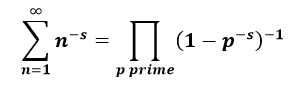
, but is it more accurate that the relevance of the RH to primes (or vice-versa) is either that the RH implies formulas for the error terms of the prime number theorem, for example, the von Koch/Schoenfeld's

(as given in https://en.wikipedia.org/wiki/Riemann_hypothesis#Distribution_of_prime_numbers)
or even more so that the ρ in some of the explicit formulas for L-functions ranges over the non-trivial zeros of the Riemann zeta function (as outlined in https://en.wikipedia.org/wiki/Explicit_formulae_for_L-functions#Riemann's_explicit_formula)?
Or do the latter two results simply hark back to the Euler result in some way?
, but is it more accurate that the relevance of the RH to primes (or vice-versa) is either that the RH implies formulas for the error terms of the prime number theorem, for example, the von Koch/Schoenfeld's
(as given in https://en.wikipedia.org/wiki/Riemann_hypothesis#Distribution_of_prime_numbers)
or even more so that the ρ in some of the explicit formulas for L-functions ranges over the non-trivial zeros of the Riemann zeta function (as outlined in https://en.wikipedia.org/wiki/Explicit_formulae_for_L-functions#Riemann's_explicit_formula)?
Or do the latter two results simply hark back to the Euler result in some way?
