Cons. of energy with rotational motion

Click For Summary
SUMMARY

The discussion focuses on the physics of a solid brass ball rolling along a loop-the-loop track, specifically addressing the minimum height from which it must be released to avoid leaving the track at the top. The derived equation for the minimum height h is h = (7/10)g(R-r) + 2R, where g is the acceleration due to gravity, R is the radius of the loop, and r is the radius of the ball. Additionally, the horizontal component of the force acting on the ball at point Q is calculated using the equation N = m(50gR)/(7(R-r)), where N represents the normal force.

PREREQUISITES
  • Understanding of Newton's laws of motion
  • Familiarity with centripetal force and acceleration
  • Knowledge of rotational kinetic energy concepts
  • Basic algebra for solving equations
NEXT STEPS
  • Study the principles of rotational dynamics in physics
  • Learn about centripetal acceleration and its applications
  • Explore the derivation of energy conservation equations in rolling motion
  • Investigate the effects of different shapes and masses on rolling motion
USEFUL FOR

Students studying physics, particularly those focusing on mechanics, as well as educators looking for practical examples of energy conservation and rotational motion principles.

musicfairy
Messages
101
Reaction score
0
In Figure 11-32, a solid brass ball of mass m and radius r will roll without slipping along the loop-the-loop track when released from rest along the straight section. For the following answers use g for the acceleration due to gravity, and m, r, and R, as appropriate, where all quantities are in SI units.
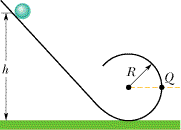

hrw7_11-32.gif


(a) From what minimum height h above the bottom of the track must the marble be released to ensure that it does not leave the track at the top of the loop? (The radius of the loop-the-loop is R. Assume R > r.)

(b) If the marble is released from height 6R above the bottom of the track, what is the magnitude of the horizontal component of the force acting on it at point Q?


For part a I came up with the equation

mgh = (1/2)mv2 + (1/2)mv2 + 2mgR
gh = (7/10)v2 + 2gR

I think that's right, but I can't figure out how to solve for v. I'm guessing that It has something to do with centripetal force.


Part b probably needs an answer from part a. The horizontal component of the force is the normal force (= centripetal force?).

Help please.
 
Physics news on Phys.org
your logic is good (except I don't get your second 1/2mv2).

You are right about centripetal force. At the top the ball needs enough velocity so that its centripetal inertia= its weight. The force of gravity must equal its centripetal force. This will translate directly into an equation for velocity from centripetal acceleration or froce.
 
musicfairy said:
For part a I came up with the equation

mgh = (1/2)mv2 + (1/2)mv2 + 2mgR
gh = (7/10)v2 + 2gR
OK. (That second term in your first equation should be rotational KE.)

I think that's right, but I can't figure out how to solve for v. I'm guessing that It has something to do with centripetal force.
Right. Apply Newton's 2nd law to solve for v.


Part b probably needs an answer from part a.
Not really.
The horizontal component of the force is the normal force (= centripetal force?).
Yep.
 
For that I meant to say 1/5mv2

For part a I set N = 0 at the top of the loop

N + mg = mv2/(R-r)

g = v2/(R-r)

v2 = g(R-r)

gh = (7/10)g(R-r) + 2gR

h = (7/10)g(R-r) + 2R


Part b

Using the equation from earlier...

g(6R) = (7/10)v2 + gR
v2 = (50/7)gR

N = mv2 / (R-r)
N = m(50gR)/(7(R-r))


But it won't take my answer. =(


What did I do wrong now?
 
musicfairy said:
For that I meant to say 1/5mv2

For part a I set N = 0 at the top of the loop

N + mg = mv2/(R-r)

g = v2/(R-r)

v2 = g(R-r)

gh = (7/10)g(R-r) + 2gR

h = (7/10)g(R-r) + 2R
The height of the ball's center at the top of the motion should be 2R-r, not 2R.

Part b

Using the equation from earlier...

g(6R) = (7/10)v2 + gR
v2 = (50/7)gR

N = mv2 / (R-r)
N = m(50gR)/(7(R-r))
This looks OK to me.
 

Similar threads

  • · Replies 12 ·
Replies
12
Views
12K
Replies
8
Views
4K
  • · Replies 10 ·
Replies
10
Views
7K
  • · Replies 19 ·
Replies
19
Views
4K
  • · Replies 11 ·
Replies
11
Views
2K
Replies
1
Views
4K
  • · Replies 5 ·
Replies
5
Views
2K
Replies
6
Views
4K
Replies
1
Views
2K
  • · Replies 4 ·
Replies
4
Views
2K