Conservation of linear momentum when friction is present

Click For Summary
SUMMARY

The discussion centers on the conservation of linear momentum in inelastic collisions involving friction. Participants assert that while external frictional forces act on the system, they are negligible during the collision, allowing momentum to be conserved for practical calculations. The analogy of considering the Earth along with the colliding blocks as a system is debated, with the consensus that the Earth's momentum change is insignificant compared to the total momentum, thus treated as "lost" in practical scenarios. The work-energy theorem is suggested as an alternative approach when analyzing momentum post-collision.

PREREQUISITES
  • Understanding of inelastic collisions
  • Familiarity with the work-energy theorem
  • Basic knowledge of frictional forces and their effects
  • Concept of momentum conservation in physics
NEXT STEPS
  • Study the principles of inelastic collisions in detail
  • Learn about the work-energy theorem and its applications
  • Explore the effects of friction on momentum in various scenarios
  • Investigate the implications of considering larger systems in momentum conservation
USEFUL FOR

Physics students, educators, and anyone interested in understanding the nuances of momentum conservation in the presence of friction during collisions.

zorro
Messages
1,378
Reaction score
0
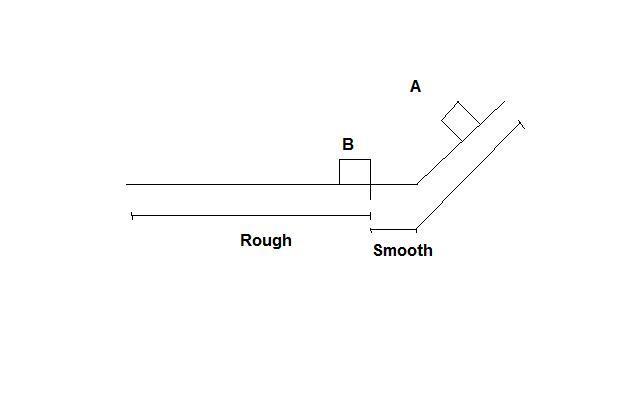
See the figure-

attachment.php?attachmentid=32890&stc=1&d=1299618716.jpg


The block A collides inelastically with the block B. I have seen in 2 of my books that they apply conservation of momentum in such problems along x-direction. According to me, since there is an external frictional force acting, the linear momentum is not conserved.

Is it that they consider Earth + A + B to be the system and ignore the velocity of the Earth ?
Please throw some light on this.
 

Attachments

  • Untitled.jpg
    Untitled.jpg
    5.7 KB · Views: 3,245
Physics news on Phys.org
The friction does transfer some of the momentum to the table (or whatever). Simpler experiment - put a book on the table and give it a push (impart momentum) and it will soon stop (momentum transferred to table).
 
Hi Abdul! :smile:
Abdul Quadeer said:
The block A collides inelastically with the block B. I have seen in 2 of my books that they apply conservation of momentum in such problems along x-direction. According to me, since there is an external frictional force acting, the linear momentum is not conserved.

As you know, momentum is not conserved after the collision, and we have to use the work energy theorem instead.

But during the collision, the friction force is non-impulsive, ie it acts for such a short time that its effect can be ignored …

it has no effect on the sudden change in momentum …

so momentum is conserved. :smile:
 
tiny-tim said:
But during the collision, the friction force is non-impulsive, ie it acts for such a short time that its effect can be ignored …

So ideally the momentum is not conserved?
 
Abdul Quadeer said:
So ideally the momentum is not conserved?

Yes, but well below the threshold of accuracy with which you could measure the velocities. :wink:
 
Is this approximation same as the situation when we ignore the momentum of the Earth by considering A+B+Earth as our system?
 
I don't think so (I don't really see the analogy :redface:).
 
But that would violate mathematical laws. You must get the same equation by two different methods. Otherwise either one of them is wrong.
 
Momentum is conserved. You change the momentum of the Earth itself. But that amount is so small compared to Earth's total momentum that you could never measure it. So for all practical purposes the momentum is treated as "lost". Think of it this way. If you pour a glass of water into the ocean you increase its volume. But if you go to any station that measures sea level you will never ever observe a change in sea level because of your action. It is the same with the momentum of a sliding object on the Earth. The momentum is still there, you just can't measure it.
 

Similar threads

  • · Replies 3 ·
Replies
3
Views
3K
  • · Replies 16 ·
Replies
16
Views
1K
  • · Replies 9 ·
Replies
9
Views
2K
  • · Replies 6 ·
Replies
6
Views
2K
  • · Replies 53 ·
2
Replies
53
Views
5K
  • · Replies 14 ·
Replies
14
Views
2K
  • · Replies 13 ·
Replies
13
Views
3K
  • · Replies 11 ·
Replies
11
Views
3K
  • · Replies 4 ·
Replies
4
Views
3K
  • · Replies 4 ·
Replies
4
Views
3K