Constructing an Oriented Atlas for S1 (Self Study)

  • Context: Undergrad 
  • Thread starter Thread starter Amateur659
  • Start date Start date
  • Tags Tags
    Atlas Self study Study
Click For Summary
SUMMARY

The discussion focuses on constructing an oriented atlas for S1 by utilizing a one-coordinate system based on angles from a reference ray. The proposed method simplifies the atlas to two charts, each covering 3/4 of the ring and overlapping at quarter-circle regions. This approach minimizes complexity by avoiding Cartesian coordinates and maintains a Jacobian of 1 x 1 in the overlap regions. The participant seeks validation of their method and whether they are overlooking any critical aspects.

PREREQUISITES
  • Understanding of oriented atlases in differential geometry
  • Familiarity with S1 (the unit circle) and its properties
  • Knowledge of Jacobians and their significance in mapping
  • Basic concepts of coordinate systems, particularly angular coordinates
NEXT STEPS
  • Research the properties of oriented atlases in differential geometry
  • Explore the implications of using angular coordinates in mapping
  • Study the concept of bicontinuous mappings and their applications
  • Investigate the role of Jacobians in coordinate transformations
USEFUL FOR

This discussion is beneficial for mathematicians, differential geometers, and students studying topology, particularly those interested in the construction and application of oriented atlases.

Amateur659
Messages
4
Reaction score
2
Hello,

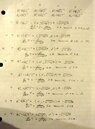
I am trying to construct an oriented atlas for S1 by considering the 8 transitions from the basic coordinate projection atlas. However, it does not appear to be possible to modify this atlas without destroying existing progress.

Am I on the right track towards constructing the oriented atlas? Is there some other direction I should choose? Is there something obvious I am missing?

I've attached my work below.

Thank you for your time.
 

Attachments

  • diff-geom-work.jpg
    diff-geom-work.jpg
    45.2 KB · Views: 202
Physics news on Phys.org
I think using Cartesian coordinates makes it unnecessarily complex. Instead use a one-coordinate system where the coordinate is angle from a given reference ray through the origin. Then your atlas needs only two charts. Make each one cover say 3/4 of the ring, and make the reference ray for the second one 180 degrees from the first reference ray. Then you have two overlapping part-rings covering the circle, each with a bicontinuous mapping to [0, 3 pi / 2], and quarter-circle overlaps at each end. You only have two overlap regions to look at, and in both the Jacobian is 1 x 1, ie a scalar.
 
  • Like
Likes   Reactions: Orodruin
andrewkirk said:
Make each one cover say 3/4 of the ring
Am I just obsessed if I always make my circle charts cover the full circle minus a point?
 

Similar threads

  • · Replies 4 ·
Replies
4
Views
2K
  • · Replies 7 ·
Replies
7
Views
4K
  • · Replies 8 ·
Replies
8
Views
3K
  • · Replies 14 ·
Replies
14
Views
10K
  • · Replies 8 ·
Replies
8
Views
2K
  • · Replies 15 ·
Replies
15
Views
2K
  • · Replies 14 ·
Replies
14
Views
4K
  • · Replies 20 ·
Replies
20
Views
3K
  • · Replies 4 ·
Replies
4
Views
3K
  • · Replies 5 ·
Replies
5
Views
1K