Math Amateur
Gold Member
MHB
- 3,920
- 48
- TL;DR
- This thread concerns an aspect of the proof of the theorem that states that a function is continuous on an open set if and only if the inverse image under f of every open set is open
I am reading Houshang H. Sohrab's book: "Basic Real Analysis" (Second Edition).
I am focused on Chapter 4: Topology of R and Continuity ... ...
I need help in order to fully understand the proof of Theorem 4.3.4 ... ... Theorem 4.3.4 and its proof read as follows:
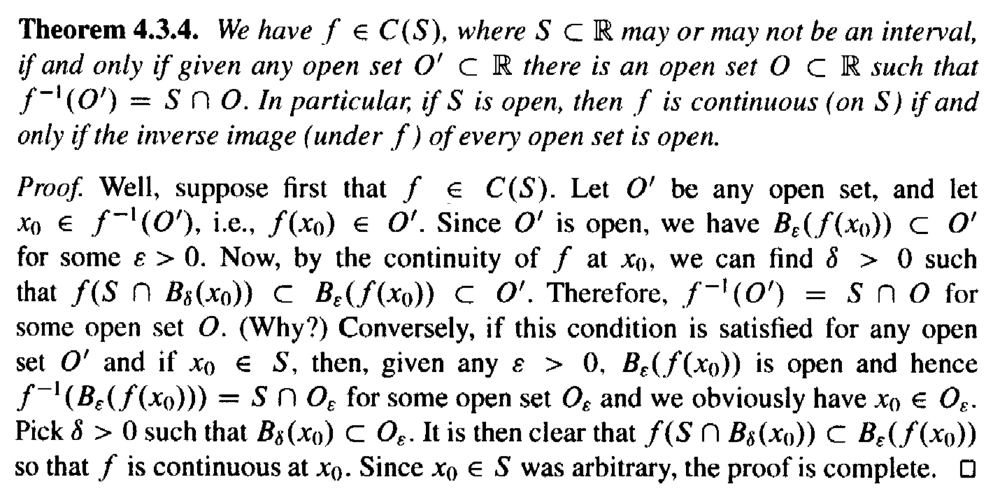
In the above proof by Sohrab we read the following:
" ... ... Therefore ##f^{ -1 } (O') = S \cap O## for some open set ##O## ... ... "Can someone please explain why the above quoted statement is true ...
----------------------------------------------------------------------------------------------------
My thoughts on this matter so far ...
Since ##f## is continuous at ##x_0## we can find ##\delta## such that
##f( S \cap B_\delta ( x_0 ) ) \subseteq B_\epsilon ( f(x_0) ) \subseteq O'##Now ... take inverse image under f of the above relationship (is this a legitimate move?)then we have ... ##S \cap B_\delta ( x_0 ) \subseteq f^{ -1 } ( B_\epsilon ( f(x_0) ) ) \subseteq f^{ -1 } ( O' )##So that ... if we put the open set ##B_\delta ( x_0 )## equal to ##O''## then we get##f^{ -1 } ( O' ) \supseteq S \cap O''## ...But now ... how do we find ##O## such that ##f^{ -1 } ( O' ) = S \cap O## ...?
Help will be appreciated ...
Peter
I am focused on Chapter 4: Topology of R and Continuity ... ...
I need help in order to fully understand the proof of Theorem 4.3.4 ... ... Theorem 4.3.4 and its proof read as follows:
In the above proof by Sohrab we read the following:
" ... ... Therefore ##f^{ -1 } (O') = S \cap O## for some open set ##O## ... ... "Can someone please explain why the above quoted statement is true ...
----------------------------------------------------------------------------------------------------
My thoughts on this matter so far ...
Since ##f## is continuous at ##x_0## we can find ##\delta## such that
##f( S \cap B_\delta ( x_0 ) ) \subseteq B_\epsilon ( f(x_0) ) \subseteq O'##Now ... take inverse image under f of the above relationship (is this a legitimate move?)then we have ... ##S \cap B_\delta ( x_0 ) \subseteq f^{ -1 } ( B_\epsilon ( f(x_0) ) ) \subseteq f^{ -1 } ( O' )##So that ... if we put the open set ##B_\delta ( x_0 )## equal to ##O''## then we get##f^{ -1 } ( O' ) \supseteq S \cap O''## ...But now ... how do we find ##O## such that ##f^{ -1 } ( O' ) = S \cap O## ...?
Help will be appreciated ...
Peter