Continuity of f(0): Does It Exist?

  • Context: MHB 
  • Thread starter Thread starter Chipset3600
  • Start date Start date
  • Tags Tags
    Continuity Point
Click For Summary
SUMMARY

The discussion centers around the continuity of the function f(0) defined as a piecewise function. Participants identified that f(0) is not properly defined in the original formulation, leading to confusion. The correct limit as x approaches 0 is established as 1, suggesting that the function should be redefined to include this value at x=0. The revised function proposed includes a constant value of 1 for f(0) and corrects the terms for x<0 and x>0.

PREREQUISITES
  • Understanding of piecewise functions
  • Knowledge of limits in calculus
  • Familiarity with trigonometric functions and their properties
  • Ability to interpret mathematical notation and symbols
NEXT STEPS
  • Study the properties of piecewise functions in calculus
  • Learn about limits and continuity, focusing on the epsilon-delta definition
  • Explore the implications of defining functions at specific points
  • Investigate the behavior of trigonometric functions near their limits
USEFUL FOR

Students of calculus, mathematics educators, and anyone interested in understanding function continuity and limits in mathematical analysis.

Chipset3600
Messages
79
Reaction score
0
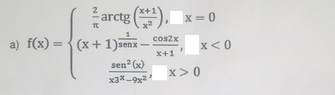
Hello MHB, the f(0) of this function doesn't exist, so I am i wrong or this question don't hv solution?

View attachment 406
 

Attachments

  • forum.png
    forum.png
    8.9 KB · Views: 89
Physics news on Phys.org
Chipset3600 said:
Hello MHB, the f(0) of this function doesn't exist, so I am i wrong or this question don't hv solution?

View attachment 406

Hi Chipset3600, :)

Your function seem to have some strange symbols which I don't understand. Is it,

\[f(x)=\begin{cases}\frac{2}{\pi}\mbox{arctan}\left(\frac{x+1}{x^2}\right),&\,x=0\\

(x+1)^{1/\sec(x)}-\frac{\cos 2x}{x+1},&\,x<0\\

\frac{\sec^{2}x}{x.3^x-9x^2},&x>0\\

\end{cases}\]

In that case the definition seem to be problematic since \(f(0)\) is not defined properly. \(f(0)\) should be a constant value whereas in the definition it's not.

Kind Regards,
Sudharaka.
 
Well, my language is portuguese, i forgot the translate of symbols: sen^2(x) = sin^(x), arctg(x)=arctan(x)..
and in the exercise is sin^2(x) and not sec^2(x).
Sudharaka said:
Hi Chipset3600, :)

Your function seem to have some strange symbols which I don't understand. Is it,

\[f(x)=\begin{cases}\frac{2}{\pi}\mbox{arctan}\left(\frac{x+1}{x^2}\right),&\,x=0\\

(x+1)^{1/\sec(x)}-\frac{\cos 2x}{x+1},&\,x<0\\

\frac{\sec^{2}x}{x.3^x-9x^2},&x>0\\

\end{cases}\]

In that case the definition seem to be problematic since \(f(0)\) is not defined properly. \(f(0)\) should be a constant value whereas in the definition it's not.

Kind Regards,
Sudharaka.
 
Chipset3600 said:
Well, my language is portuguese, i forgot the translate of symbols: sen^2(x) = sin^(x), arctg(x)=arctan(x)..
and in the exercise is sin^2(x) and not sec^2(x).

Good. But the problem here is that the function is not defined at \(x=0\) properly. We know that,

\[\lim_{x\rightarrow 0}\left[\frac{2}{\pi}\mbox{arctan}\left( \frac{x+1}{x^2}\right)\right]=1\]

So maybe the author would have meant ,

\[

f(x)=\begin{cases}1,&\,x=0\\

(x+1)^{1/\sin(x)}-\frac{\cos 2x}{x+1},&\,x<0\\ \frac{\sin^{2}x}{x.3^x-9x^2},&x>0\\

\end{cases}\]
 

Similar threads

  • · Replies 12 ·
Replies
12
Views
3K
  • · Replies 3 ·
Replies
3
Views
2K
  • · Replies 9 ·
Replies
9
Views
3K
  • · Replies 4 ·
Replies
4
Views
1K
  • · Replies 9 ·
Replies
9
Views
2K
  • · Replies 9 ·
Replies
9
Views
2K
  • · Replies 9 ·
Replies
9
Views
3K
  • · Replies 3 ·
Replies
3
Views
3K
  • · Replies 18 ·
Replies
18
Views
3K
  • · Replies 1 ·
Replies
1
Views
2K