Continuity of the Bezier Curve, Question

  • Thread starter Thread starter mymachine
  • Start date Start date
  • Tags Tags
    Continuity Curve
Click For Summary
The discussion centers on the continuity and smoothness of two cubic Bezier curves, A and B, particularly at the junction where A3 meets B0. For the curves to be smooth at this point, the segments A2-A3 and B0-B1 must be collinear, ensuring that their slopes match. While A3 and B0 can be the same point, they do not need to be midpoints of the segments. Both curves are described by 3rd-degree Bernstein polynomials, confirming their classification as cubic Bezier curves. The overall conclusion is that while the curves can be continuous, they may not be smooth without the specified conditions.
mymachine
Messages
42
Reaction score
0
Hi everyone,

I would like to ask about the continuity of the cubic Bezier curve.

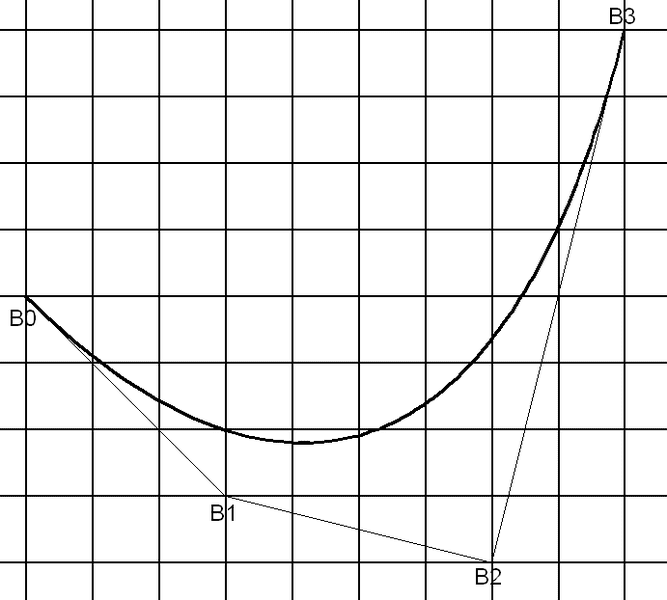
There are two cubic Bezier curves, A and B, shown as below two images:
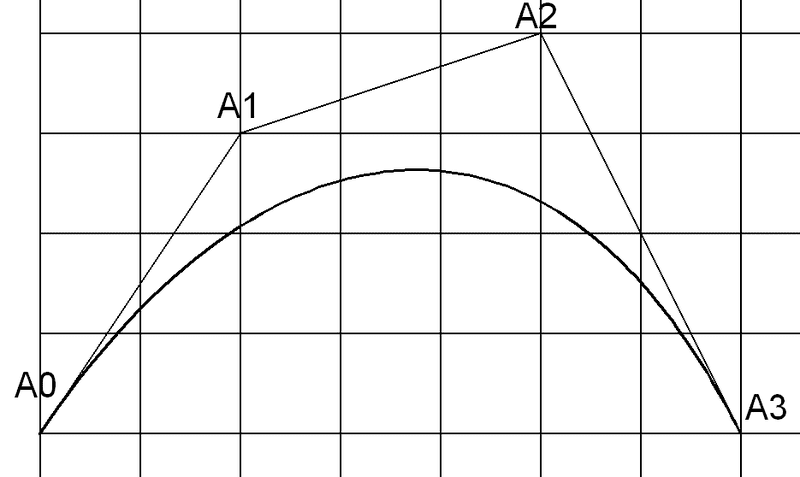
image.png

image.png


The coordinates of the A curve are:

A0 = (x0,y0) = (0,0)
A1 = (x1,y1) = (2,3)
A2 = (x2,Y2) = (5,4)
A3 = (x3,y3) = (7,0)

The coordinates of the B curve are:

B0 = (x0,y0) = (0,4)
B1 = (x1,y1) = (3,1)
B2 = (x2,y2) = (7,0)
B3 = (x3,y3) = (9,8)

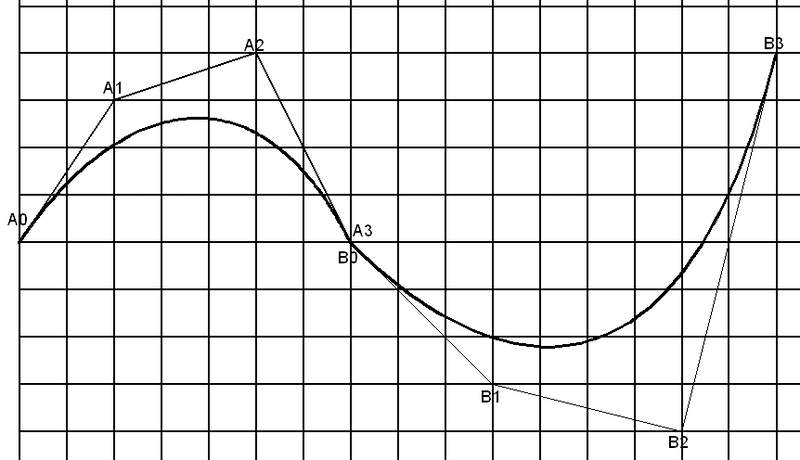
If I join these two curves together by connecting the point A3 and B0, it looks such as below image:
A_B.png


However, the curve doesn't looks smooth at point A3 = B0.

The question is, what is the equation of the Bezier curve start from
point A0 > A1 > A2 > A3=B0 > B1 > B2 > B3
where the endpoint is A0, A3 = B0, and B3
and so that the curve is continue and looks smooth?

Also, does this A+B curve is 7th degree of the Bernstein polynomial?

Thank you
 
Mathematics news on Phys.org
Is it possible if

A2, A3 = B2, and B1

are not colinear

and

A3 = B2

is not the midpoint of A2 and B1?
 
Hi, mymachine,
yes (more or less): the points A2, A3 = B0, and B1 should be collinear. This is because the curve "A" is tangent at A3 to the straight segment A2-A3, and the curve "B" is tangent at B0 to the segment B0-B1. If these two slopes on the curves are to be the same, the segments A2-A3 and B0-B1 must have the same slope too. And since A3=B0, this puts these points on the same straight line.

The two segments A2-A3 and B0-B1 do not need to have the same length (that is, A3 = B0 does not need to be a midpoint of A2-B1).

Your last question, I couldn't understand. The Bernstein polynomials that constitute both the "A" and "B" curves are 3rd-degree polynomials (which is why these are called "cubic" Béziers).

(Just as a side comment, mathematicians use the word "continuity" to refer to the fact that, in your example, A3 = B0; that is, that you didn't need to lift the "pencil" to continue drawing, that the curve does not have a "hole" because of A3 and B0 not coinciding.) Your curve, as described, is continuous; it's just not smooth.

Hope this helps!
 
Last edited:
Here is a little puzzle from the book 100 Geometric Games by Pierre Berloquin. The side of a small square is one meter long and the side of a larger square one and a half meters long. One vertex of the large square is at the center of the small square. The side of the large square cuts two sides of the small square into one- third parts and two-thirds parts. What is the area where the squares overlap?

Similar threads

Replies
5
Views
3K
  • · Replies 1 ·
Replies
1
Views
1K
Replies
11
Views
6K
  • · Replies 5 ·
Replies
5
Views
2K
  • · Replies 4 ·
Replies
4
Views
2K
  • · Replies 11 ·
Replies
11
Views
13K
  • · Replies 4 ·
Replies
4
Views
2K
  • · Replies 2 ·
Replies
2
Views
27K
  • · Replies 1 ·
Replies
1
Views
2K
  • · Replies 2 ·
Replies
2
Views
2K