Continuous functions on metric spaces part 2

Join the discussion
Ask a follow-up here, or get your own question answered by working scientists, mathematicians and engineers — people, not an autocomplete.
Real named experts · corrections over time · the nuance an AI answer skips
8 replies · 1K views
Lambda96
Messages
233
Reaction score
77
Homework Statement
Show that the mapping ##x \mapsto d(x,p)## is linear.
Relevant Equations
none
Hi,

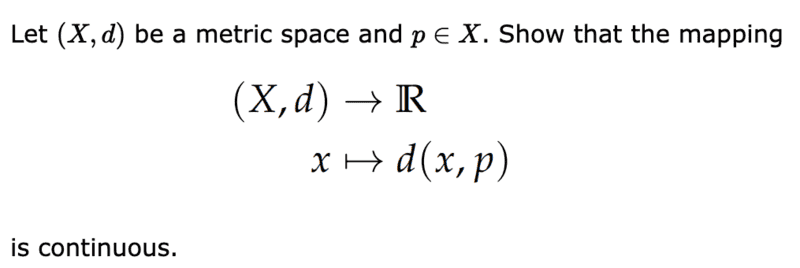
The task is as follows
Bildschirmfoto 2024-05-18 um 18.49.02.png


For the proof I wanted to use the boundedness, in the script of my professor the following is given, since both ##(X,d)## and ##\mathbb{R}## are normalized vector spaces

Bildschirmfoto 2024-05-18 um 16.21.50.png

I have now proceeded as follows ##|d(x,p)| \le C |x|## according to Archimedes' principle, a number ##C## now exists, which ensures that the inequality is valid for all ##x##.
 
on Phys.org
fresh_42 said:
##d(\cdot , p)## isn't linear.

We are not even given that [itex]X[/itex] is a vector space, so we don't have a concept of linearity.

@Lambda96: All you have available to you are the properties of an arbitrary metric and the definition of continuity with respect to that metric. Consider the triangle rule.
 
Reply
  • Like
Likes   Reactions: docnet, PeroK, FactChecker and 1 other person
Thank you fresh_42 and pasmith for your help 👍👍

The continuity of a function ##f## is defined as follows:

A function ##f## is called continuous at the point ##x_0## if for every ##\epsilon## there exists a ##\delta## such that for all ##x \in D_f## with ##|x-x_0| < \delta## : ##|f(x) - f(x_0)|< \epsilon## applies

Do you mean fresh_42 that I should now do the following?

$$|x-x_0| < \delta \rightarrow |d(x,p) - d(x_0,p)|< \epsilon$$

Then I should now determine the ##\delta##, right?
 
Lambda96 said:
Thank you fresh_42 and pasmith for your help 👍👍

The continuity of a function ##f## is defined as follows:

A function ##f## is called continuous at the point ##x_0## if for every ##\epsilon## there exists a ##\delta## such that for all ##x \in D_f## with ##|x-x_0| < \delta## : ##|f(x) - f(x_0)|< \epsilon## applies

Do you mean fresh_42 that I should now do the following?

$$|x-x_0| < \delta \rightarrow |d(x,p) - d(x_0,p)|< \epsilon$$

Then I should now determine the ##\delta##, right?

Yes, and yes. Use @pasmith's hint. The triangle inequality is basically all we have. Note that ##|x-x_0|=d(x,x_0).##
 
Last edited:
Reply
  • Like
Likes   Reactions: Lambda96
Thank you fresh_42 for your help 👍


The triangle inequality is as follows ##d(x,x_0) \le d(x,p) + d(p,x_0)##


With the triangle inequality you can then set up the two inequalities ## d(x,p) - d(p,x_0) \le d(x,x_0)## and ## d(p,x_0)- d(x,p) \le d(x,x_0)## from this then follows ##|d(x,p) - (p,x_0)| \le d(x,x_0)##

The following ##|d(x,p)- d(p,x_0)| < \epsilon## holds and because of ##|d(x,p) - (p,x_0)| \le d(x,x_0)## with ##|x-x_0|=d(x,x_0)## then ##\delta=\epsilon## follows
 
Lambda96 said:
Thank you fresh_42 for your help 👍


The triangle inequality is as follows ##d(x,x_0) \le d(x,p) + d(p,x_0)##


With the triangle inequality you can then set up the two inequalities ## d(x,p) - d(p,x_0) \le d(x,x_0)## and ## d(p,x_0)- d(x,p) \le d(x,x_0)## from this then follows ##|d(x,p) - (p,x_0)| \le d(x,x_0)##

The following ##|d(x,p)- d(p,x_0)| < \epsilon## holds and because of ##|d(x,p) - (p,x_0)| \le d(x,x_0)## with ##|x-x_0|=d(x,x_0)## then ##\delta=\epsilon## follows
I'll make this general comment for the last time. You are not thinking through these problems in terms of what you are trying to prove. Your work is superficial, IMO. It's not that you need detail, as such, but that you need to be much clearer about the steps required in the proof.

In this case, specifically, you didn't say that for a function to be continuous, we mean that it is continuous at every point ##x_0 \in X##. You might say you knew that. But, I'm not convinced that you recognised that.

So, your proof should start: "Let ##x_0 \in X## and ##\epsilon > 0##.

PS Having a coherent, logical structure to your proof is a good habit to get into.
 
Last edited:
Reply
  • Informative
  • Like
Likes   Reactions: Lambda96 and docnet
Thanks PeroK for the tip 👍

Unfortunately, I forgot to say in my calculation that I was only interested with the calculation of how to determine the ##\delta##. In my documents I have provided complete proof