Continuous functions on metric spaces

  • Thread starter Thread starter Lambda96
  • Start date Start date
  • Tags Tags
    Function Proof
Click For Summary
SUMMARY

The discussion centers on proving the continuity of functions within the metric space \(C^0(I)\) using the epsilon-delta definition. Participants clarify that if \(f, g \in C^0(I)\), then \(\sup_{x \in [a,b]} |F(x)-G(x)| < \delta\) implies \(|\int_{a}^{b} f(x)dx - \int_{a}^{b} g(x)dx| < \epsilon\). The correct choice of \(\delta\) is established as \(\delta = \frac{\epsilon}{b-a}\). The conversation also emphasizes the importance of recognizing \(C^0\) as a normed vector space, allowing for the subtraction of functions.

PREREQUISITES
  • Understanding of the epsilon-delta definition of continuity
  • Familiarity with the properties of the Riemann integral
  • Knowledge of normed vector spaces, specifically \(C^0(I)\)
  • Basic concepts of supremum norms and their applications
NEXT STEPS
  • Study the properties of normed spaces and their implications for continuity
  • Learn about the Riemann integral and its relationship with continuous functions
  • Explore the epsilon-delta definition in greater depth, including examples
  • Investigate linear mappings and their role in proving continuity
USEFUL FOR

Mathematics students, particularly those studying real analysis or functional analysis, as well as educators preparing for teaching continuity in metric spaces.

Lambda96
Messages
233
Reaction score
77
Homework Statement
Show that the mapping ##\phi## is continuous
Relevant Equations
none
Hi,

I don't know if I have solved task correctly
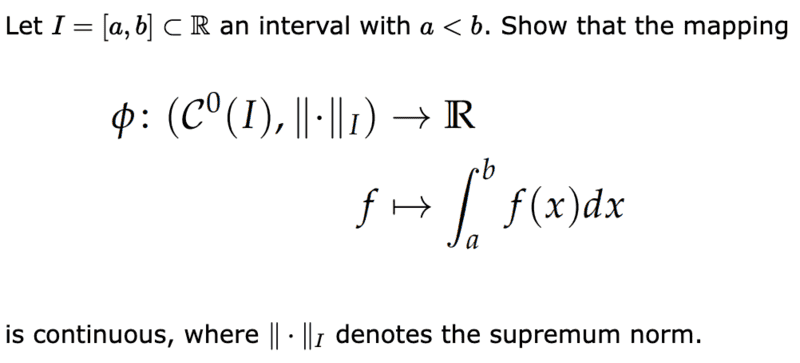
Bildschirmfoto 2024-05-17 um 13.50.12.png


I used the epsilon-delta definition for the proof, so it must hold for ##f,g \in (C^0(I), \| \cdot \|_I)## ##\sup_{x \in [a,b]} |F(x)-G(x)|< \delta \longrightarrow \quad |\int_{a}^{b} f(x)dx - \int_{a}^{b} g(x)dx |< \epsilon##

I then proceeded as follows

##|\int_{a}^{b} f(x)dx - \int_{a}^{b} g(x)dx | =|F(b)-F(a)-G(b)+G(a)|=|F(b)-G(b)+G(a)-F(a)|##

Then I used the supremum norm to estimate the above expression ##|F(b)-F(a)-G(b)+G(a)|=|F(b)-G(b)+G(a)-F(a)| \le \sup_{x \in [a,b]} |F(x)-G(x)|+\sup_{x \in [a,b]} |F(x)-G(x)|+\sup_{x \in [a,b]} |G(x)-F(x)|=2\sup_{x \in [a,b]} |F(x)-G(x)|<2\delta## it then follows that ##\delta## must be defined as follows ##\delta= \frac{\epsilon}{2} ##
 
Physics news on Phys.org
You want to find a ##\delta## such that if ##||f-g|| = \sup_{x \in I}|f(x)-g(x)| < \delta## then ##|\phi(f) - \phi(g)|< \varepsilon##. It seems to me that you have instead used the primitive function of ##f## and ##g## in the supremum norm.
 
  • Like
Likes   Reactions: PeroK, Lambda96 and docnet
Hint: By basic properties of the Riemann integral, <br /> \left| \int_a^b f(x)\,dx \right| \leq \int_a^b |f(x)|\,dx \leq (b- a) \sup |f|.
 
  • Like
Likes   Reactions: docnet and Lambda96
Orodruin said:
You want to find a ##\delta## such that if ##||f-g|| = \sup_{x \in I}|f(x)-g(x)| < \delta## then ##|\phi(f) - \phi(g)|< \varepsilon##. It seems to me that you have instead used the primitive function of ##f## and ##g## in the supremum norm.
How do you know the space ##C^0## has a vector space structure that allows you to subtract functions? Edit: Never mind, it's a normed space, hence a vector space.
Seems you could too, just use the open set definition and verify that the inverse image of an interval is open in ##C^0## with the given norm.
 
  • Like
Likes   Reactions: docnet and Lambda96
Thank you Orodruin, pasmith and WWGD for your help 👍👍👍

I have now used the tip from pasmith and received the following

The following must apply:
##\sup_{x \in [a,b]} |f(x)-g(x)|< \delta \longrightarrow \quad |\int_{a}^{b} f(x)dx - \int_{a}^{b} g(x)dx |< \epsilon##

Then I determined ##\delta## as follows
$$|\int_{a}^{b} f(x)dx - \int_{a}^{b} g(x)dx \le |\int_{a}^{b} |f(x)|dx - \int_{a}^{b} |g(x)|dx \le (b-a) \sup f|x|-(b-a) \sup |g(x)| = (b-a) \bigl( \sup|f(x)| - \sup|g(x)| \bigr)$$

Then ##\delta## must be ##\delta = \frac{\epsilon}{b-a}##
 
  • Like
Likes   Reactions: WWGD
Lambda96 said:
Then I determined ##\delta## as follows
$$|\int_{a}^{b} f(x)dx - \int_{a}^{b} g(x)dx \le |\int_{a}^{b} |f(x)|dx - \int_{a}^{b} |g(x)|dx \le (b-a) \sup f|x|-(b-a) \sup |g(x)| = (b-a) \bigl( \sup|f(x)| - \sup|g(x)| \bigr)$$
The first inequality is incorrect.
 
  • Like
Likes   Reactions: Lambda96
Lambda96 said:
$$|\int_{a}^{b} f(x)dx - \int_{a}^{b} g(x)dx \le |\int_{a}^{b} |f(x)|dx - \int_{a}^{b} |g(x)|dx \le (b-a) \sup f|x|-(b-a) \sup |g(x)| = (b-a) \bigl( \sup|f(x)| - \sup|g(x)| \bigr)$$
That all looks ill-conceived to me. For example, I don't think you've corrently identified the metric that is derived from the given supremum norm.

PS as pointed out in post #2.
 
  • Like
Likes   Reactions: Lambda96 and docnet
|\phi(f) - \phi(g)| = \left| \int_a^b f(x)\,dx - \int_a^b g(x)\,dx \right| = \left| \int_a^b f(x) - g(x)\,dx\right| etc.
 
  • Like
Likes   Reactions: Lambda96 and docnet
Thank you Orodruin, PeroK and pasmith for your help 👍👍👍

$$ \bigg \vert \int_{a}^{b} f(x) dx - \int_{a}^{b} g(x)dx \bigg \vert= \bigg \vert\int_{a}^{b} f(x)-g(x) dx \bigg \vert \le \int_{a}^{b} |f(x)-g(x)| dx \le (b-a) \sup|f(x)-g(x)|$$


From this follows ##\delta=\frac{\epsilon}{b-a}##
 
  • #10
Lambda96 said:
Thank you Orodruin, PeroK and pasmith for your help 👍👍👍

$$ \bigg \vert \int_{a}^{b} f(x) dx - \int_{a}^{b} g(x)dx \bigg \vert= \bigg \vert\int_{a}^{b} f(x)-g(x) dx \bigg \vert \le \int_{a}^{b} |f(x)-g(x)| dx \le (b-a) \sup|f(x)-g(x)|$$


From this follows ##\delta=\frac{\epsilon}{b-a}##
That's fine as far as it goes, but you really need a sound, logical proof. All ##\epsilon-\delta## proofs, in principle, should start with "Let ##\epsilon > 0 \dots ##".
 
  • #11
WWGD said:
How do you know the space ##C^0## has a vector space structure that allows you to subtract functions? Edit: Never mind, it's a normed space, hence a vector space.
Even without that, it should be pretty clear that a pointwise sum of continuous functions is a continuous function. All of the vector space axioms are clearly satisfied.

WWGD said:
Seems you could too, just use the open set definition and verify that the inverse image of an interval is open in ##C^0## with the given norm.
This is always my preferred way forward. However, the OP is most likely not aware of this definition of continuity.
 
  • #12
WWGD said:
Seems you could too, just use the open set definition and verify that the inverse image of an interval is open in ##C^0## with the given norm.
Orodruin said:
This is always my preferred way forward. However, the OP is most likely not aware of this definition of continuity.
I'd like to see a simple proof in this case using that method. Or any proof, simple or otherwise, that isn't essentially just the ##\epsilon-\delta## we have already.
 
  • #13
Many thanks to all of you for your help 👍👍👍👍👍


For the above problem, I had decided to use the proof for the epsilon delta definition, as my lecturer told me that I would have to know it for the exam.

According to my professor's lecture notes, if the mapping is linear, you can also use boundedness to prove continuity

Bildschirmfoto 2024-05-18 um 16.21.50.png


I have another problem where I have to show continuity, can I post it here or should I open a new thread?
 
  • #14
You should start a new thread. Note that this new question is a generalization of the question you posted in this thread.
 
  • Like
Likes   Reactions: mathwonk and PeroK
  • #15
Lambda96 said:
According to my professor's lecture notes, if the mapping is linear, you can also use boundedness to prove continuity

View attachment 345476
Do you see the close relationship between the proof of that theorem and the proof in this particular case?
 

Similar threads

Replies
22
Views
2K
  • · Replies 20 ·
Replies
20
Views
3K
  • · Replies 11 ·
Replies
11
Views
3K
  • · Replies 2 ·
Replies
2
Views
2K
  • · Replies 13 ·
Replies
13
Views
2K
Replies
5
Views
2K
  • · Replies 1 ·
Replies
1
Views
1K
  • · Replies 3 ·
Replies
3
Views
2K
  • · Replies 1 ·
Replies
1
Views
1K
Replies
5
Views
2K