Femme_physics
Gold Member
- 2,548
- 1
I'm 95% sure I got it all correct, but I'd appeciate another set of eyes
1) What's a thermistor? What is its principle of action?
2) What's a thermocouple, and what is its principle of action?
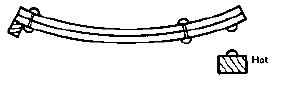
3) How does temperature transducer act based on the bimetal principle? Demonstrate your explanation with a drawing.
4) In a certain system given a temperature sensor of the type PT100 that behaves according to the formula
R=R0(1+a(T-T0)
whereas:
a = 0.00385 1/Celsius
R0 = 100 ohms
T0 = The relative temperature = 0 Celsius
A) In a certain temperature R = 215.5 ohms, calculate that temperature.
B) Calculate the temperature you got in clause A in units of Kelvin and Ferheneit.
1) Thermistor - a resistor that changes its resistance depending on temperature due to the crystaline structure of the substance the thermistor is made of.
2) Thermocouple - sensor for measuring temperature. It consists of two dissimilar metals, joined together at one end.
3) The bimetal-principle: A compound strip is formed by riveting or welding two layers of metals, chosen so as to have very different values of linear expansivity. The linear expansivity (old name, expansion coefficient) is the fractional change of length per degree change of temperature and for all metals is positive, meaning that the strip expands as the temperature increases. This bending action can be sensed by a displacement transducer. The conventional type of bimetallic strip element is still to be found in some thermostats, although the strip is very often arranged into a spiral. This allows for much greater sensitivity, since the sensitivity depends on the length of the strip. The amount of deflection can be fairly precisely proportional to temperature change if the temperature range is small.

4) http://img201.imageshack.us/img201/2306/frkh.jpg
Homework Statement
1) What's a thermistor? What is its principle of action?
2) What's a thermocouple, and what is its principle of action?
3) How does temperature transducer act based on the bimetal principle? Demonstrate your explanation with a drawing.
4) In a certain system given a temperature sensor of the type PT100 that behaves according to the formula
R=R0(1+a(T-T0)
whereas:
a = 0.00385 1/Celsius
R0 = 100 ohms
T0 = The relative temperature = 0 Celsius
A) In a certain temperature R = 215.5 ohms, calculate that temperature.
B) Calculate the temperature you got in clause A in units of Kelvin and Ferheneit.
The Attempt at a Solution
1) Thermistor - a resistor that changes its resistance depending on temperature due to the crystaline structure of the substance the thermistor is made of.
2) Thermocouple - sensor for measuring temperature. It consists of two dissimilar metals, joined together at one end.
3) The bimetal-principle: A compound strip is formed by riveting or welding two layers of metals, chosen so as to have very different values of linear expansivity. The linear expansivity (old name, expansion coefficient) is the fractional change of length per degree change of temperature and for all metals is positive, meaning that the strip expands as the temperature increases. This bending action can be sensed by a displacement transducer. The conventional type of bimetallic strip element is still to be found in some thermostats, although the strip is very often arranged into a spiral. This allows for much greater sensitivity, since the sensitivity depends on the length of the strip. The amount of deflection can be fairly precisely proportional to temperature change if the temperature range is small.
4) http://img201.imageshack.us/img201/2306/frkh.jpg
Last edited by a moderator:

