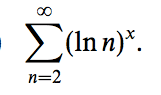
What are the values of ##x## for which the series (ln n)^x converges?

  • Context: Undergrad 
  • Thread starter Thread starter Happiness
  • Start date Start date
  • Tags Tags
    Convergence
Click For Summary
SUMMARY

The series \((\ln n)^x\) is divergent for all values of \(x\) based on comparisons with the harmonic series. The analysis shows that for large \(n\), the terms of the series grow larger than those of the harmonic series, confirming divergence. Specifically, using the inequality \(y^p < e^y\) for large \(y\) supports this conclusion. The discussion also highlights the complexity of comparing the series with divergent series and clarifies the equivalence of different series forms.

PREREQUISITES
  • Understanding of series convergence and divergence
  • Familiarity with logarithmic functions and their properties
  • Knowledge of the harmonic series
  • Basic calculus concepts, particularly limits and inequalities
NEXT STEPS
  • Study the properties of the harmonic series and its divergence
  • Learn about series comparison tests in calculus
  • Explore the behavior of logarithmic functions as \(n\) approaches infinity
  • Investigate the implications of the inequality \(y^p < e^y\) in series analysis
USEFUL FOR

Mathematicians, students studying calculus, and anyone interested in series convergence analysis will benefit from this discussion.

Happiness
Messages
686
Reaction score
30
Find the values of ##x## for which the following series is convergent.
Screen Shot 2016-06-13 at 1.25.44 am.png


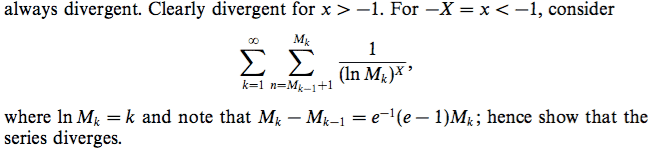
I compared the series with the harmonic series and deduced it is always divergent. I used ##y^p<e^y## for large ##y##. I used a different method from the answer given, which I don't understand.
Screen Shot 2016-06-13 at 1.25.21 am.png


When ##k=1##, ##M_1=e=2.72## and ##M_0=1##. Since ##M_0+1\leq n\leq M_1##, we have ##n=2##, giving us the term ##\frac{1}{1^X}##.

When ##k=2##, ##M_2=e^2=7.39## and ##M_1=e=2.72##. Since ##M_1+1\leq n\leq M_2##, we have ##n=4, 5, 6, 7##, giving us the terms ##\frac{1}{2^X}+\frac{1}{2^X}+\frac{1}{2^X}+\frac{1}{2^X}##.

Finding the possible values of ##n## is troublesome.

Is there a typo in the given answer?
 
Last edited:
Physics news on Phys.org
You get of the order of e terms of 1/1X, e2 terms of 1/2X, e3 terms of 1/3X and so on (up to the constant prefactor). Following the same logic as your approximation, ##\displaystyle \frac{e^n}{n^X}## grows to infinity instead of going to zero.
 
  • Like
Likes   Reactions: Happiness
mfb said:
You get of the order of e terms of 1/1X, e2 terms of 1/2X, e3 terms of 1/3X and so on (up to the constant prefactor). Following the same logic as your approximation, ##\displaystyle \frac{e^n}{n^X}## grows to infinity instead of going to zero.

Why is the series in the question and the series in the answer equivalent?

Their first terms are clearly different. The former's is ##\frac{1}{(\ln 2)^X}## while the latter's is ##\frac{1}{1^X}##.

If they are not equivalent, how do we show that the former is always bigger than the latter for every term?
 
The first fraction is always larger than the second by construction of the Mk. So your series is larger than a divergent series.
 
mfb said:
The first fraction is always larger than the second by construction of the Mk. So your series is larger than a divergent series.

Could you explain how? I don't see it.
 
ln(2) < 1
ln(3) < 2, ln(4) < 2, ln(5) < 2, ln(6) < 2, ln(7) < 2

Therefore 1/ln(2)X > 1/1X and so on for positive X.
 
  • Like
Likes   Reactions: Happiness
The given answer is so complicated vs if we just compare the series with the harmonic series.
 
Happiness said:
The given answer is so complicated vs if we just compare the series with the harmonic series.
How do you do that for x=-3?
 
mfb said:
How do you do that for x=-3?

Let ##y=\ln n##. For large ##n, y^3<e^y##. So ##(\ln n)^3<n##. Then ##\frac{1}{(\ln n)^3}>\frac{1}{n}##. The series is bigger than the harmonic series for every term. Hence it is also divergent.
 
  • #10
Ah right, that works as well, and it is easier.
 

Similar threads

  • · Replies 3 ·
Replies
3
Views
3K
  • · Replies 5 ·
Replies
5
Views
3K
  • · Replies 7 ·
Replies
7
Views
2K
  • · Replies 3 ·
Replies
3
Views
2K
  • · Replies 5 ·
Replies
5
Views
3K
  • · Replies 5 ·
Replies
5
Views
3K
  • · Replies 5 ·
Replies
5
Views
2K
  • · Replies 1 ·
Replies
1
Views
1K
  • · Replies 3 ·
Replies
3
Views
2K
  • · Replies 3 ·
Replies
3
Views
3K