Convergence of Series: Homework Statement and Attempt at Solution

Click For Summary

Homework Help Overview

The discussion revolves around determining the convergence of a series involving terms of the form -1/(3*k) + 1/(3*k+1) + 1/(3*k+2). Participants explore various convergence tests and the implications of their algebraic manipulations.

Discussion Character

  • Exploratory, Assumption checking, Mathematical reasoning

Approaches and Questions Raised

  • Participants discuss the intuition behind divergence due to the 1/k element and explore algebraic manipulations to analyze convergence. Questions arise regarding the validity of treating the series as an alternating series and the implications of limits approaching zero.

Discussion Status

There is an active exploration of different approaches, including algebraic simplifications and limit comparisons. Some participants suggest that the series may converge, while others argue against this by referencing the harmonic series. No consensus has been reached, but various lines of reasoning are being examined.

Contextual Notes

Participants note the complexity of applying certain convergence tests and the potential for telescoping series to influence convergence outcomes. The discussion reflects a mix of intuition and formal reasoning without definitive conclusions.

ptolema
Messages
82
Reaction score
0
it's a new semester, and we're at it again. series abounds!

Homework Statement


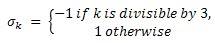
Let
cond1.jpg
.
Determine whether the following series converges:
cond.jpg


Homework Equations


-1 [tex]\leq[/tex] [tex]\sigma[/tex]k [tex]\leq[/tex] 1

The Attempt at a Solution


i feel like the series inherently diverges because of the 1/k element. also,
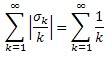
cond2-1.jpg
, so i know that the series does not converge absolutely. of course, that isn't solid proof that the series diverges, but other convergence tests are harder to work with for this particular problem. since the [tex]\sigma[/tex]k and 1/k series both diverge, it makes sense to me that the above series would also diverge. could someone help me make this less intuitive and find a more direct approach?
 
Physics news on Phys.org
Think about doing some algebra on -1/(3*k)+1/(3*k+1)+1/(3*k+2). Does that help you get past intuition?
 
after a bit of algebra, I got to
frac.jpg
. I tried taking the limit as k-->infinity, and the limit turned out to be zero. from this, i can kind of tell that as k increases, the sums of consecutive terms in the series get smaller and approach zero. this suggests convergence.
also, after looking at it for a while, I decided to treat it as a weird case of alternating series. since lim 1/k as k->infinity is zero, i reached the tentative conclusion that the series converges. as any of my arguments valid?
 
ptolema said:
after a bit of algebra, I got to
frac.jpg
. I tried taking the limit as k-->infinity, and the limit turned out to be zero. from this, i can kind of tell that as k increases, the sums of consecutive terms in the series get smaller and approach zero. this suggests convergence.
also, after looking at it for a while, I decided to treat it as a weird case of alternating series. since lim 1/k as k->infinity is zero, i reached the tentative conclusion that the series converges. as any of my arguments valid?

It's DEFINITELY not convergent. Look at the expression you got. For large k that's approximately 9k^2/(27k^3) (ignoring smaller powers). That's 3/k. You have to add those up for all k. It's like a harmonic series. To formalize it think about a limit comparison test.
 
Last edited:
We can save ourselves some algebra and a limit comparison test. Firstly, we can ignore the first term of the series since it won't effect convergence. Call this adjusted series S. Then note the consecutive pairs [tex]\frac{1}{3k+2}, \frac{-1}{3(k+1) }[/tex] will "telescope", leaving a small positive residue term each time. Then [tex]S > \sum_{k=1}^{\infty} \frac{1}{3k+1} > \sum_{k=1}^{\infty} \frac{1}{3(k+1)} = \frac{1}{3} \sum_{k=2}^{\infty} \frac{1}{k}[/tex] .
 

Similar threads

  • · Replies 3 ·
Replies
3
Views
2K
  • · Replies 4 ·
Replies
4
Views
1K
  • · Replies 4 ·
Replies
4
Views
2K
  • · Replies 2 ·
Replies
2
Views
2K
Replies
7
Views
2K
  • · Replies 7 ·
Replies
7
Views
2K
Replies
7
Views
2K
  • · Replies 1 ·
Replies
1
Views
2K
  • · Replies 1 ·
Replies
1
Views
1K
  • · Replies 17 ·
Replies
17
Views
3K