Converting between λ and ν for Blackbody Radiation?

Click For Summary
SUMMARY

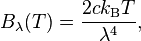
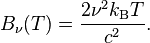
The discussion centers on converting between wavelength (λ) and frequency (ν) in the context of blackbody radiation, specifically using the Rayleigh-Jeans Law. The relationship is established through the equation ν = c/λ, leading to the expressions for spectral radiance: Bν = (2kBTν²/c²) and Bλ = (2ckBT/λ⁴). The conversation highlights the limitations of the Rayleigh-Jeans Law at short wavelengths, known as the ultraviolet catastrophe, and discusses the measurement of spectral radiance using different equipment for Bλ and Bν.

PREREQUISITES
  • Understanding of blackbody radiation concepts
  • Familiarity with the Rayleigh-Jeans Law
  • Basic knowledge of spectral radiance equations
  • Knowledge of the relationship between wavelength and frequency
NEXT STEPS
  • Research the Planck's Law of blackbody radiation
  • Learn about the ultraviolet catastrophe and its implications
  • Explore the equipment used for measuring spectral radiance (Bλ and Bν)
  • Study the derivation of the Rayleigh-Jeans Law and its limitations
USEFUL FOR

Physicists, engineers, and students studying thermodynamics and electromagnetic radiation, particularly those interested in blackbody radiation and its measurement techniques.
tade
Messages
720
Reaction score
26
Forgive me for this stupid question, but how do I convert between

b57bebb5337f0de6333ec9bc85688c08.png


and

46a1efc581519117de92da6afb5a8e78.png


I tried c = νλ but that doesn't work. This is the Rayleigh Jeans Law by the way.
 
Last edited:
Science news on Phys.org
tade said:
Forgive me for this stupid question, but how do I convert between

p?image=https%3A%2F%2Fupload.wikimedia.org%2Fmath%2Fb%2F5%2F7%2Fb57bebb5337f0de6333ec9bc85688c08.png


and

p?image=https%3A%2F%2Fupload.wikimedia.org%2Fmath%2F4%2F6%2Fa%2F46a1efc581519117de92da6afb5a8e78.png


I tried c = νλ but that doesn't work.
pl. give the full expression of the quoted equation and where these two are being used.
 
The Rayleigh–Jeans law agrees with experimental results at large wavelengths (low frequencies) but strongly disagrees at short wavelengths (high frequencies). This inconsistency between observations and the predictions of classical physics is commonly known as the ultraviolet catastrophe,

see the full expressions
associated Rayleigh–Jeans limits are given by

c0313ce746394b13ace2e1e668e6f176.png

or

22ed0ae7e400ebb5306a059fb4b69c1f.png

now you can see the approximations- actually they are not exact expressions
 
You only have to remember that these are probability distributions ##\mathrm{d} N/\mathrm{d} \nu## or ##\mathrm{d} N/\mathrm{d} \lambda##. Now you have ##\nu=c/\lambda##. This implies
$$B_{\nu}=\frac{\mathrm{d} N}{\mathrm{d} \nu}=\frac{\mathrm{d} N}{\mathrm{d} \lambda} \left|\frac{\mathrm{d} \lambda}{\mathrm{d} \nu}\right| = B_{\lambda} \frac{c}{\nu^2}.$$
Now with
$$B_{\lambda}=\frac{2 c k_B T}{\lambda^4}=\frac{2 k_B T \nu^4}{c^3} \; \Rightarrow\; B_{\nu}=\frac{2 k_B T \nu^2}{c^2},$$
and this was to be shown.
 
Thank you guys.

For
b57bebb5337f0de6333ec9bc85688c08.png


and

46a1efc581519117de92da6afb5a8e78.png


the peak intensities occur at different wavelengths or frequencies.How do scientists measure the spectral radiance of blackbodies? Are there TWO types of equipment, one for B_\lambda and the other for B_\nu, such that each device yields a peak at a different frequency?
 

Similar threads

  • · Replies 29 ·
Replies
29
Views
4K
  • · Replies 1 ·
Replies
1
Views
1K
  • · Replies 1 ·
Replies
1
Views
2K
  • · Replies 3 ·
Replies
3
Views
2K
  • · Replies 20 ·
Replies
20
Views
2K
  • · Replies 4 ·
Replies
4
Views
2K
  • · Replies 6 ·
Replies
6
Views
3K
  • · Replies 5 ·
Replies
5
Views
2K
  • · Replies 11 ·
Replies
11
Views
4K
  • · Replies 2 ·
Replies
2
Views
2K