Convince Covid-19 Vaccine Efficiency Through Statistics

Click For Summary
SUMMARY

The discussion centers on the validity of comparing death percentages from Covid-19 between vaccinated and unvaccinated populations, particularly among individuals under 50. It concludes that such comparisons are misleading without controlling for confounding factors like comorbidities and the overall vaccination rate, which in the UK is approaching 90%. The AstraZeneca vaccine is highlighted as the primary vaccine used in England, and statistical analysis indicates that vaccination significantly reduces the risk of death, with estimates showing an effectiveness of approximately 82% against death for those aged 70-79. Observational studies without proper controls are deemed unreliable for drawing definitive conclusions about vaccine efficacy.

PREREQUISITES
  • Understanding of basic statistics and observational study design
  • Familiarity with vaccine efficacy metrics and public health data interpretation
  • Knowledge of Covid-19 vaccination rates and demographics in the UK
  • Awareness of common misconceptions in epidemiological statistics, such as the base rate fallacy
NEXT STEPS
  • Research the methodology behind observational studies in epidemiology
  • Learn about the AstraZeneca vaccine and its efficacy data
  • Examine the Vaccine Surveillance reports for detailed statistics on Covid-19 outcomes
  • Study the base rate fallacy and its implications in public health messaging
USEFUL FOR

Public health officials, epidemiologists, statisticians, and anyone involved in vaccine advocacy or public health communication will benefit from this discussion.

vabsie
Messages
7
Reaction score
0
I have been trying to convince someone that it is wrong to compare the death percentages of two different populations (percentage of death of Covid-19 cases per category: vaccinated vs unvaccinated) in an uncontrolled setting (i.e. real-world data), and conclude that the Covid-19 vaccine does not work.

Can you guys help me out on the validity of this claim using Statistics?

So here is the much argued upon chart (2 screenshots of the same chart).
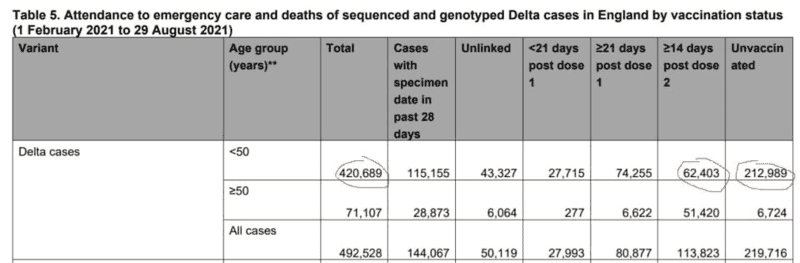
1631189982677.png

1631190071622.png


My questions are:
1. Is it valid to compare the percentages of death over the total number of covid-cases for ages <50 between these two groups: unvaccinated and vaccinated (see circled numbers in the table). That is death percentage of unvaccinated is 0.05%, while death percentage of vaccinated is 0.6%.
2. Which brings me to this next point. Based on 1, is it valid to say that the vaccine does not work?

Geez. I can't believe I am posting this on here. But yeah, Statistics is the way to go to save a friend.Source of data: https://assets.publishing.service.g...le/1014926/Technical_Briefing_22_21_09_02.pdf
 
Physics news on Phys.org
Naively the % of deaths among vaccinated is greater than unvaxxed, however
A) does not specify other health conditions - likely the vaxxed admitted had other health issues- in the under 50 age group presumably vulnerable people got vaxxed at a higher rate
B) presumes they were actually vaccinated - did the NHS verify or was it just a question answered - sick people may be embarrassed to admit they did not get the vax and lie
C) The UK's vaccination rate is approaching 90%, so the vast majority of adults are vaccinated, the sample is biased - at some high vaccination rate (like in Israel) cases among vaxxed people will become the majority
 
vabsie said:
Based on 1, is it valid to say that the vaccine does not work?
Depends on what you mean by “work”. This shows that in the studied population the vaccine does not keep hospitalized patients out of the morgue on average. But it sheds no light on whether it keeps symptomatic patients out of the hospital, whether it keeps infected people from becoming symptomatic, or whether it keeps exposed people from becoming infected.

It also provides no information about the population or any co-morbidities. Failure to account for such things in an observational study means that the study isn’t reliable.
 
England has reached 88% vaccinated. With that in mind, your data seems to show that vaccination works well to keep people from needing emergency care since they are far fewer than 88%. The conclusion might be that if a vaccinated person needs emergency care he is in the same or greater danger of dying. That is a big 'if'.
You should be specific about the particular vaccine. England developed and relied primarily on the AstraZeneca vaccine.
 
In the end though, statistics is unlikely to convince your friend. Many people harbor hidden fears or beliefs that prevent them from getting the vaccine and no amount of statistics will help until you know the root cause of why they won't get the vaccine.
 
  • Like
  • Informative
Likes   Reactions: Filip Larsen, nsaspook and FactChecker
FactChecker said:
The conclusion might be that if a vaccinated person needs emergency care he is in the same or greater danger of dying. That is a big 'if'.
A more likely conclusion is that the vaccinated and unvaccinated populations differ systematically in one or more risk factors or comorbidities. Without such controls observational studies are generally useless
 
  • Like
Likes   Reactions: StatGuy2000, WWGD and jedishrfu
An argument that I have seen used is that the long-term effects of recent vaccines have not ( by their recency) been tested. Of course, you won't reach the 5G/Microchip crowd but maybe this claim can be addressed. Edit: But it would help if you told us (if you know) a more precise basis why your friend opposes vaccination.
 
WWGD said:
the long-term effects of recent vaccines have not ( by their recency) been tested
That should only be discussed along with the fact that the long-term effects of COVID itself have also not been tested for the same reason.
 
  • Like
Likes   Reactions: WWGD
Dale said:
A more likely conclusion is that the vaccinated and unvaccinated populations differ systematically in one or more risk factors or comorbidities. Without such controls observational studies are generally useless
Same thing. I went to the bottom line of all the miscellaneous comorbidities. There may be dozens of them. They lead to increased risk. The set of those who are admitted to emergency hospital care is a self-selected sample with a higher likelihood of having comorbidities.
 
Last edited:
  • Like
Likes   Reactions: Dale
  • #10
Dale said:
That should only be discussed along with the fact that the long-term effects of COVID itself have also not been tested for the same reason.
I personally believe it's a rationalization for their fear of vaccine, but that's what they're claiming.
 
  • Like
Likes   Reactions: nsaspook and FactChecker
  • #11
I've tried to use the base rate fallacy to convince somehttps://www.npr.org/2021/08/20/1029...e-rate-fallacy-as-it-pertains-to-the-pandemic
AMANDA ARONCZYK, BYLINE: At the end of July, I went to Iceland for the same reason that lots of people have been traveling there. They've had very low COVID rates and very high vaccination rates. So Iceland said to potential tourists, come to Iceland, where you can pay big bucks to ride little horses. But as we are packing to go on our trip, there was this COVID spike there. And this was very concerning because most of the people getting infected were fully vaccinated. You might have heard similar worries about Israel or the U.K. or about that outbreak in Provincetown, Mass. Katrine Wallace, an epidemiologist at University of Illinois at Chicago, ran the Iceland numbers for me. She found that over one month this summer, 67% of COVID infections there were in people who were fully vaccinated, which sounds really bad.

KATRINE WALLACE: So when you first look at that, at first blush, you say, oh, that means most people that are vaccinated will end up getting COVID. So we shouldn't use the vaccine, right?

ARONCZYK: But that 67% does not mean that the vaccine isn't working. It's a misreading of what's actually happening.

WALLACE: It is just people committing the base rate fallacy. They're not considering the whole context of the data.
Click to expand...
WALLACE: What I would advise is just anytime you see, like, X percent of this or, you know, five out of 10 that, I would just say, what's the broader context here? What are we talking about?

ARONCZYK: Because once you consider the base rate, you get a very different story.

but it seldom works for the same reason listed below.

People are poisoning themselves with ivermectin, it is likely because they cannot do basic math to properly figure out a dose requirement.
Next time someone asks why I need to know fractions or even proportions, here is your example...
 
  • Like
Likes   Reactions: Dale, FactChecker and WWGD
  • #12
vabsie said:
My questions are:
1. Is it valid to compare the percentages of death over the total number of covid-cases for ages <50 between these two groups: unvaccinated and vaccinated (see circled numbers in the table). That is death percentage of unvaccinated is 0.05%, while death percentage of vaccinated is 0.6%.
2. Which brings me to this next point. Based on 1, is it valid to say that the vaccine does not work?
No it is not, because there are many more vaccinated people than unvaccinated people. So you have to compare the rates of death between vaccinated and unvaccinated people, ie. compare [(vaccinated deaths)/(number of vaccinated people)] with [(unvaccinated deaths)/(number of unvaccinated people)]. These estimates are available in the Vaccine Surveillance report (p15), where the death rate among vaccinated people aged 70-79 is 9.2/100,000 and the death rate among unvaccinated people is 52.1/100,000, so one estimate of vaccine effectiveness is (1-9.2/52.1)x100% ~ 82%.

One factor that may make that number an underestimate is that many in the UK have been naturally infected, which also provides protection to the unvaccinated. There are other factors, and the report itself warns "In the context of very high vaccine coverage in the population, even with a highly effective vaccine, it is expected that a large proportion of cases, hospitalisations and deaths would occur in vaccinated individuals, simply because a larger proportion of the population are vaccinated than unvaccinated and no vaccine is 100% effective. This is especially true because vaccination has been prioritised in individuals who are more susceptible or more at risk of severe disease. Individuals in risk groups may also be more at risk of hospitalisation or death due to non-COVID-19 causes, and thus may be hospitalised or die with COVID-19 rather than because of COVID-19." However, one can see that even without correcting for those factors, vaccination reduces the risk of death by about 5 times for that age group.

With the proper corrections, the report estimates the vaccine gives about 91-98% protection against hospitalization caused by the Delta variant (Table 3, p8).
 
Last edited:
  • Informative
  • Like
Likes   Reactions: StatGuy2000, nsaspook and FactChecker
  • #13
This is more of a distraction than maybe a downright fallacy: Bringing up the fact that Heart disease, Automobile deaths all have a higher fatality rate. Well, I have never got heart disease by talking with people who had it themselves.
 
  • Like
Likes   Reactions: Dale

Similar threads

  • · Replies 2 ·
Replies
2
Views
2K
  • · Replies 2 ·
Replies
2
Views
1K
  • · Replies 1 ·
Replies
1
Views
1K
  • · Replies 100 ·
4
Replies
100
Views
10K
  • · Replies 6 ·
Replies
6
Views
2K
  • · Replies 47 ·
2
Replies
47
Views
10K
  • · Replies 8 ·
Replies
8
Views
2K
  • · Replies 0 ·
Replies
0
Views
2K
