How is the Electron Configuration of Central Atoms in Complex Salts Determined?

Click For Summary
SUMMARY

The discussion centers on the electron configuration of the central atom in the complex salt [Fe(CN)6]2-. Participants clarify that the oxidation state of iron (Fe) in this context is typically +3 or +2, not +4, and that the correct formulas for the complex are [Fe(CN)6]3- and [Fe(CN)6]4-. The conversation highlights the importance of Crystal Field Theory (CFT) and Crystal Field Stabilization Energy (CFSE) in determining electron configurations, particularly in low-spin complexes. Misprints in textbooks are also addressed, emphasizing the need for accurate chemical representations.

PREREQUISITES
  • Understanding of Crystal Field Theory (CFT)
  • Knowledge of Crystal Field Stabilization Energy (CFSE)
  • Familiarity with oxidation states of transition metals
  • Basic concepts of ligand field theory
NEXT STEPS
  • Research the electron configurations of transition metals in various oxidation states
  • Study the implications of ligand strength on electron configurations in coordination complexes
  • Explore the Jahn-Teller effect and its impact on molecular geometry
  • Investigate the differences between strong field and weak field ligands in complex formation
USEFUL FOR

Chemistry students, particularly those studying inorganic chemistry, educators teaching coordination chemistry, and researchers focusing on transition metal complexes will benefit from this discussion.

AdityaDev
Messages
527
Reaction score
33
I am confused with the electron configuration of central atoms in complex salts eg. ##[Fe(CN)_6]^{2-}## configuration just Fe atom is
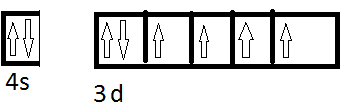
2.png

Now the complex is low spin so the configuration becomes,
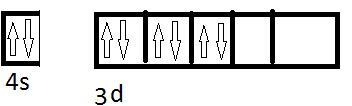
1.png


Now we have 6CN. where will they donate their electrons? Will the donate electrons in the remaining ##e_g## to form ##d^nsp^m## or will they donate electrons in the 4s, 4p and 4d to form ##sp^nd^m## or will they have some other configuration? Can you give some exceptional cases (like for Pt all ligands are strong field and most are square planar)
I have read Crystal Field Theory and VSEPR theory. I also know Jahn-teller distorsion and Crystal field splitting.Also, the oxidation number of Fe is +4.
So will the electrons first be removed first from 4s before 3d?Is this true for all cases?
.
 
Last edited by a moderator:
Chemistry news on Phys.org
AdityaDev said:
##[Fe(CN)_6]^{2-}##

Are you sure about the formula?

AdityaDev said:
the oxidation number of Fe is +4

That would be quite unusual.
 
Borek said:
Are you sure about the formula?
That would be quite unusual.
It may not be possible. It's a question in J D lee inorganic chemistry... But just check if I am right.
 
AdityaDev said:
It may not be possible. It's a question in J D lee inorganic chemistry... But just check if I am right.
No, there is no formula like ##[Fe(CN)_6]^{2-} ##. Fe has the most stable form as ## Fe^{3+} ## and sometimes forms as ## Fe^{2+}##. There is formula like ##[Fe(CN)_6]^{4-} ## and ##[Fe(CN)_6]^{3-} ##
There might be a misprinting.
 
Raghav Gupta said:
No, there is no formula like ##[Fe(CN)_6]^{2-} ##. Fe has the most stable form as ## Fe^{3+} ## and sometimes forms as ## Fe^{2+}##. There is formula like ##[Fe(CN)_6]^{4-} ## and ##[Fe(CN)_6]^{3-} ##
There might be a misprinting.
I know... just assume its correct... and let's just try to work with CFSE and CFT. Forget about periodic table.
 
This thread may be closed by someone because of Fe4+. I know it doesn't work that way.lets have a new Fe. I just want to know if what I'm doing is right. This has happened some times in physics forums where people are not understanding what I mean.
PF values civility
PF values grammar
PF values blah blah blah...
where is PF values creativity?
I had typed and edited the thread. It took me 20 minutes ( I could have just mugged it up but want to understand... You know, i think its the thirst for understanding that's important for a science student).
Assume its Fe4+. If you can't work with such situations, just close the thread.PF is good for advanced theories and here you value Socratic education (like chemical forums). But in my country, problem solving skills is given an emphasis. If i am not good in it, then i won't get a good college.
------------------------------------------------------------------------------------------
Sorry if this reply seems belligerent.
 
Last edited:
AdityaDev said:
I know... just assume its correct... and let's just try to work with CFSE and CFT. Forget about periodic table.
Well actually my inorganic chemistry is a bit bad. So others will be able to help you in this case. I only knew in this thread that there is no formula such as ## [ Fe(CN)_6]^{2-} ## .
 
I think it is
Raghav Gupta said:
Well actually my inorganic chemistry is a bit bad. So others will be able to help you in this case. I only knew in this thread that there is no formula such as ## [ Fe(CN)_6]^{2-} ## .
fecn6 "4-" not 2-. Its a mistake in the book.
 
Oh sorry I didn't looked at your above consecutive reply because at that time I was typing my reply.
 
  • #10
We are posting at the same time in this thread is creating a mess , sorry.
 
  • #11
Raghav Gupta said:
We are posting at the same time in this thread is creating a mess , sorry.
Its ok.
 
  • #12
AdityaDev said:
Its ok.
Well Aditya(I suppose it's your first name ) what about our previous conversations?
Sorry others as it is going one on one interaction?
 

Similar threads

Replies
4
Views
2K
  • · Replies 4 ·
Replies
4
Views
5K
  • · Replies 8 ·
Replies
8
Views
3K
  • · Replies 1 ·
Replies
1
Views
3K
  • · Replies 2 ·
Replies
2
Views
3K
  • · Replies 3 ·
Replies
3
Views
11K
Replies
1
Views
2K