Corollary to Correspondence Theorem for Modules

  • Context: Graduate 
  • Thread starter Thread starter Math Amateur
  • Start date Start date
  • Tags Tags
    Modules Theorem
Click For Summary
SUMMARY

The discussion centers on the proof of Corollary 6.25, which is derived from Theorem 6.22 (the Correspondence Theorem for Modules) as presented in Joseph J. Rotman's book, Advanced Modern Algebra. The proof establishes that if I is a maximal ideal of R and M = R/I, then any submodule of M can be expressed as S/I with I ⊆ S ⊆ R. The analysis confirms that M is simple, and if M is a simple R left module, a ring homomorphism φ can be defined, leading to the conclusion that I is a maximal left ideal. This rigorous examination clarifies the relationship between maximal ideals and simple modules.

PREREQUISITES
  • Understanding of modules in abstract algebra
  • Familiarity with the Correspondence Theorem for Modules
  • Knowledge of ring homomorphisms and their properties
  • Concept of maximal ideals in ring theory
NEXT STEPS
  • Study the implications of the Correspondence Theorem for Modules in various algebraic structures
  • Explore examples of simple modules and their characteristics
  • Investigate the role of maximal ideals in ring theory
  • Learn about the applications of ring homomorphisms in module theory
USEFUL FOR

Students and researchers in abstract algebra, particularly those focusing on module theory and ring theory, will benefit from this discussion. It is especially relevant for individuals seeking to deepen their understanding of the Correspondence Theorem and its applications in algebra.

Math Amateur
Gold Member
MHB
Messages
3,920
Reaction score
48
I am reading Joseph J. Rotman's book: Advanced Modern Algebra and I am currently focused on Section 6.1 Modules ...

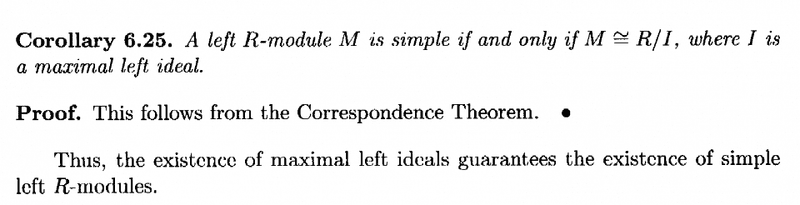
I need some help with the proof of Corollary 6.25 ... Corollary to Theorem 6.22 (Correspondence Theorem) ... ...

Corollary 6.25 and its proof read as follows:
?temp_hash=3e7e3658af5514dc0972081c2217eed4.png
Can someone explain to me exactly how Corollary 6.25 follows from the Correspondence Theorem for Modules ...?

Hope that someone can help ...

Peter=============================================

*** EDIT ***

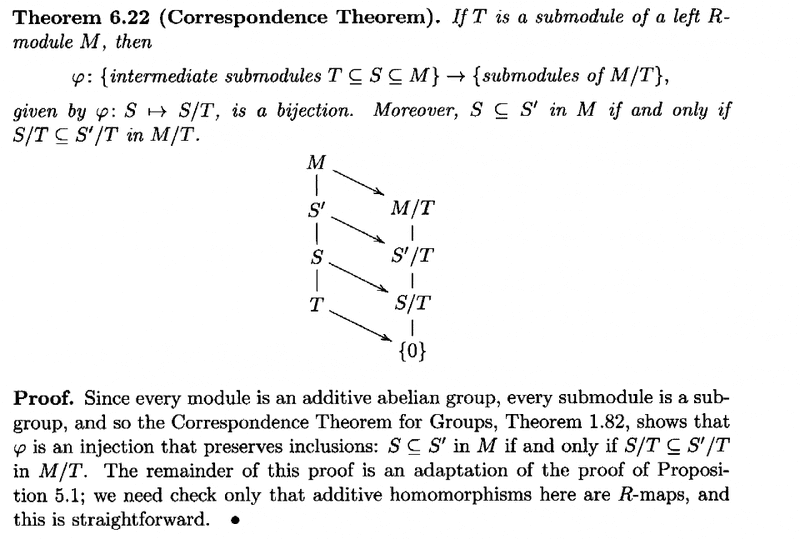
The above post refers to the Correspondence Theorem for Modules (Theorem 6.22 in Rotman's Advanced Modern Algebra) ... so I am proving the text of the Theorem from Rotman's Advanced Modern Algebra as follows:
?temp_hash=3e7e3658af5514dc0972081c2217eed4.png
 

Attachments

  • Rotman - AMA - Corollary 6.25    ....png
    Rotman - AMA - Corollary 6.25 ....png
    34.5 KB · Views: 805
  • Rotman - Theorem 6.22.png
    Rotman - Theorem 6.22.png
    40.1 KB · Views: 1,373
Physics news on Phys.org
If I is a maximal ideal of R and M := R / I then a submodule of M is of the form S / I with I ⊆ S ⊆ R (6.22). The module property makes S an ideal of R. So either S = I, i.e. S / I = 0, or S = R, i.e. S / I = M, which means M is simple. On the other hand, if M is a simple R left module then we can pick an element m ∈ M, m ≠ 0. Then φ : R → M with φ(r) := r.m defines a ring homomorphism. φ cannot be 0, because otherwise {m} would be a non-zero submodule of M. (We suppose that either R has a 1 and 1.m = m or more generally require that R doesn't operate trivially on M, i.e. R.M may not be {0}.) Since I am φ is a non-zero submodule of M and M is simple, φ has to be surjective (im φ = M) with kernel I:= ker φ.
Therefore R / I = R / ker φ ≅ I am φ = M.
According to Theorem 6.22 the absence of submodules of M ≅ R / I implies the absence of ideals in R containing I, i.e. I is a maximal left ideal.
 
Last edited:
  • Like
Likes   Reactions: Math Amateur
Thanks so much for your analysis Fresh 42 ... most helpful ...

Peter
 

Similar threads

  • · Replies 1 ·
Replies
1
Views
2K
  • · Replies 1 ·
Replies
1
Views
3K
Replies
4
Views
2K
  • · Replies 2 ·
Replies
2
Views
1K
Replies
9
Views
2K
  • · Replies 3 ·
Replies
3
Views
5K
  • · Replies 3 ·
Replies
3
Views
2K
Replies
2
Views
1K
  • · Replies 5 ·
Replies
5
Views
2K
  • · Replies 6 ·
Replies
6
Views
2K