Undergrad Correspondence Theorem for Groups .... Another Question ....

  • Thread starter Thread starter Math Amateur
  • Start date Start date
  • Tags Tags
    Groups Theorem
Click For Summary
The discussion focuses on understanding the proof of Proposition 1.82 from Rotman's "Advanced Modern Algebra," specifically regarding the Correspondence Theorem for groups. Participants clarify that the preimage of a subgroup under a homomorphism is indeed a subgroup of the original group, and they explore why the preimage contains the kernel. They also emphasize that for any surjective function, the image of the preimage of a subgroup equals the subgroup itself, which is crucial for demonstrating the surjectivity of the homomorphism. The conversation highlights the importance of correctly interpreting the notation and ensuring clarity in the proof's steps. Overall, the exchange aids in grasping the foundational concepts of group theory and homomorphisms.
Math Amateur
Gold Member
MHB
Messages
3,920
Reaction score
48
I am reading the book: "Advanced Modern Algebra" (Second Edition) by Joseph J. Rotman ...

I am currently focused on Chapter 1: Groups I ...

I need help with an aspect of the proof of Proposition 1.82 (Correspondence Theorem) ...

Proposition 1.82 reads as follows:
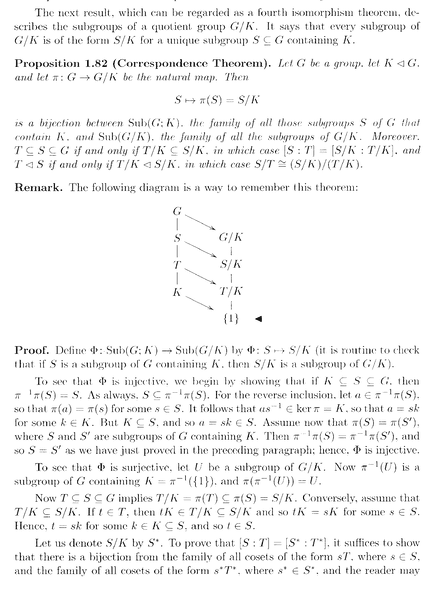
Rotman - 1 - Proposition 1.82 ... .png

Rotman - 2 - Proposition 1.82 ... .PART 2 .png

In the above proof by Rotman we read the following:

" ... ... To see that ##\Phi## is surjective, let ##U## be a subgroup of ##G/K##. Now ##\pi^{-1} (U)## is a subgroup of ##G## containing ##K = \pi^{-1} ( \{ 1 \} )##, and ##\pi ( \pi^{-1} (U) ) = U## ... ... "My questions on the above are as follows:
Question 1

How/why is ##\pi^{-1} (U)## is a subgroup of ##G## containing ##K##? And further, how does ##\pi^{-1} (U) = \pi^{-1} ( \{ 1 \} )## ... ... ?
Question 2

How/why exactly do we get ##\pi ( \pi^{-1} (U) ) = U##? Further, how does this demonstrate that ##\Phi## is surjective?
Help will be much appreciated ...

Peter
 

Attachments

  • Rotman - 1 - Proposition 1.82 ... .png
    Rotman - 1 - Proposition 1.82 ... .png
    47.7 KB · Views: 572
  • Rotman - 2 - Proposition 1.82 ... .PART 2 .png
    Rotman - 2 - Proposition 1.82 ... .PART 2 .png
    13.6 KB · Views: 476
Physics news on Phys.org
Hi Peter

Question 1:

The preimage of a subgroup of the codomain is always a subgroup of the domain. Try to prove this using the characterisation of subgroups

(i.e., show that ##\pi^{-1}(U) \neq \emptyset## and ##a,b \in \pi^{-1}(U) \implies ab^{-1} \in \pi^{-1}(U)##)

##K \subseteq \pi^{-1}(U)## because ##K = \pi^{-1}(\{1\}) = \pi^{-1}(\{e_{G/K}\})##

Question 2:

Furthermore, for any surjective function:

##\pi(\pi^{-1}(U)) = U##.

Try to prove this (set theory question, has nothing to do with groups)

This shows that ##\Phi## is surjective, because you took an arbitrary ##U## subgroup of ##G/K## and then show that ##\Phi(\pi^{-1}(U)) = \pi^{-1}(U)/K =\pi(\pi^{-1}(U)) = U##.

Note that it is important here that ##\pi^{-1}(U)## contains ##K##, otherwise the quotient is not well defined.
 
Thanks Math_QED ... appreciate your help and support...

Just now reflecting on what you have written ...

Peter
 
Hi Math_QED ...

Taking up your suggestion ...We have that ##U## is a subgroup of ##G/K## ...

Want to show that ##\pi^{-1} (U) \neq \emptyset## and that ##a,b \in \pi^{-1} (U) \Longrightarrow ab^{-1} \in \pi^{-1} (U)##Now ...

##\pi( 1_G ) = 1_{ G/K } \Longrightarrow \pi^{-1} ( 1_{ G/K } ) = 1_G##

##\Longrightarrow \pi^{-1} (U) \neq \emptyset##Now ...

... let ##a, b \in \pi^{-1} (U)##

##\Longrightarrow \pi(a), \pi(b) \in U##

##\Longrightarrow \pi(a), [ \pi(b) ]^{-1} \in U## since ##U## is a subgroup ...

##\Longrightarrow \pi(a), \pi( b^{-1} ) \in U## since ##\pi## is a homomorphism ...

##\Longrightarrow \pi(a) \pi( b^{-1} ) \in U## since ##U## is a subgroup ...

##\Longrightarrow \pi( a b^{-1} ) \in U## since ##\pi## is a homomorphism ...

##\Longrightarrow a b^{-1} \in \pi^{-1} (U)## ...

Therefore ##\pi^{-1} (U)## is a subgroup of ##G## ...Is that correct ...?

Peter
 
Math Amateur said:
Is that correct ...?
Yes, it is.
 
  • Like
Likes Math Amateur
Math Amateur said:
Hi Math_QED ...

##\pi( 1_G ) = 1_{ G/K } \Longrightarrow \pi^{-1} ( 1_{ G/K } ) = 1_G##

##\Longrightarrow \pi^{-1} (U) \neq \emptyset##Is that correct ...?

Peter

The idea is correct, but the line

##\pi( 1_G ) = 1_{ G/K } \Longrightarrow \pi^{-1} ( 1_{ G/K } ) = 1_G##

doesn't make sense. The preimage is a set, and can't be equal to something that isn't a set. Even if you would have written ##\{1_G\}##, it wouldn't be correct though.

Notice that ##\pi^{-1}(1_{G/K})## is shorthand notation for ##\pi^{-1}(\{1_{G/K}\})##. We are not talking about inverse functions here.

You should rather write ##\pi(1_G) = 1_{G/K} \in U##, which means that ##1_G \in \pi^{-1}(U)##. Can you explain me why ##1_{G/K} \in U##? This is essential here.

The rest is correct.
 
Last edited by a moderator:
  • Like
Likes Math Amateur and fresh_42
I am studying the mathematical formalism behind non-commutative geometry approach to quantum gravity. I was reading about Hopf algebras and their Drinfeld twist with a specific example of the Moyal-Weyl twist defined as F=exp(-iλ/2θ^(μν)∂_μ⊗∂_ν) where λ is a constant parametar and θ antisymmetric constant tensor. {∂_μ} is the basis of the tangent vector space over the underlying spacetime Now, from my understanding the enveloping algebra which appears in the definition of the Hopf algebra...

Similar threads

  • · Replies 2 ·
Replies
2
Views
1K
  • · Replies 5 ·
Replies
5
Views
2K
Replies
2
Views
1K
  • · Replies 26 ·
Replies
26
Views
853
  • · Replies 13 ·
Replies
13
Views
1K
  • · Replies 7 ·
Replies
7
Views
3K
  • · Replies 1 ·
Replies
1
Views
3K
  • · Replies 1 ·
Replies
1
Views
531
  • · Replies 3 ·
Replies
3
Views
5K
Replies
1
Views
1K
