etotheipi
The exercise is to derive the form of the symmetric, trace-free and transverse gravitational wave perturbation ##\hat{E}_{ij}## to the FRW metric$$ds^2 = a^2(\tau) \left[ -d\tau^2 + (\delta_{ij} + 2\hat{E}_{ij})dx^i dx^j \right]$$First step is to figure out the connection coefficients, which are supposed to be:
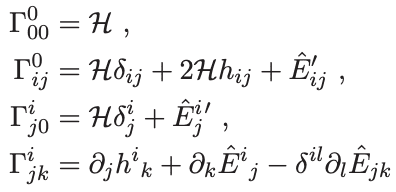
I presumed ##h_{ij}## is metric on the spatial slices i.e. ##h_{ij} = \delta_{ij} + 2\hat{E}_{ij}##, but that doesn't seem consistent with the above from what I worked out below. I reckon the notation ##\hat{E}_{ij}'## is supposed to be ##\partial_0 \hat{E}_{ij}##, but that I'm not totally sure about either. I'd worked out:\begin{align*}
\Gamma^0_{00} &= \frac{1}{2}g^{0m} \left( 2\partial_0 g_{m0} - \partial_m g_{00} \right) \\
&= \frac{1}{2} g^{00} \partial_0 g_{00} \\
&= \frac{1}{2} \cdot \frac{-1}{a^2} \cdot -2a \dot{a} = \frac{\dot{a}}{a} = \mathcal{H}
\\ \\
\Gamma^0_{ij} &= \frac{1}{2} g^{0m} \left( \partial_j g_{mi} + \partial_i g_{mj} - \partial_m g_{ij} \right) \\
&= \frac{1}{2} g^{00} \left( - \partial_0 g_{ij} \right) \\
&= \frac{-1}{2a^2} \left( -\partial_0 \left[a^2\left\{ \delta_{ij} + 2\hat{E}_{ij} \right\} \right] \right) \\
&= \frac{1}{2a^2} \left( 2a\dot{a} \left[ \delta_{ij} + 2\hat{E}_{ij} \right] + 2a^2 \hat{E}_{ij}' \right) \\
&= \mathcal{H} \left[ \delta_{ij} + 2\hat{E}_{ij} \right] + \hat{E}_{ij}'
\\ \\
\Gamma^i_{j0} &= \frac{1}{2} g^{im} \left( \partial_0 g_{mj} + \partial_j g_{m0} - \partial_m g_{j0} \right) \\
&= \frac{1}{2} g^{ik} \left( \partial_0 g_{kj} \right) \\
&= \frac{1}{2} g^{ik} \left( \partial_0 \left[ a^2 \left\{ \delta_{kj} + 2\hat{E}_{kj} \right\} \right] \right) \\
&= \frac{1}{2} g^{ik} \left( 2a \dot{a} \left[ \delta_{kj} + 2\hat{E}_{kj}\right] + 2a^2\hat{E}_{kj}' \right) \\
&= a^2 \mathcal{H} \left[ \delta^i_j + 2\hat{E}^i_j \right] + a^2{\hat{E}^{i}_j}' \\\\ \\
\Gamma^i_{jk} &= \frac{1}{2} g^{im}(\partial_k g_{mj} + \partial_j g_{mk} - \partial_m g_{jk}) \\
&= \frac{1}{2}g^{il} \left(\partial_k \left[ a^2 \left\{ \delta_{lj} + 2\hat{E}_{lj} \right\} \right] + \partial_j \left[ a^2 \left\{ \delta_{lk} + 2\hat{E}_{lk} \right\} \right] - \partial_l \left[ a^2 \left\{ \delta_{jk} + 2\hat{E}_{jk} \right\} \right]\right) \\
&= a^2 g^{il} \left(\partial_k \hat{E}_{lj} + \partial_j \hat{E}_{lk} - \partial_l \hat{E}_{jk} \right) \\
&= a^2 \left(\partial_k \hat{E}^i_{j} + \partial_j \hat{E}^i_{k} - g^{il} \partial_l \hat{E}_{jk} \right)
\end{align*}I don't really know what I'm doing wrong?
I presumed ##h_{ij}## is metric on the spatial slices i.e. ##h_{ij} = \delta_{ij} + 2\hat{E}_{ij}##, but that doesn't seem consistent with the above from what I worked out below. I reckon the notation ##\hat{E}_{ij}'## is supposed to be ##\partial_0 \hat{E}_{ij}##, but that I'm not totally sure about either. I'd worked out:\begin{align*}
\Gamma^0_{00} &= \frac{1}{2}g^{0m} \left( 2\partial_0 g_{m0} - \partial_m g_{00} \right) \\
&= \frac{1}{2} g^{00} \partial_0 g_{00} \\
&= \frac{1}{2} \cdot \frac{-1}{a^2} \cdot -2a \dot{a} = \frac{\dot{a}}{a} = \mathcal{H}
\\ \\
\Gamma^0_{ij} &= \frac{1}{2} g^{0m} \left( \partial_j g_{mi} + \partial_i g_{mj} - \partial_m g_{ij} \right) \\
&= \frac{1}{2} g^{00} \left( - \partial_0 g_{ij} \right) \\
&= \frac{-1}{2a^2} \left( -\partial_0 \left[a^2\left\{ \delta_{ij} + 2\hat{E}_{ij} \right\} \right] \right) \\
&= \frac{1}{2a^2} \left( 2a\dot{a} \left[ \delta_{ij} + 2\hat{E}_{ij} \right] + 2a^2 \hat{E}_{ij}' \right) \\
&= \mathcal{H} \left[ \delta_{ij} + 2\hat{E}_{ij} \right] + \hat{E}_{ij}'
\\ \\
\Gamma^i_{j0} &= \frac{1}{2} g^{im} \left( \partial_0 g_{mj} + \partial_j g_{m0} - \partial_m g_{j0} \right) \\
&= \frac{1}{2} g^{ik} \left( \partial_0 g_{kj} \right) \\
&= \frac{1}{2} g^{ik} \left( \partial_0 \left[ a^2 \left\{ \delta_{kj} + 2\hat{E}_{kj} \right\} \right] \right) \\
&= \frac{1}{2} g^{ik} \left( 2a \dot{a} \left[ \delta_{kj} + 2\hat{E}_{kj}\right] + 2a^2\hat{E}_{kj}' \right) \\
&= a^2 \mathcal{H} \left[ \delta^i_j + 2\hat{E}^i_j \right] + a^2{\hat{E}^{i}_j}' \\\\ \\
\Gamma^i_{jk} &= \frac{1}{2} g^{im}(\partial_k g_{mj} + \partial_j g_{mk} - \partial_m g_{jk}) \\
&= \frac{1}{2}g^{il} \left(\partial_k \left[ a^2 \left\{ \delta_{lj} + 2\hat{E}_{lj} \right\} \right] + \partial_j \left[ a^2 \left\{ \delta_{lk} + 2\hat{E}_{lk} \right\} \right] - \partial_l \left[ a^2 \left\{ \delta_{jk} + 2\hat{E}_{jk} \right\} \right]\right) \\
&= a^2 g^{il} \left(\partial_k \hat{E}_{lj} + \partial_j \hat{E}_{lk} - \partial_l \hat{E}_{jk} \right) \\
&= a^2 \left(\partial_k \hat{E}^i_{j} + \partial_j \hat{E}^i_{k} - g^{il} \partial_l \hat{E}_{jk} \right)
\end{align*}I don't really know what I'm doing wrong?
Last edited by a moderator:
