Could Induced Fission Be Achieved by Combining Proton and Electron Beams?

  • Thread starter Thread starter jlefevre76
  • Start date Start date
  • Tags Tags
    Fission Induced
Click For Summary

Discussion Overview

The discussion revolves around the feasibility of achieving induced fission by intersecting proton and electron beams to produce a neutron beam, which could then potentially induce fission in fissile materials like U235. Participants explore the theoretical implications, challenges, and existing knowledge related to neutron generation and nuclear reactions.

Discussion Character

  • Exploratory
  • Technical explanation
  • Debate/contested

Main Points Raised

  • One participant proposes that intersecting a high-energy proton beam with an electron beam could produce a neutron beam, which might induce fission in U235 or other materials.
  • Concerns are raised about the feasibility of this idea, particularly regarding the statistical likelihood of collisions and whether the energy gained from fission would exceed the energy required to generate it.
  • Another participant references neutron sources and their role in nuclear reactors, suggesting that a neutron source is essential to initiate a chain reaction.
  • There is a discussion about the distinction between reactor-grade and weapons-grade uranium, with emphasis on their differing U235 to U238 ratios and implications for nuclear reactions.
  • One participant challenges the understanding of the term "chain reaction" in the context of nuclear reactors, suggesting that it is often used differently compared to its use in nuclear weapons discussions.
  • Another participant asserts that the previous claims about nuclear reactors are substantially incorrect and suggests reviewing relevant literature for clarification.

Areas of Agreement / Disagreement

The discussion contains multiple competing views regarding the feasibility of using proton and electron beams for neutron generation and the nature of chain reactions in nuclear reactors. There is no consensus on the accuracy of the claims made about nuclear reactor processes.

Contextual Notes

Participants express uncertainty about the statistical aspects of particle collisions and the energy dynamics involved in induced fission. There are also unresolved details regarding the definitions and distinctions between types of nuclear reactions.

jlefevre76
Messages
119
Reaction score
6
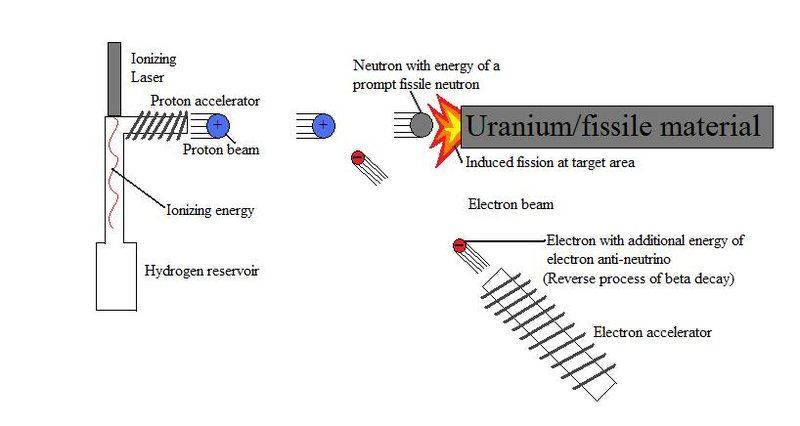
If you set up a proton beam, intersected the proton beam with an electron beam, and made sure the electron beam (or possibly the proton beam) was high enough energy to compensate for the missing electron anti-neutrino, could you produce a neutron beam?

Could the neutron beam then be used to induce fission in U235 or some other fissile material (or possible a non-fissile material)?

I've heard "cross sections" of particles make it difficult to produce collisions, so I'm wondering how feasible of an idea this would be. (Statistically, would they combine often enough to make it worth it in terms of energy released?) I know induced fission is physically possible, however, would you get a greater amount of energy from the fission than energy required to generate the fission when all variables are then accounted for? (I'm guessing if that were the case, we'd already have applications for it.) https://en.wikipedia.org/wiki/Uranium-235

I've drawn a figure to help describe the basic idea, please see the attached file.
?temp_hash=e0d5393b87ae6a18700b29d4fa26bdd0.jpg
 

Attachments

  • inducedfission.jpg
    inducedfission.jpg
    29.7 KB · Views: 688
  • ?temp_hash=e0d5393b87ae6a18700b29d4fa26bdd0.jpg
    ?temp_hash=e0d5393b87ae6a18700b29d4fa26bdd0.jpg
    29.7 KB · Views: 624
Last edited:
Engineering news on Phys.org
This article https://en.m.wikipedia.org/wiki/Neutron_source. discusses ways to generate neutrons including accelerators.

A neutron source is a required part of every reactor to kick things off. The chain reaction is the source thereafter.
 
anorlunda said:
This article https://en.m.wikipedia.org/wiki/Neutron_source. discusses ways to generate neutrons including accelerators.

A neutron source is a required part of every reactor to kick things off. The chain reaction is the source thereafter.
Understood, every nuclear reactor, as I understand, uses reactor grade uranium (higher U235 to U238 ratio). Rods of the reactor grade uranium are placed in graphite sleeves to act as a moderator (allows transmission of the neutrons from rod to rod). In the case of nuclear reactors, the uranium itself is a source of neutrons. Is that not correct? In the case of a nuclear reactor, we actually don't want a "chain reaction" if you mean chain reaction in the way it's usually used.
 
Last edited:
jlefevre76 said:
Understood, every nuclear reactor, as I understand, uses reactor grade uranium (higher U235 to U238 ratio). Rods of the reactor grade uranium are placed in graphite sleeves to act as a moderator (allows transmission of the neutrons from rod to rod). In the case of nuclear reactors, the uranium itself is a source of neutrons. Is that not correct? In the case of a nuclear reactor, we actually don't want a "chain reaction" if you mean chain reaction in the way it's usually used.

No, that is substantially wrong in the details. Try reading this first.
https://en.wikipedia.org/wiki/Nuclear_reactor#Fission
 
Surely they have to distinguish them by some means (they are two very different physical processes caused by varying rates of the reaction, as reactor grade uranium will contain 3-5% U235, and weapons grade 20-80%, according to Wikipedia). Perhaps runaway chain reaction versus controlled chain reaction? Subcritical versus supercritical might be an appropriate distinction (the article seems to indicate).

In either case, this is honestly the first time I've heard a nuclear reactor process to be called a "chain reaction." Technically, it is, I wasn't disagreeing with that point, I've only ever heard "chain reaction" used in the context of nuclear weapons.
 
Last edited by a moderator:
The question has been answered. Thread closed.
 

Similar threads

  • · Replies 1 ·
Replies
1
Views
2K
  • · Replies 46 ·
2
Replies
46
Views
16K
Replies
3
Views
4K
  • · Replies 9 ·
Replies
9
Views
4K
  • · Replies 7 ·
Replies
7
Views
2K
  • · Replies 12 ·
Replies
12
Views
5K
  • · Replies 1 ·
Replies
1
Views
2K
  • · Replies 3 ·
Replies
3
Views
8K
  • · Replies 4 ·
Replies
4
Views
3K
  • · Replies 4 ·
Replies
4
Views
2K