Coulomb's Law and point charges

Click For Summary

Homework Help Overview

The discussion revolves around a problem involving Coulomb's Law and the forces acting on two point charges suspended by threads. The original poster seeks to determine the angle θ formed by the threads due to the repulsive force between the charges.

Discussion Character

  • Exploratory, Assumption checking, Mathematical reasoning

Approaches and Questions Raised

  • Participants discuss the equilibrium of forces acting on the charges, with the original poster attempting to set up equations based on force balance. There is exploration of the geometry involved, particularly regarding the relationship between the angle θ and the distance r between the charges. Some participants suggest using trigonometric relationships to express r in terms of θ.

Discussion Status

The conversation is ongoing, with participants providing insights and corrections to each other's reasoning. There is a recognition of the need to clarify the relationships between the variables involved, particularly in light of the small angle approximation. Some participants are working through equations and seeking further assistance with numerical solutions.

Contextual Notes

There are indications of confusion regarding the values used in calculations, particularly in relation to the constants and parameters defined in the problem statement. Participants are encouraged to ensure they are using the correct data as per the original problem.

absolutezer0es
Messages
14
Reaction score
0
Two m = 6.0g point charges on 1.0-m-long threads repel each other after being charged to q = 120nC , as shown in the figure.

What is the angle θ? You can assume that θ is a small angle.
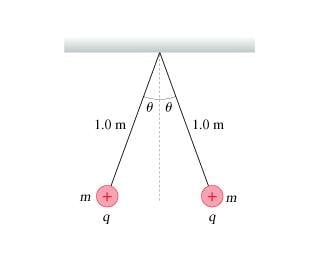
25_P58.jpg


Hopefully the image will work.

I feel like something is missing. I've gotten 7.4 and 3.4 degrees - both wrong. I know the sum of the forces in all directions must equal zero. My equations then are:

Fx = -Tsinθ+Felectric
Fy = Tcosθ - mg

We know m, g, and q. I know that coulomb's law is:

F = Kq^2/r^2 ... but we don't know r.

Any ideas?
 
Physics news on Phys.org
You are given the length of the string and the angle. Do you see a right triangle you could make in order to determine r?
 
Ah, yes ... a little clearer now.

So sinθ = r/1 = r. Alright let me run with that. Let's see if I can get it now.

Thanks for the nudge!
 
Wait! Are you sure ##\sin{\theta}=r##? Remember ##r## is the distance between the charges...
 
When I replied, I realized I made a mistake, like you said. It's not r, but rather r/2!

I was able to boil down the equation to:

(sinθ)^2*(tanθ) = kq^2/(4mg)

I'm pretty sure you can't boil it down anymore than that, so I used my old grapher to find the intersection point between both sides.

Got it!

Thanks a ton Zeta! I appreciate the insight!
 
absolutezer0es said:
When I replied, I realized I made a mistake, like you said. It's not r, but rather r/2!

I was able to boil down the equation to:

(sinθ)^2*(tanθ) = kq^2/(4mg)

I'm pretty sure you can't boil it down anymore than that, so I used my old grapher to find the intersection point between both sides.

Got it!

Thanks a ton Zeta! I appreciate the insight!
You can actually do it withOUT using a graph. Note the hint: you may assume that the angle is small. In that approximation, what can you say about ## \tan \theta ## and ##\sin \theta ## ?
 
nrqed said:
You can actually do it withOUT using a graph. Note the hint: you may assume that the angle is small. In that approximation, what can you say about ## \tan \theta ## and ##\sin \theta ## ?
Can you help? I worked through this and plugged my numbers in but when I try to solve for theta I don't get any kind of real number. Here's what I put in Wolfram Alpha:
http://www.wolframalpha.com/input/?...*(8*10^-9)^2/(4*4*10^-3*9.8)+for+x+in+degrees

Thanks!
 
danielhep said:
Can you help? I worked through this and plugged my numbers in but when I try to solve for theta I don't get any kind of real number. Here's what I put in Wolfram Alpha:
http://www.wolframalpha.com/input/?i=(sin(x))^2*tan(x)=8.99*10^9*(8*10^-9)^2/(4*4*10^-3*9.8)+for+x+in+degrees

Thanks!
Wolfram says:

upload_2017-3-10_4-10-49.png


Can you explain those numbers? I recognize k and g but the rest is a mystery given the data in the problem statement of post #1.

If you are actually working on a different problem with different data please start a new thread of your own. Hijacking old threads is against the rules.
 

Similar threads

Replies
17
Views
3K
Replies
5
Views
1K
Replies
21
Views
2K
  • · Replies 5 ·
Replies
5
Views
2K
  • · Replies 6 ·
Replies
6
Views
2K
Replies
5
Views
2K
Replies
6
Views
9K
  • · Replies 1 ·
Replies
1
Views
2K
  • · Replies 4 ·
Replies
4
Views
1K
  • · Replies 8 ·
Replies
8
Views
6K