Coupled oscillators -- period of normal modes

Click For Summary
SUMMARY

The discussion focuses on the analysis of coupled oscillators with two masses, deriving the normal modes: the pendulum mode and the breathing mode. The equations of motion are established using Newton's laws, leading to the angular frequencies defined as ##\omega_p = \sqrt{\frac{g}{l}}## and ##\omega_b = \sqrt{\frac{g}{l} + \frac{2k}{m}}##. The participants clarify the relationship between the period of oscillation and the parameters k and m, with a specific example of a period of 1.5 seconds provided to determine the ratio k/m. The final expression for ##\omega_b## is confirmed to be ##\omega_b = \sqrt{8.2 + 2(\frac{2\pi}{1.5})^2}##.

PREREQUISITES
  • Understanding of Newton's laws of motion
  • Familiarity with oscillatory motion and angular frequency
  • Knowledge of coupled oscillators and normal modes
  • Basic grasp of spring constants and mass-spring systems
NEXT STEPS
  • Study the derivation of normal modes in coupled oscillators
  • Learn about the physical interpretation of angular frequency in oscillatory systems
  • Explore the relationship between period and frequency in harmonic motion
  • Investigate the effects of varying mass and spring constant on oscillation periods
USEFUL FOR

Physics students, mechanical engineers, and anyone studying dynamic systems involving oscillations and coupled oscillators.

happyparticle
Messages
490
Reaction score
24
Homework Statement
I have to determine the periods of the normal modes.

I have 2 mass ##m_1 = m_2##, l = 1.2m and if I hold vertically one of the mass the period of the other mass is 1.5s.
Relevant Equations
F = ma

##m\ddot x = -\frac{mgx_1}{l} -k(x_1 - x_2)##
##m\ddot x_2 = -\frac{mgx_2}{l} +k(x_1 - x_2)##
Hi,

I know there's are 2 normal modes because the system has 2 mass. I did the Newton's law for both mass.

##m\ddot x_1 = -\frac{mgx_1}{l} -k(x_1 - x_2)## (1)
##m\ddot x_2 = -\frac{mgx_2}{l} +k(x_1 - x_2)## (2)

In the pendulum mode ##x_1 = x_2## and in the breathing mode ##x_1 = -x_2##

I get the pendulum and breathing mode by adding equation 1 and 2 and subtracting 1 and 2 then I replace ##x_1-x_2## by q2 and ##x_1+x_2## by q1.
Finally I have ##\omega_p = \sqrt{\frac{g}{l}}## and ##\omega_b = \sqrt{\frac{g}{l} + \frac{2k}{m}}##
It's quite easy to get the period for ##\omega_p##. However, I'm not sure how to find the period for ##\omega_b##, since I don't have k and m.
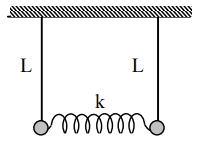
LmU6yJh.png
 
Last edited by a moderator:
Physics news on Phys.org
You will need to supply a diagram or a full description of the physical arrangement. In particular, I am confused regarding whether these x displacements are horizontal or vertical.
 
haruspex said:
You will need to supply a diagram or a full description of the physical arrangement. In particular, I am confused regarding whether these x displacements are horizontal or vertical.
My bad, sorry. I uploaded an image.
 
EpselonZero said:
My bad, sorry. I uploaded an image.
Doesn't this tell you k/m?
"if I hold vertically one of the mass the period of the other mass is 1.5s."
 
  • Like
Likes   Reactions: happyparticle
haruspex said:
Doesn't this tell you k/m?
"if I hold vertically one of the mass the period of the other mass is 1.5s."

I need to find the period for the normal modes. I don't see the link between 1.5s and the normal modes.
 
EpselonZero said:
I need to find the period for the normal modes. I don't see the link between 1.5s and the normal modes.
You wrote that what was blocking you was that you did not know k/m.
What wouid the period be if you suspended one of the masses from the other and let it oscillate vertically?
 
I see...

Can I plug ##\frac{1.5}{2\pi}## to find ##\omega_b##?

It seems too easy.
 
EpselonZero said:
I see...

Can I plug ##\frac{1.5}{2\pi}## to find ##\omega_b##?

It seems too easy.
not quite that simple... it tells you k/m. Your equation for ##\omega_b## has another term
 
##\omega_b = \sqrt{\frac{g}{l} + \frac{2k}{m}}##
##g = 9.8## and ##l = 1.2##

##\omega_b = \sqrt{8.2 + 2(\frac{1.5}{2pi})}##

Is it correct?
 
  • #10
EpselonZero said:
##\omega_b = \sqrt{\frac{g}{l} + \frac{2k}{m}}##
##g = 9.8## and ##l = 1.2##

##\omega_b = \sqrt{8.2 + 2(\frac{1.5}{2pi})}##

Is it correct?
Doesn’t look right to me.
What is the expression for the period of a mass on a spring?
 
  • #11
Right, I made a mistake.

##\omega_b = \sqrt{8.2 +2(\frac{2\pi}{1.5})^2}##
 
  • #12
EpselonZero said:
Right, I made a mistake.

##\omega_b = \sqrt{8.2 +2(\frac{2\pi}{1.5})^2}##
Right.
 
  • Like
Likes   Reactions: happyparticle

Similar threads

Replies
4
Views
2K
  • · Replies 16 ·
Replies
16
Views
2K
  • · Replies 3 ·
Replies
3
Views
958
  • · Replies 1 ·
Replies
1
Views
1K
Replies
1
Views
1K
Replies
2
Views
2K
Replies
42
Views
3K
Replies
5
Views
2K
  • · Replies 7 ·
Replies
7
Views
2K
Replies
1
Views
1K