Crank/Piston Motion: Understanding dB/dt, dB/dθ & d2B/dT2

  • Context: MHB 
  • Thread starter Thread starter tomc612
  • Start date Start date
  • Tags Tags
    Motion
Click For Summary
SUMMARY

The forum discussion centers on the mathematical relationships governing crank/piston motion, specifically the derivatives dB/dt and dB/dθ. Participants derive formulas using the Law of Cosines and chain rule, leading to the conclusion that dB/dt = K * dB/dθ, where K represents the angular velocity in radians/sec. The final formula for dB/dt is expressed as -ak * sin(θ)(1 + (a * cos(θ) / √(c² - a² * sin²(θ)))), providing a comprehensive understanding of the motion dynamics involved.

PREREQUISITES
  • Understanding of crank/piston dynamics
  • Familiarity with calculus, specifically differentiation and the chain rule
  • Knowledge of the Law of Cosines
  • Basic algebra for solving inequalities and quadratic equations
NEXT STEPS
  • Explore advanced applications of the Law of Cosines in mechanical systems
  • Study optimization techniques in calculus for constrained variables
  • Learn about the implications of angular velocity in mechanical engineering
  • Investigate the use of implicit differentiation in real-world engineering problems
USEFUL FOR

Mechanical engineers, physics students, and anyone involved in the analysis of kinematic systems will benefit from this discussion, particularly those focusing on crank/piston mechanisms and their mathematical modeling.

tomc612
Messages
17
Reaction score
0
Hi,
Looking for some help on a crank/piston motion equation..

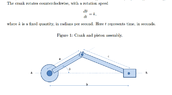
If a crank rotates counter clockwise measured in Radians/sec -as d\theta/dt = K T = time in secs

The arms of the crank A and B are fixed and B is the stroke length with \theta as the angle between A and B
So far I've got that B = Acos\theta + \sqrt{C^2 -(Asin\theta)^2}

Min/max for B is at \theta = 0, Pi, 2Pi.

Q. What is the relationship between dB/dt and dB/d\theta -
A. is this that dB/dT = d\theta/dT x dB/d\theta?

Q. obtain a formula for dB/dT. Answer should be in terms of A, C, \theta and K
A. dB/d\theta = -Asin\theta+ A^2sin\thetacos\theta/\sqrt{C^2 -(Asin\theta)^2}

So my question is dB/dt then simply the the above formula for dB/d\theta x K
=K(-Asin\theta+ A^2sin\thetacos\theta/\sqrt{C^2 -(Asin\theta)^2})

Q. Obtain a formula for d^2B/dT^2
A. if K is constant is that then second derivative of B x K
= B".K
Haven't got to working out the second derivative of B just yet,

any advice appreciated
Thanks
TomView attachment 6151
 

Attachments

  • Screen Shot 2016-11-02 at 8.03.20 pm.png
    Screen Shot 2016-11-02 at 8.03.20 pm.png
    15 KB · Views: 132
Physics news on Phys.org
Hello Tom,

I think what I would do here is first use the Law of Cosines to determine $b$:

$$c^2=a^2+b^2-2ab\cos(\theta)$$

Arrange in standard quadratic form:

$$b^2-2a\cos(\theta)b+a^2-c^2=0$$

Apply the quadratic formula, and discard the negative root (since we must have $c>a$):

$$b=\frac{2a\cos(\theta)+\sqrt{4a^2\cos^2(\theta)+4(c^2-a^2)}}{2}=a\cos(\theta)+\sqrt{c^2-a^2\sin^2(\theta)}$$

This agrees with your result.

Q. What is the relationship between $$\d{b}{t}$$ and $$\d{b}{\theta}$$?

Using the chain rule, we may state:

$$\d{b}{t}=\d{b}{\theta}\cdot\d{\theta}{t}$$

We are given:

$$\d{\theta}{t}=k$$

Therefore, we obtain:

$$\d{b}{t}=k\d{b}{\theta}$$

This is where you were headed, but you didn't make the substitution for $k$.

Q. Obtain a formula for $$\d{b}{t}$$. Answer should be in terms of $a$, $c$, $\theta$ and $k$.

Okay, given that we found:

$$b(\theta)=a\cos(\theta)+\sqrt{c^2-a^2\sin^2(\theta)}$$

Differentiating w.r.t $\theta$, there results:

$$\d{b}{\theta}=-a\sin(\theta)+\frac{1}{2}(c^2-a^2\sin^2(\theta))^{-\frac{1}{2}}(-2a^2\sin(\theta)\cos(\theta))=-a\sin(\theta)\left(1+\frac{a\cos(\theta)}{\sqrt{c^2-a^2\sin^2(\theta)}}\right)$$

And so, using our result from the first question, we have:

$$\d{b}{t}=-ak\sin(\theta)\left(1+\frac{a\cos(\theta)}{\sqrt{c^2-a^2\sin^2(\theta)}}\right)$$

Now, before we move on to the final question, we can observe that our computation will be simpler if we write:

$$\d{b}{t}=\frac{abk\sin(\theta)}{a\cos(\theta)-b}$$

Now we may apply the quotient and chain rules as appropriate. :D
 
Hi Thanks for the help, glad to see I wasn't too far off.

One thing for the formula for B, i reached the formula by creating 'h' to represent the height of the joint of A+C, and then split B in B1 and B2 at h to create to right angle triangles.

B=B1 + B2
B1 = Acos\theta
B2 = \sqrt{C^2 -h^2}
h = Asin\theta
B2 =\sqrt{C^2 -(Asin\theta)^2}
b = Acos\theta +\sqrt{C^2 -(Asin\theta)^2}
 
MarkFL said:
Hello Tom,

I think what I would do here is first use the Law of Cosines to determine $b$:

$$c^2=a^2+b^2-2ab\cos(\theta)$$

Arrange in standard quadratic form:

$$b^2-2a\cos(\theta)b+a^2-c^2=0$$

Apply the quadratic formula, and discard the negative root (since we must have $c>a$):

$$b=\frac{2a\cos(\theta)+\sqrt{4a^2\cos^2(\theta)+4(c^2-a^2)}}{2}=a\cos(\theta)+\sqrt{c^2-a^2\sin^2(\theta)}$$

This agrees with your result.

Q. What is the relationship between $$\d{b}{t}$$ and $$\d{b}{\theta}$$?

Using the chain rule, we may state:

$$\d{b}{t}=\d{b}{\theta}\cdot\d{\theta}{t}$$

We are given:

$$\d{\theta}{t}=k$$

Therefore, we obtain:

$$\d{b}{t}=k\d{b}{\theta}$$

This is where you were headed, but you didn't make the substitution for $k$.

Q. Obtain a formula for $$\d{b}{t}$$. Answer should be in terms of $a$, $c$, $\theta$ and $k$.

Okay, given that we found:

$$b(\theta)=a\cos(\theta)+\sqrt{c^2-a^2\sin^2(\theta)}$$

Differentiating w.r.t $\theta$, there results:

$$\d{b}{\theta}=-a\sin(\theta)+\frac{1}{2}(c^2-a^2\sin^2(\theta))^{-\frac{1}{2}}(-2a^2\sin(\theta)\cos(\theta))=-a\sin(\theta)\left(1+\frac{a\cos(\theta)}{\sqrt{c^2-a^2\sin^2(\theta)}}\right)$$

And so, using our result from the first question, we have:

$$\d{b}{t}=-ak\sin(\theta)\left(1+\frac{a\cos(\theta)}{\sqrt{c^2-a^2\sin^2(\theta)}}\right)$$

Now, before we move on to the final question, we can observe that our computation will be simpler if we write:

$$\d{b}{t}=\frac{abk\sin(\theta)}{a\cos(\theta)-b}$$

Now we may apply the quotient and chain rules as appropriate. :D
Hi, Also need some help on a following question to this same problem.

need work on optimisation for the values of A+B

I tried optimising by implicit differentiation of a right and angled triangle, however the values I get are out side of the given range

12. we change the values of a and c, subject to the following requirements:
a + c = 30; and 2\le  c- 􀀀 \lea  10:
(a) What is the smallest possible value for a? What is the largest possible value for a?
Justify.
 
What is this line supposed to say?

tomc612 said:
...a + c = 30; and 2\le  c- 􀀀 \lea  10:...
 
MarkFL said:
What is this line supposed to say?

Sorry, the question should read:

View attachment 6187
 

Attachments

  • Screen Shot 2016-11-13 at 3.30.54 pm.png
    Screen Shot 2016-11-13 at 3.30.54 pm.png
    11 KB · Views: 105
Okay, we are given:

$$c=30-a$$

And:

$$2\le c-a\le10$$

Substitute for $c$:

$$2\le 30-a-a\le10$$

Simplify:

$$2\le 30-2a\le10$$

You should be able to algebraically show this is equivalent to:

$$10\le a\le14$$
 

Similar threads

  • · Replies 7 ·
Replies
7
Views
429
  • · Replies 1 ·
Replies
1
Views
2K
  • · Replies 2 ·
Replies
2
Views
1K
  • · Replies 4 ·
Replies
4
Views
2K
  • · Replies 2 ·
Replies
2
Views
2K
  • · Replies 11 ·
Replies
11
Views
2K
  • · Replies 1 ·
Replies
1
Views
2K
  • · Replies 5 ·
Replies
5
Views
2K
  • · Replies 8 ·
Replies
8
Views
2K
  • · Replies 5 ·
Replies
5
Views
8K
