Cubic approximation multivariable taylor series

Click For Summary
SUMMARY

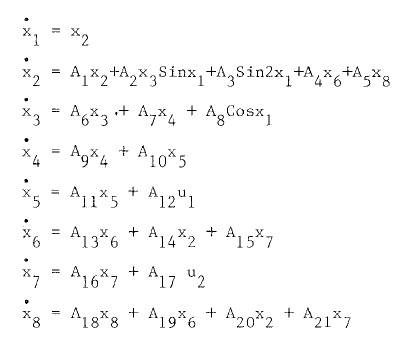
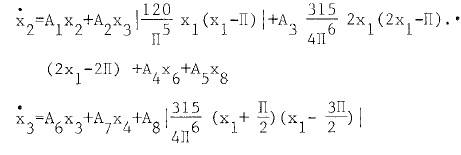
The discussion centers on the confusion surrounding the application of Taylor expansions in the context of state space equations. The original poster seeks clarification on the Taylor expansion of equations X'1 to X'8 and the derivation of coefficients A0, ΔA1, ΔA3, and ΔA11. A key point raised is that the approximations for sine and cosine functions presented are not true Taylor expansions but rather least-squares approximations, which have been identified as inaccurate for certain cases. The community emphasizes the need for correct mathematical formulation and suggests plotting functions to validate approximations.

PREREQUISITES
  • Understanding of Taylor series and their applications in mathematics.
  • Familiarity with state space equations in control theory.
  • Knowledge of least-squares approximation techniques.
  • Basic proficiency in plotting functions for visual analysis.
NEXT STEPS
  • Study the derivation and application of Taylor series in multivariable calculus.
  • Learn about least-squares approximation methods and their mathematical foundations.
  • Explore the implications of state space representation in control systems.
  • Practice plotting mathematical functions to compare approximations with actual functions.
USEFUL FOR

Mathematicians, control engineers, students in applied mathematics, and anyone involved in numerical methods or approximation techniques will benefit from this discussion.
abdooo89
Messages
20
Reaction score
0
hi everyone , i don't understand these steps for Taylor Expansion , it has used for state space equations
the equations are

image.jpg


the approximations for sin and cos

image.jpg


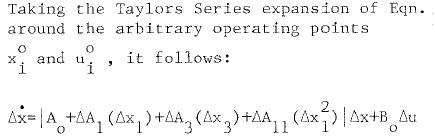
the equation for Taylor series is ( i don't understand at all )

image.jpg

image.jpg

image.jpg

image.jpg


please help me if you can
 
Physics news on Phys.org
please help me
 
Perhaps people need more help to understand what you are saying. You say "I don't understand these steps for Taylor expansion". The Taylor expansion of what function? And you have "taking the Taylor expansion of Eqn." Of what equation? There seems to be a lot here you are telling us.
 
taking the Taylor expansion of Eqn ,

i mean equations ( X'1 to X'8 )

after that Taylor expansion has been taken like that

ΔX'={ A0 + ΔA1(ΔX1)+ΔA3(ΔX3)+ΔA11(ΔX1^2))ΔX+B0 Δu → ( xx)


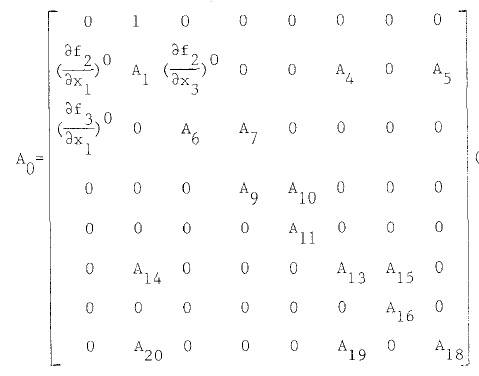
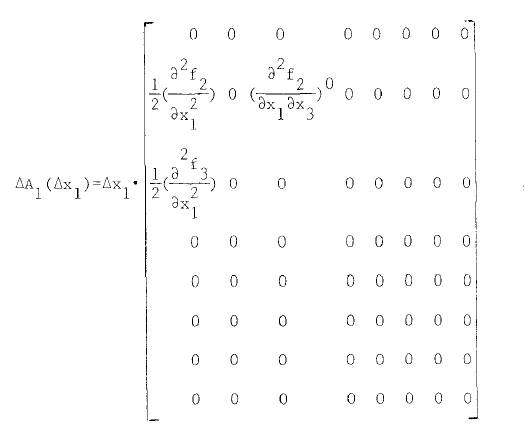
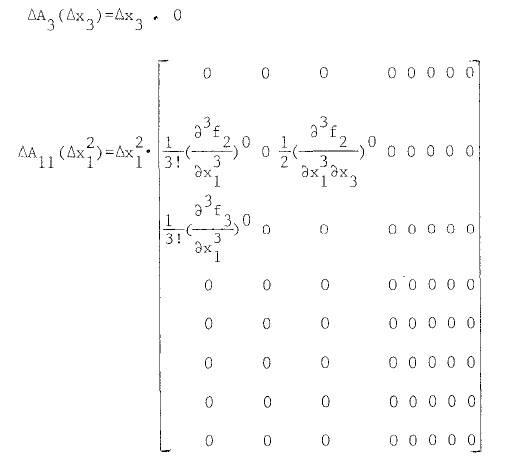
i don't understand equation ( xx = taylor expansion ) , and how can i get A0 , ΔA1 , ΔA3, ΔA11

i mean which rule they used to get A0 , ΔA1 , ΔA3, ΔA11

the complete file has been attached
 

Attachments

Last edited:
abdooo89 said:
taking the Taylor expansion of Eqn ,

i mean equations ( X'1 to X'8 )

after that Taylor expansion has been taken like that

ΔX'={ A0 + ΔA1(ΔX1)+ΔA3(ΔX3)+ΔA11(ΔX1^2))ΔX+B0 Δu → ( xx)


i don't understand equation ( xx = taylor expansion ) , and how can i get A0 , ΔA1 , ΔA3, ΔA11

i mean which rule they used to get A0 , ΔA1 , ΔA3, ΔA11

the complete file has been attached


The author is NOT (at least initially) using Taylor expansions. He uses approximations of the form
\sin x_1 \approx p_1(x_1) \equiv \frac{120}{\pi^5} x_1 (x_1 - \pi )\\<br /> \sin 2x_1 \approx p_2(x_1) \equiv \frac{315}{4 \pi^6} (2 x_1 - \pi)(2 x_1 – 2 \pi)\\<br /> \cos x_1 \approx p_3(x_1) \equiv \frac{315}{4 \pi^6} (x_1 + \frac{\pi}{2}) (x_1 - \frac{3 \pi}{2})<br />
etcetera. These are not Taylor expansions; if you read carefully you will see that he makes it clear in the article that he claims he is using a form of least-squares approximation to ##\sin x_1##, etc. However, it appears the author makes some errors; he should have
\sin x_1 \approx \frac{120}{\pi^5} x_1 (\pi - x_1)
with sign opposite sign to what he writes; if you plot the two functions you will see that the approximation is not too bad over the interval ##x \in [0,\pi]##. However, the approximations ##p_2## and ##p_3## are horrible: they do not resemble the functions ##\sin 2x_1## and ##\cos x_1## at all, as you can see by plotting them.
 
First, thank you for your reply, secondly I want to know if this approximations (p2 and p3) are not valid or horrible as you say, what is your advice for me to do?

and why ΔA3 =0
 
Last edited:
no one want to help me?
 

Similar threads

  • · Replies 2 ·
Replies
2
Views
2K
Replies
2
Views
2K
  • · Replies 5 ·
Replies
5
Views
3K
  • · Replies 3 ·
Replies
3
Views
1K
  • · Replies 13 ·
Replies
13
Views
2K
  • · Replies 11 ·
Replies
11
Views
3K
  • · Replies 5 ·
Replies
5
Views
1K
  • · Replies 1 ·
Replies
1
Views
2K
  • · Replies 14 ·
Replies
14
Views
3K
  • · Replies 1 ·
Replies
1
Views
2K