Current change after inserting thin conductive foil into resistor

6 replies · 2K views · last reply
student_man
Messages
4
Reaction score
1
Homework Statement
Given are two square parallel metal plates, with dimensions a×a whose distance between them is d where d≪a. The space between the plates is filled with a conductive liquid with resistivity p. The plates are connected to a constant voltage source U. How much will the current through the plates change when a conductive foil is inserted into the space between the plates and bent in the middle as shown in the figure? The current at any point between the plates flows in the direction perpendicular to the plane of the upper plate.
Relevant Equations
Circuit attached
I tried splitting it up into 4 individual resistors, adding them up (each side serially and then both sides with each other as parallel) and then using V=IR but it ended up being the same current as the original.
(The answer should end up being (9/8)* the original current)
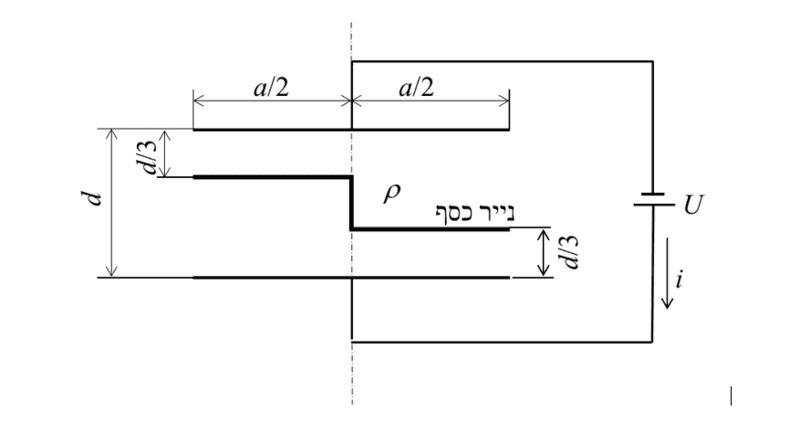
Circuit schematic of a rectangular conducting region with length a and gap d, a dash-dot symmetry axis through the middle, a thin foil on the left at depth d/3 and a bent foil on the right, labeled rho, a battery U, and current i.
 
student_man said:
Homework Statement: Given are two square parallel metal plates, with dimensions a×a whose distance between them is d where d≪a. The space between the plates is filled with a conductive liquid with resistivity p. The plates are connected to a constant voltage source U. How much will the current through the plates change when a conductive foil is inserted into the space between the plates and bent in the middle as shown in the figure? The current at any point between the plates flows in the direction perpendicular to the plane of the upper plate.
Relevant Equations: Circuit attached

I tried splitting it up into 4 individual resistors, adding them up (each side serially and then both sides with each other as parallel) and then using V=IR but it ended up being the same current as the original.
(The answer should end up being (9/8)* the original current)View attachment 333071
Welcome to PF.

Interesting problem! Can you show your math where you ended up getting the same overall current?
 
berkeman said:
Welcome to PF.

Interesting problem! Can you show your math where you ended up getting the same overall current?
Here is my math
Handwritten derivation on grid paper: left, a resistor network of R1 to R4 with a foil inserted at mid-height; centre, a split block diagram with dimensions d/2 and d/3; right, series and parallel combination steps leading to R = R_og.

I hope it's understandable : )
 
berkeman said:
I believe you left out the horizontal short-circuiting wire between the for 4 resistors... :wink:
I'm not really sure how to take it into consideration in the equations😅
The only information I'm given about the piece of foil is that it's conductive.
 
The foil is an equipotential. It is a zero ohms link across a bridge of four resistors. Solve parallel then series, not series the parallel.
 
Baluncore said:
The foil is an equipotential. It is a zero ohms link across a bridge of four resistors. Solve parallel then series, not series the parallel.
Thank you! :biggrin: