Current requires a closed loop to flow in DC, not AC?

Click For Summary
Current requires a closed loop to flow in both DC and AC circuits, despite some misconceptions. In AC circuits, while current can appear to flow without a closed loop, it actually relies on the principles of capacitance and inductance, which can create effective closed loops at high frequencies. When a capacitor is charged, it stores energy in an electric field, and as it discharges, this energy transfers through resistors in the circuit. The discussion emphasizes the importance of adhering to Kirchhoff's laws for understanding current flow, particularly in basic circuit analysis, while noting that stray capacitance can influence current behavior. Overall, a thorough understanding of circuit dynamics is essential for accurate analysis and application.
x86
Gold Member
Messages
256
Reaction score
18
It is my general understanding that according to KCL, current requires a closed loop to flow in DC. However, this is apparently not true in AC; current doesn't needa closed loop to flow.

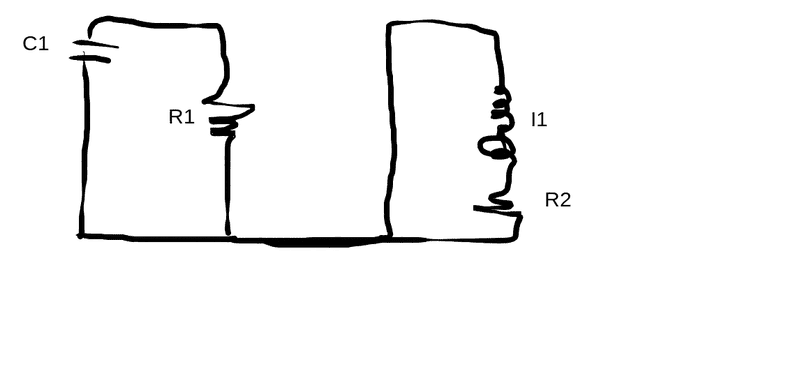
I have drawn a circuit below which causes confusion:
Drawing_8.png

C1 is a charge capacitor, R1 is a resistor, I1 an inductor, and R2 another resistor, the bottom part of the circuit is the reference, with R2 << R1.

Suppose C1 is fully charged in the above circuit. What is supposed to happen is that all of its charge will leave and flow through R1.

Suppose that we add some kind of AC voltage source to make the voltage across I1 and R2 not zero. So now both parts of the circuit have current flowing between them.

My question is this: will any current from the capacitor go into the second part of the current, across the straight line at the bottom?

Will any current from the right loop go across the line at the bottom, to the left loop? Will any current from the left loop go to the right loop?

Since AC doesn't require a closed loop for current to flow, shouldn't the answer to that question be "YES" ?
 
Last edited:
Engineering news on Phys.org
Lets assume we are not discussing electromagentic radiation and propagation (like radio antennas and transformers), but rather current flow through wires.
AC requires a closed loop for current to flow, just like DC. But, capacitors and inductors are not "open circuits".

When C1 is charged, it contains a field between its plates (which is kind of an exception to my above assumption) which stores energy (somewhat like a battery). Work was performed to produce that field. As current flows through R1, the field collapses to 0, and the work done to produce the field is transferred to R1.

When a capacitor "conducts" AC, it does so by charging the capacitor on 1 half cycle, then discharging and recharging on the other half. The current actually leads the voltage by 90 degrees. When the AC voltage peaks (assuming a sine wave) the current is actually 0. There are no electrons flowing completely through the circuit. The electrons flow into one plate, building up a field, then back out as the field collapses.

Whatever is happening in the two sides of your circuit is not affected by the single common wire. There is no potential across that wire, so no current flows.

http://www.allaboutcircuits.com/vol_2/chpt_4/2.html
 
Last edited:
  • Like
Likes x86
x86 said:
Since AC doesn't require a closed loop for current to flow,

Learn to "Freeze Frame" your thinking.

At any instant, AC is DC. So it requires a closed loop.

Antennas are a special case and it could be argued that the loop is closed through the capacitance of the universe.

For ordinary circuits, KCL holds. As meBigGuy said.
 
  • Like
Likes x86
Pedantically current only flows through closed circuits. Reality is more complex.

It is important to understand electricity doesn't move through wires, but around them. The energy is in the magnetic field around the wire and the electric field between the wire and ground (current still flows through the wire, but not energy). Every wire has both capacitance and inductance. The capacitive and inductive effects can couple energy across gaps. For low frequencies these effects are usually so small they can be ignored, but at high frequencies they can become quite significant. Circuits can sometimes even use the effects of gaps as tuning elements, etc. Yet these gaps can be treated as capacitors or transformers, so the rules still hold, sort of.

Antennas work by a different principal.
 
  • Like
Likes x86
x86: my advice is stick with Kirchoff until you're ready for Maxwell.
 
x86 said:
My question is this: will any current from the capacitor go into the second part of the current, across the straight line at the bottom?

Let us add to your circuit
one voltage source
and a capacitor representing the capacitance between the two loops. Stray capacitance exists but at ordinary frequencies is too small to pass significant current.
It exists because real wires and resistors and coils have surface area, and area/distance between conductive surfaces is capacitance. Remember εA/D ?

So in your circuit as you drew it, no current traverses that straight wire joining the two loops.

But when you add the effect of stray capacitance, you create a closed loop around which current can flow per laws of Kirchoff and Ohm.

Cstray.jpg


So it's back to "To what degree do you wish to push your analysis?"

In beginning circuit courses it is important to develop rigor in thought.
If professsor doesn't ask for paths through air, don't complicate your work by including them. That'll come when you get into RF design.

In this picture, the aluminum plate next to the radio tube is a "neutralizing capacitor" installed to create an intentional 'not so stray ' capacitance . Sometimes you'll see just a wire standing adjacent the tube - don't bend it it was adjusted at the factory ! Its purpose is to "neutralize" the effect of other stray capacitance(s)., observe the large metal "plate" inside the tube with its considerable area...
cap%20poss.jpg


Always stick with Kirchoff. At beginning of our studies , developing rigor in our work habits is more important than wandering off into pedantic details.
 
  • Like
Likes x86
jim hardy said:
Learn to "Freeze Frame" your thinking.

At any instant, AC is DC. So it requires a closed loop.

This is a good way to put it!
 

Similar threads

  • · Replies 2 ·
Replies
2
Views
2K
  • · Replies 12 ·
Replies
12
Views
4K
  • · Replies 19 ·
Replies
19
Views
6K
  • · Replies 4 ·
Replies
4
Views
2K
  • · Replies 10 ·
Replies
10
Views
4K
Replies
13
Views
3K
  • · Replies 14 ·
Replies
14
Views
2K
  • · Replies 15 ·
Replies
15
Views
2K
  • · Replies 26 ·
Replies
26
Views
7K
Replies
4
Views
2K