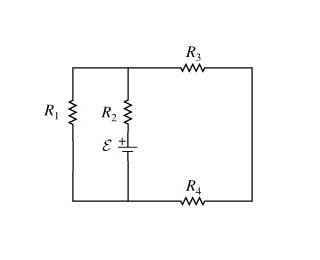
Current through each individual resistor of a circuit

Click For Summary

Homework Help Overview

The discussion revolves around determining the current through individual resistors in a circuit, specifically focusing on the application of Ohm's law and Kirchhoff's laws. The original poster has calculated the equivalent resistance and current for the circuit but is struggling to find the individual currents for each resistor.

Discussion Character

  • Exploratory, Conceptual clarification, Mathematical reasoning

Approaches and Questions Raised

  • The original poster attempts to calculate individual currents based on the equivalent current and resistance values but questions the accuracy of their results. Some participants suggest providing more details about the resistor values and current calculations, while others emphasize the importance of using the correct voltage across each resistor rather than a single voltage value.

Discussion Status

Participants are actively engaging in clarifying the calculations and assumptions made by the original poster. Some guidance has been offered regarding the application of Kirchhoff's laws and the need to consider voltage drops across individual resistors. There is an ongoing exploration of the relationships between the components in the circuit.

Contextual Notes

The original poster has provided the values for the resistors and the battery voltage, but there is a noted confusion regarding the application of voltage across each resistor in the context of series and parallel configurations. The discussion highlights potential misunderstandings about how to apply circuit laws correctly.

Linus Pauling
Messages
187
Reaction score
0
1.
1082045.jpg


What is the current through each resistor


2. All the obvious stuff...


3. Ok, without showing all my work, here's what I have solved and know is right:

The equivalent resistance of the whole circuit is 56.3 ohm. From this, I used Ohm's law to get the equivalent current for the circuit, which is 0.213A.

Where I am stuck is now using this to get the individual currents for each resistor. For example, I calculated I_2 = V/R_2 = 12V/45ohm = 0.27A

Similarly, I found found the others, so here's what I got (which is incorrect):

I_1 = 0.8A
I_2 = 0.27
I_3 = 0.48
I_4 = 0.6

Also, I notice that these values sum to 2.12, which approximately euqals 2.13, which is the equivalent current with the decimal point moved over... where am I going wrong?
 
Physics news on Phys.org
It would help to show the values of each resistor and also showing the details for your current calculations.
 
Ahh, sorry for that:

V_bat = 12V
R1 = 15ohm
R2 = 45
R3 = 25
R4 = 20

My calculated values for the equivalent resistance and current of the circuit are correct. Briefly, R3 and 4 are in series, equiv resistor is in parallel with R1, and that equiv resistor is in series with R2.
 
I've noticed in several of your circuit threads you keep making the same mistake. You can't just plug in 12 volts for V for every resistor. You have to use the actual voltage across the resistor.

In the equivalent circuit, you found that the current through the battery is 0.213 A, right? Because R2 and the battery are connected in series, the current through them must be equal. Now that you know that the current through R2 is 0.213 A, you can apply Ohm's law to calculate the voltage drop across the resistor, V=(0.213 A)(45 Ω)=9.59 V. The direction of the voltage drop is from the end where the current enters the resistor to the end where it leaves the resistor.

Now apply Kirchoff's voltage law to the lefthand loop to find the voltage across R1. Once you know that, use Ohm's law to find the current through R1.

Then you can apply Kirchoff's current law to the top node. Since you know how much current entered via R2 and how much current left through the left branch, you can determine the amount that must have gone through the right branch. R3 and R4 are in series, so the same current flows through each.

As a check, you should calculate the voltage drop across R3 and R4 and make sure Kirchoff's voltage law holds for the righthand loop. If it doesn't, you made a mistake somewhere.
 

Similar threads

  • · Replies 2 ·
Replies
2
Views
2K
  • · Replies 13 ·
Replies
13
Views
1K
Replies
7
Views
1K
  • · Replies 6 ·
Replies
6
Views
2K
  • · Replies 6 ·
Replies
6
Views
2K
  • · Replies 16 ·
Replies
16
Views
2K
Replies
4
Views
2K
Replies
3
Views
976
Replies
3
Views
2K
  • · Replies 6 ·
Replies
6
Views
3K