D Latch using Transmission Gates

  • Thread starter Thread starter jaus tail
  • Start date Start date
  • Tags Tags
    Transmission
Click For Summary
SUMMARY

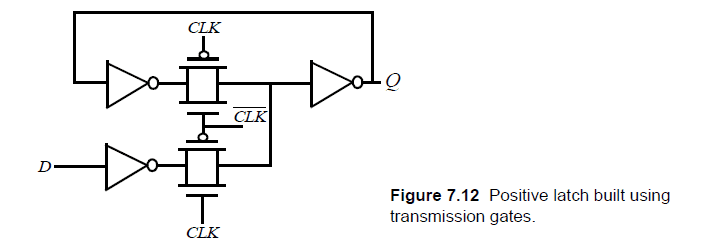
The discussion centers on the use of three inverters in a D latch circuit utilizing transmission gates, as described in "Digital Integrated Circuits" by Jan M. Rabaey. The inverters serve multiple purposes: the lower inverter acts as an input buffer amplifier, while the upper two inverters create a positive feedback loop that retains the last digital output state. This configuration functions as a sample and hold circuit, ensuring signal integrity by compensating for potential voltage drops, thereby maintaining logic levels in digital memory applications.

PREREQUISITES
  • Understanding of D latch circuits
  • Familiarity with transmission gates
  • Knowledge of inverter functionality in digital circuits
  • Basic concepts of digital memory elements
NEXT STEPS
  • Study the operation of D latches and their applications in digital circuits
  • Explore the role of transmission gates in CMOS technology
  • Investigate the impact of voltage levels on digital logic states
  • Learn about flip-flops and their use as memory elements in digital systems
USEFUL FOR

Electrical engineers, digital circuit designers, and students studying integrated circuit design will benefit from this discussion, particularly those interested in memory elements and signal integrity in digital systems.
jaus tail
Messages
613
Reaction score
48
TL;DR
Why is inverter used for D Latch using Transmission Gates?
My book has this diagram:
246326

Book: Digital Integrated Circuits by Jan M. Rabaey

I don't understand the purpose of using the three Inverters. It's not mentioned in the book, nor could I find anything on the internet.
 

Attachments

  • 1562670684079.png
    1562670684079.png
    1,018 bytes · Views: 257
Engineering news on Phys.org
Probably because you generally want to buffer all inputs and outputs (to get high input impedance and low output impedance. The only time I've used an unbuffered inverter is in some crystal oscillator circuits...
 
  • Like
Likes jaus tail
jaus tail said:
I don't understand the purpose of using the three Inverters.
Two inversions cancel to make a non-inverting amplifier.

The lower inverter is an input buffer amplifier. Q follows D, through two inverters, while the lower transmission gate is conducting.

The upper two-inverter loop provides a positive feedback digital memory. It holds the last digital output state while the D input is isolated and the upper transmission gate is conducting.

It is a “sample and hold” circuit, applied to a digital signal.
 
  • Like
Likes jaus tail and berkeman
But why do I need inverters? If the two inverters are in series, the output is same as input. I might as well not use them.
 
jaus tail said:
If the two inverters are in series, the output is same as input. I might as well not use them.
With two inverters, if you feed the output of each, back to the input of the other, you have a flip-flop which is a memory element.
 
  • Like
Likes jaus tail
246471
 
  • Like
Likes jaus tail
Also maybe it can be that inverter also makes up for voltage drop if any. Like inverter will again either pull up to 5 V or 0 V. Like if memory has output as 5 V, then with time it may degrade to 4.5 V and then to 3 V. If it goes below 2.5 V, it may be treated as logic 0.

So with 2 inverters the 4.5 V is again pulled up, and logic remains high.
 

Similar threads

  • · Replies 6 ·
Replies
6
Views
3K
Replies
2
Views
398
  • · Replies 2 ·
Replies
2
Views
2K
Replies
3
Views
3K
  • · Replies 3 ·
Replies
3
Views
1K
  • · Replies 6 ·
Replies
6
Views
2K
  • · Replies 17 ·
Replies
17
Views
9K
  • · Replies 8 ·
Replies
8
Views
2K
Replies
5
Views
3K
  • · Replies 17 ·
Replies
17
Views
6K