Another paper has identified plausible sources of unaccounted for background in addition to tritium, and astrophysical constraints
also disfavor the solar axion hypothesis.
One of the authors of the paper in
a statement made to the New York Times clarifies:
“We want to be very clear that all we are reporting is observation of an excess (a fairly significant one) and not a discovery of any kind,” said Evan Shockley of the University of Chicago in an email.
This very public statement undermining the cymbal crash that is getting attention for this paper, and the self-contradictory language in the abstract and press release, strongly suggests that the 163 scientists in the collaboration were sharply divided over whether such a highly speculative and ill supported claim of new physics should be included in the abstract and press release accompanying the paper. Shockley is doing his best not to have his professional reputation tarnished by this paper by making this statement.
The pre-print of the
new paper by the XEON1T dark matter detection experiment (press release available
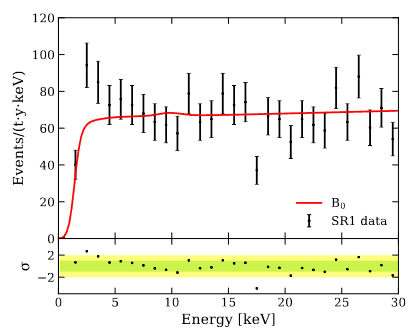
here) didn't discovery anything cool and basically admits that in its abstract, which should have read as follows :
We report results from searches for new physics with low-energy electronic recoil data recorded with the XENON1T detector. With an exposure of 0.65 tonne-years and an unprecedentedly low background rate of 76±2stat events/(tonne×year×keV) between 1-30 keV. . . .
The excess can . . . be explained by β decays of tritium, which was initially not considered, at 3.2σ significance with a corresponding tritium concentration in xenon of (6.2±2.0)×10^−25 mol/mol. Such a trace amount can be neither confirmed nor excluded with current knowledge of production and reduction mechanisms. . . .
This analysis also sets the most restrictive direct constraints to date on pseudoscalar and vector bosonic dark matter for most masses between 1 and 210 keV/c2.
Why did the authors go further an explore BSM physics explanations in the face of a reasonable alternative possibility, and the fact that it was impossible to prove or disprove the tritium contamination hypothesis
because "the tiny levels of tritium in question here would be impossible to perfectly screen out. And with XENON1T now taken apart to build a bigger future experiment, it’s impossible to go back and check."?
Normally, fairly speculative observations like the hypotheses proposed in the main paper about axions would have been omitted, and the physicists who were advocated of that explanation would have published their own hep-ph paper without putting the collaboration's entire staff's reputation on the line by including it in the main paper to propose an idea like this one.
I think that the most likely reason that this didn't happen was out of personal homage for the late Roberto Peccei and his surviving family members.
Roberto Peccei, the physicist at UCLA who first proposed the axion as a hypothetic particle to explain the lack of CP violation in the strong force called the axion back in 1977 died on
June 1, 2020 at age 78 of non-COVID related causes. According to Lubos Motl, graduate students working on the experiment had been aware of the result for about a year before it was published. Given how the academic grapevine works, Peccei himself had probably been informed of the result by someone associated with the collaboration prior to its publication.
It isn't implausible that the collaboration allowed the axion claim to be highlighted despite only marginal support for it in this experiment, to honor and call attention to his recent passing. As a towering figure in high energy physics, Peccei certainly deserved more of a tribute than his passing initially received.