Data of several moons of the planets Uranus (new)

Click For Summary
SUMMARY

This discussion focuses on calculating Kepler's Third Law constant (Ku) for the moons of Uranus using gravitational data. Participants are tasked with determining Ku values based on the formula -GMm/r, averaging these values, and completing missing data for four moons. Additionally, the discussion addresses the historical context of moon discoveries, emphasizing the differences in discovery timelines. Key concepts include Kepler's Third Law and the Standard Gravitational Parameter.

PREREQUISITES
  • Understanding of Kepler's Third Law
  • Familiarity with the Standard Gravitational Parameter
  • Basic knowledge of gravitational calculations
  • Ability to interpret astronomical data tables
NEXT STEPS
  • Research the application of Kepler's Third Law in celestial mechanics
  • Learn how to calculate the Standard Gravitational Parameter for celestial bodies
  • Study the historical context of moon discoveries in the solar system
  • Explore methods for analyzing astronomical data sets
USEFUL FOR

Astronomy students, astrophysicists, and educators interested in celestial mechanics and the historical discovery of planetary moons will benefit from this discussion.

alicia113
Messages
103
Reaction score
0
Copy the table and determine keepers third law constant ku for Uranus using the data for the first floor moons
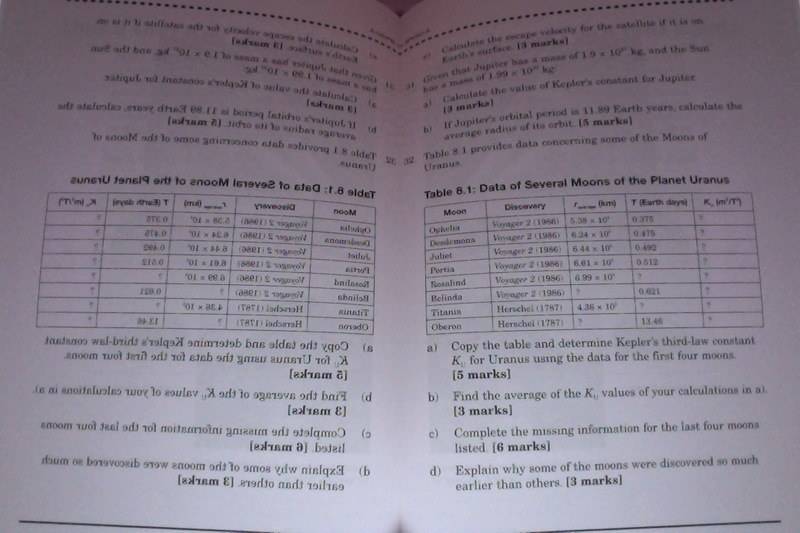

Photo on 2012-08-21 at 11.14 AM.jpg


sorry for the mirror effect its the only way i could get the page so you could read it .. its on the right # 32


b) find the average of the Ku, values of your calculations in a)

c) complete the missing information for the last four moons listed

d) explain why some of the moons were discovered so much earlier than the others

i have no idea how to even start these
all i know is -GMm/r
 
Physics news on Phys.org


alicia113 said:
Copy the table and determine keepers third law constant ku for Uranus using the data for the first floor moons


View attachment 50061

sorry for the mirror effect its the only way i could get the page so you could read it .. its on the right # 32


b) find the average of the Ku, values of your calculations in a)

c) complete the missing information for the last four moons listed

d) explain why some of the moons were discovered so much earlier than the others

i have no idea how to even start these
all i know is -GMm/r

Didn't you at least look up "Kepler's Third Law"? How about "Standard Gravitational Parameter"? What's Newton's version of Kepler's 3rd?
 

Similar threads

  • · Replies 4 ·
Replies
4
Views
3K
  • · Replies 2 ·
Replies
2
Views
3K
Replies
1
Views
2K
Replies
17
Views
4K
  • · Replies 3 ·
Replies
3
Views
2K
Replies
2
Views
6K
  • · Replies 2 ·
Replies
2
Views
2K
  • · Replies 7 ·
Replies
7
Views
3K
  • · Replies 2 ·
Replies
2
Views
3K
  • · Replies 10 ·
Replies
10
Views
3K