Decomposing SU(4) into SU(3) x U(1)

Click For Summary
SUMMARY

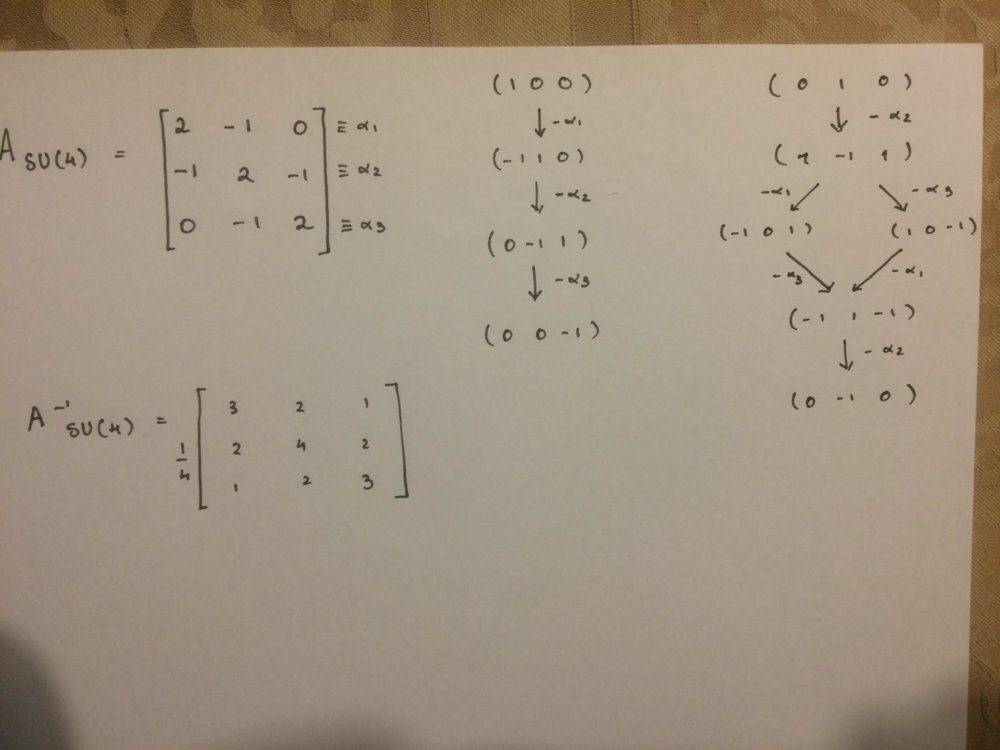
The discussion focuses on decomposing the SU(4) group into SU(3) x U(1) using the Cartan matrix and weight schemes. The Cartan matrix of SU(4) has been determined, along with its inverse, to facilitate this decomposition. The dimensions of SU(4) and SU(3) x U(1) are noted as 15 and 9, respectively, highlighting the mathematical relationship between these groups. The user seeks clarification on the classification theorem for the Lie algebras associated with SU(4) and SU(3>.

PREREQUISITES
  • Understanding of Cartan matrices in Lie groups
  • Familiarity with irreducible representations (irreps) of Lie algebras
  • Knowledge of SU(n) and U(n) group dimensions
  • Basic concepts of weight schemes in representation theory
NEXT STEPS
  • Study the classification theorem for the Lie algebra of SU(4)
  • Research the decomposition of representations in SU(3) x U(1)
  • Learn about the weight diagrams for SU(3) and their implications
  • Explore the relationship between SU(4) and its subgroups in detail
USEFUL FOR

The discussion is beneficial for theoretical physicists, mathematicians specializing in representation theory, and anyone studying the structure of Lie groups and their applications in particle physics.

RicardoMP
Messages
48
Reaction score
2
I'm solving these problems concerning the SU(4) group and I've reached the point where I have determined the Cartan matrix of SU(4), its inverse and the weight schemes for (1 0 0) and (0 1 0) highest weight states.
83052426_998197147219953_6309952079091728384_n.jpg

How do I decompose the (1 0 0) and (0 1 0) into irreps of SU(3) x U(1) using the inverse of the Cartan matrix of SU(4) and the weight scheme?
 
Physics news on Phys.org
Can you elaborate who ##SU(4)## is connected to ##SU(3) \times U(1)##? The dimension of ##SU(n)## is ##n^2-1## and the dimension of ##U(n)## is ##n^2##. Hence we have ##15## on one side and ##9## on the other.

I only know the irreducible representations of ##\mathfrak{su}(2)##, so I'm not sure what the classification theorem for ##\mathfrak{su}(4)## and ##\mathfrak{su}(3)## says. Not to mention the groups.
 

Similar threads

  • · Replies 1 ·
Replies
1
Views
2K
  • · Replies 6 ·
Replies
6
Views
2K
  • · Replies 1 ·
Replies
1
Views
2K
  • · Replies 1 ·
Replies
1
Views
2K
  • · Replies 1 ·
Replies
1
Views
2K
  • · Replies 12 ·
Replies
12
Views
3K
  • · Replies 4 ·
Replies
4
Views
661
  • · Replies 1 ·
Replies
1
Views
3K
  • · Replies 26 ·
Replies
26
Views
987
  • · Replies 0 ·
Replies
0
Views
2K