High School Is the Definite Integral of the Function Exactly 1?

Click For Summary
SUMMARY

The definite integral of the function defined as arccot(x coth(1/x)) from 0 to infinity does not equal exactly 1. Using Maple with 30-digit precision, the integral evaluates to approximately 1.97425968165579173304278091386. Multiplying this result by the fraction 50,000/98,713 yields a value of approximately 0.999999838752642373873137739639, which is very close to 1 but not exact. The rounding behavior observed in Wolfram Alpha may be due to limitations in computation time for non-Pro users.

PREREQUISITES
  • Understanding of definite integrals and their properties
  • Familiarity with the arccotangent and hyperbolic functions
  • Basic knowledge of numerical integration techniques
  • Experience with Maple software for symbolic computation
NEXT STEPS
  • Explore advanced features of Wolfram Alpha Pro for extended computation
  • Learn about numerical integration methods in Maple
  • Investigate the properties of arccotangent and hyperbolic functions
  • Study the implications of precision in numerical analysis
USEFUL FOR

Mathematicians, students studying calculus, software developers using Maple for symbolic computation, and anyone interested in numerical integration techniques.

Saracen Rue
Messages
150
Reaction score
10
Hi everyone,

I am trying to find the definite integral of a function (see attached image) from 0 to infinity using Wolfram alpha. I'm just looking for some verification on if the integral actual is equal to exactly 1, or if there's some rounding errors going on.

Thank you for your time :)
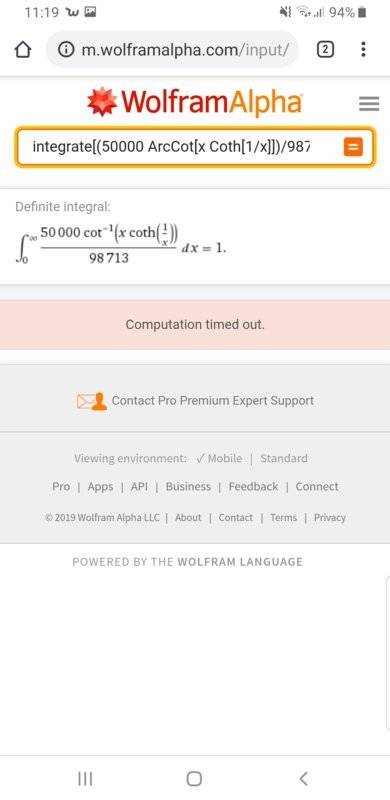
Screenshot_20190331-111946_Chrome.jpg
 
Physics news on Phys.org
This is just a guess on my part, but the person who made up the problem may have done a numerical integration, and found the answer to be such that multiplying by the fraction 50,000/98713 made it very close to 1. Perhaps there is a way to evaluate it in closed form, but it is beyond my capabilities.
 
Charles Link said:
This is just a guess on my part, but the person who made up the problem may have done a numerical integration, and found the answer to be such that multiplying by the fraction 50,000/98713 made it very close to 1. Perhaps there is a way to evaluate it in closed form, but it is beyond my capabilities.
Thanks for your insight :)

The part that's confusing me is that Wolfram Alpha is usually very good with these type of problems and would provide an answer correct to 100+ decimal places. The fact that it seems to just be rounding it to '1' is quite unusal.

Prehapa the problem is that I don't have Wolfram Alpha Pro which allows for extended computation time. If anyone with Pro does read this, please try computing this question for me and let me know if it provides a different answer or not. Thank you :)
 
Saracen Rue said:
Thanks for your insight :)

The part that's confusing me is that Wolfram Alpha is usually very good with these type of problems and would provide an answer correct to 100+ decimal places. The fact that it seems to just be rounding it to '1' is quite unusal.

Prehapa the problem is that I don't have Wolfram Alpha Pro which allows for extended computation time. If anyone with Pro does read this, please try computing this question for me and let me know if it provides a different answer or not. Thank you :)

The result is not exactly 1.0000 ... Here is a computation using Maple, set to 30-digit precision.

restart;
k:=50000/98713;

50000
k := -----
98713

> f0:=arccot(x*coth(1/x));

f0 := arccot(x coth(1/x))

> Digits:=30;

Digits := 30

> evalf(Int(f0,x=0..infinity));

1.97425968165579173304278091386

> J0:=%;

J0 := 1.97425968165579173304278091386

> k*J0;

0.999999838752642373873137739639
 
  • Like
Likes Charles Link
Relativistic Momentum, Mass, and Energy Momentum and mass (...), the classic equations for conserving momentum and energy are not adequate for the analysis of high-speed collisions. (...) The momentum of a particle moving with velocity ##v## is given by $$p=\cfrac{mv}{\sqrt{1-(v^2/c^2)}}\qquad{R-10}$$ ENERGY In relativistic mechanics, as in classic mechanics, the net force on a particle is equal to the time rate of change of the momentum of the particle. Considering one-dimensional...

Similar threads

  • · Replies 8 ·
Replies
8
Views
3K
  • · Replies 4 ·
Replies
4
Views
1K
  • · Replies 6 ·
Replies
6
Views
3K
  • · Replies 4 ·
Replies
4
Views
6K
  • · Replies 16 ·
Replies
16
Views
4K
  • · Replies 5 ·
Replies
5
Views
2K
  • · Replies 3 ·
Replies
3
Views
2K
  • · Replies 8 ·
Replies
8
Views
2K
  • · Replies 1 ·
Replies
1
Views
3K
  • · Replies 12 ·
Replies
12
Views
2K