Can rotating shafts experience changes in deflection due to inertial effects?

Click For Summary
SUMMARY

The discussion centers on the deflection of rotating shafts and the impact of inertial effects. It is established that rotational inertia does not decrease the deflection of a rotating rod compared to a stationary rod. Instead, the primary concern is the fatigue life evaluation based on maximum bending stress, particularly in demanding applications such as jet engines. Key inertial effects to consider in design include whirl, torsion-wise instability, inertial stiffening, and gyro deflection.

PREREQUISITES
  • Understanding of rotational dynamics and shaft mechanics
  • Familiarity with fatigue life evaluation techniques
  • Knowledge of stress analysis in mechanical components
  • Basic principles of inertial effects in rotating systems
NEXT STEPS
  • Research "fatigue life evaluation methods for rotating shafts"
  • Study "inertial effects in jet engine design"
  • Explore "whirl and torsional instability in rotating machinery"
  • Learn about "gyro deflection and its implications in engineering"
USEFUL FOR

Mechanical engineers, design engineers, and anyone involved in the analysis and design of rotating machinery components, particularly in high-stress applications like aerospace and automotive industries.
Spectre
Messages
2
Reaction score
0
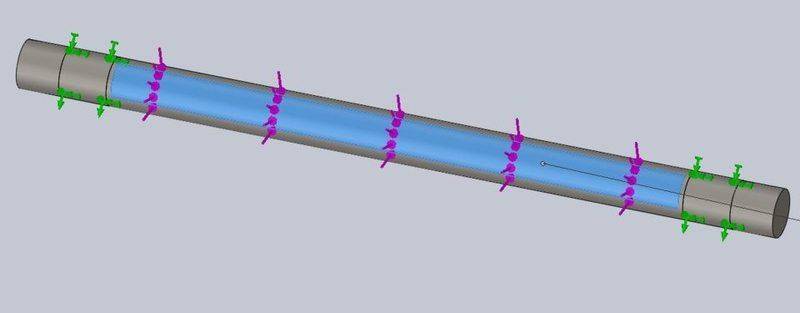
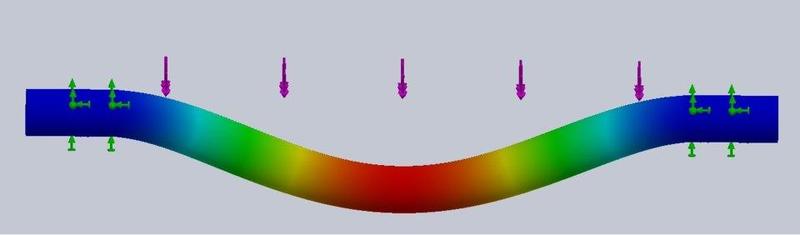
I am curious how the deflection of a shaft changes due to rotation. In the force diagram image the green arrows show the rotational fixture locations and the purple arrow show the location of the applied force. The second image shows the deflection during a static test. If the force is applied from a stationary position, how would the amount of deflection change due to the rotation of the shaft along is axial axis? Does a rotating shaft deflect less than a rotations shaft?
Shaft Force Diagram.jpg
Shaft Deflection.jpg
 
Engineering news on Phys.org
If the static force were applied from a fixed direction, as with a pulley being loaded by the tension of a belt attached to another pulley then the deflection would remain in the horizontal plane between the two pulley shaft centerlines; on the other hand, if the force rotates about the shaft as if the the pulley had a weight attached at some point on it circumference then the deflection will rotate with the weight. Either way the amount of deflection will be same in both cases.
 
JBA,
This issue is a fixed direction force due to a belt running around a rod as you state in your first example. Just to clarify, rotational inertia would have no affect on decreasing the deflection of the rotating rod compared to the deflection on a stationary rod?
 
No it will not have any effect, the main effect will be full stress reversal fatigue on the shaft, so a fatigue life evaluation based upon the maximum bending stress would be in order as apart of the design.
 
Just for general interest :

In more demanding applications like jet engines inertial effects do have to be considered in design of the rotating components

The most common effects are :

Whirl .
Torsion wise instability .
Inertial stiffening .
Gyro deflection .
 
  • Like
Likes   Reactions: Heral89

Similar threads

  • · Replies 5 ·
Replies
5
Views
5K
Replies
2
Views
1K
  • · Replies 3 ·
Replies
3
Views
2K
  • · Replies 10 ·
Replies
10
Views
1K
  • · Replies 6 ·
Replies
6
Views
10K
Replies
5
Views
4K
  • · Replies 18 ·
Replies
18
Views
2K
  • · Replies 3 ·
Replies
3
Views
3K
  • · Replies 8 ·
Replies
8
Views
2K
  • · Replies 18 ·
Replies
18
Views
2K