Degrees of freedom (question based on an interview I attended)

Click For Summary

Discussion Overview

The discussion revolves around the concept of degrees of freedom (DOF) in a mechanical context, particularly in relation to an interview question. Participants explore various interpretations of the problem, including translation and rotational degrees of freedom, and the implications of constraints on the system.

Discussion Character

  • Exploratory
  • Technical explanation
  • Debate/contested
  • Conceptual clarification

Main Points Raised

  • Some participants emphasize that the number of degrees of freedom is contingent upon the specific problem being posed, suggesting that context is crucial.
  • One participant proposes that the assembly consists of a top block, a leaf spring, and a bottom block, and describes their respective degrees of freedom based on their rigidity and flexibility.
  • Another participant suggests a total of six degrees of freedom, identifying translation and rotation for each axis, but does not elaborate on the reasoning behind this count.
  • There is a suggestion that the interviewer may be more interested in the interviewee's thought process and problem-solving approach rather than a definitive answer.
  • Some participants propose that clarifying questions about the system's constraints and definitions are essential to accurately assess the degrees of freedom.
  • A participant notes the importance of defining the unfettered system and applying constraints to arrive at a meaningful answer.

Areas of Agreement / Disagreement

Participants express differing views on the number of degrees of freedom and the factors influencing this count. There is no consensus on a definitive answer, and multiple interpretations of the problem remain present.

Contextual Notes

Participants highlight the need for clarity regarding the definitions of motion and constraints, as well as the potential ambiguity in the interview question itself. The discussion reflects varying assumptions about the system being analyzed.

Who May Find This Useful

This discussion may be of interest to individuals preparing for technical interviews in mechanical engineering or related fields, as well as those studying degrees of freedom in mechanical systems.
k.udhay
Messages
167
Reaction score
13
TL;DR
This question is based on an interview I attended. I coudn't answer the question convincingly to myself. So seeking some help here.
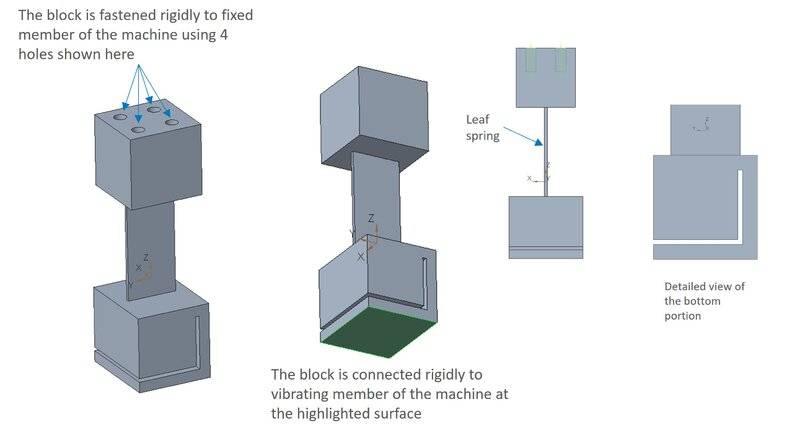
I was asked by an interviewer the number of degrees of freedom (in both translation and rotational senses) this part has with respect to each axis. Indeed I can share what I think of here, but I want to start it fresh and correct.
If you were the interviewee, what would have been your answer and the rational associated?

Spring block - Degrees of freedom problem.jpg
Thanks in advance!
Edit: Added this --> (in both translation and rotational senses)
 
Engineering news on Phys.org
My answer would be that you have not specified the problem. The number of relevant degrees of freedom depends upon the question being asked of this object. For instance it contains ~NAvagadro atoms but those degrees of freedom can be replaced by a suitable average.
So you need to consider the minimum number of variables required to specify the system. It would be easier and better for you to tell us your solution first.
 
hutchphd said:
My answer would be that you have not specified the problem. The number of relevant degrees of freedom depends upon the question being asked of this object. For instance it contains ~NAvagadro atoms but those degrees of freedom can be replaced by a suitable average.
So you need to consider the minimum number of variables required to specify the system. It would be easier and better for you to tell us your solution first.
Thanks for your answer. It is a mehcanical problem and hence I would not get into the atomic level.
My answer (I think) was this:

XCCW
1​
CW
1​
Until the gap in the groove is closed
+
1​
Acc. to stiffness of leaf spring
-
1​
Acc. to stiffness of leaf spring
YCCW
1​
Acc. to stiffness of leaf spring
CW
1​
Acc. to stiffness of leaf spring
+
0​
-
0​
ZCCW
0​
CW
0​
+
0​
-
 
I'd go with six DOF.

Translation:
  • X (leaf spring)
  • Y (groove)
  • Z (leaf spring)

Rotation:
  • X (groove)
  • Y (leaf spring)
  • Z (leaf spring; twisting)
 
Here's how I would attack this problem. My assumption is that the interviewer is more interested in how I attack problems than whether I can come up with (the)(a) correct answer during the interview. That being the case, I would expect that the interviewer wants to hear my thought process more than (s)he wants to hear my conclusions. So this is what I would be saying, somewhat paraphrased:

"The assembly consists of a top block, a leaf spring, and a bottom block with features."

"The leaf spring is flexible in the X direction, but is rigid in the Y direction."

"Similarly, the bottom block is flexible about the X axis, and rigid in the other axes."

"The top block is rigidly fastened to the machine, so has zero DOF."

"The bottom surface of the bottom block is rigidly connected to the machine, so has zero DOF. The fact that it is fastened to a vibrating member does not affect the DOF."

"The slot machined in the bottom piece would allow the bottom piece to flex. However, such flexing is prevented by the leaf spring. Zero DOF for flexing about the X axis."

"The leaf spring allows the bottom block to move in the X direction, but the bottom block is fastened to the machine. Zero DOF for the bottom block in the X-direction."

"I see one DOF - the middle of the leaf spring can be moved in the X direction. Even though it cannot be moved very far, it is one DOF."

"Conclusion - one DOF."
 
  • Like
Likes   Reactions: gmax137, Vanadium 50 and Lnewqban
As part of the process, I would first ask what it means that the bottom member can "vibrate" (does that mean move freely or only in a particular fashion). This is a terrible test question but not a bad interview question.
I agree the important part of the answer is to
  1. Define the unfettered system
  2. Apply the constraints
Is there a way change the question so it would also overtly require reliance on symmetry ?
 
hutchphd said:
but not a bad interview question.
I agree.

A good response would include questions from you - like "is motion of the lea spring only a DOF, or is it treated as internal, like atomic motion?" The answer they are looking for is not a number, its whether you can ask good clarifying questions.
 
Last edited:
  • Like
Likes   Reactions: Rive and gmax137

Similar threads

  • · Replies 1 ·
Replies
1
Views
1K
  • · Replies 5 ·
Replies
5
Views
3K
  • · Replies 1 ·
Replies
1
Views
2K
Replies
1
Views
1K
Replies
11
Views
2K
  • · Replies 8 ·
Replies
8
Views
5K
  • · Replies 7 ·
Replies
7
Views
2K
  • · Replies 2 ·
Replies
2
Views
3K
  • · Replies 4 ·
Replies
4
Views
5K
  • · Replies 5 ·
Replies
5
Views
2K