Density of air at one atmosphere pressure

Click For Summary
SUMMARY

The discussion focuses on calculating the density of air at one atmosphere pressure using the ideal gas equation, specifically the formula d = \frac {pM_m}{RT}. Participants clarify that this formula applies to single-component gases, and for mixtures, a mixing rule based on mole fractions is necessary. The conversation also addresses a potential typo in the original question, confirming that the wording is correct. Participants recommend learning LaTeX for better formula presentation.

PREREQUISITES
  • Understanding of the ideal gas law, specifically pv = nRT
  • Knowledge of molar mass and its significance in gas density calculations
  • Familiarity with mixing rules for gas mixtures
  • Basic skills in LaTeX for formatting mathematical expressions
NEXT STEPS
  • Learn how to apply the ideal gas law to calculate the density of different gases
  • Research the concept of mole fractions and their role in gas mixtures
  • Study the derivation and application of mixing rules for gas densities
  • Explore LaTeX documentation to improve mathematical expression formatting
USEFUL FOR

Students and professionals in chemistry, physics, and engineering who are involved in gas density calculations and require clarity on the ideal gas law and its applications in mixtures.

Bolter
Messages
262
Reaction score
31
Homework Statement
Calculate the density of air
Relevant Equations
PV = nRT
How would I tackle a problem like this?

Screenshot 2019-12-22 at 22.23.55.png

I made a start by writing down the ideal gas equation and then done some manipulation on both sides to get the density expression of the ideal gas.
I'm not sure if this is what the question wants as I'm dealing with 2 different types of gases in the same atmosphere.
My density formula that I have obtained only applies to find the density of one type of gas?
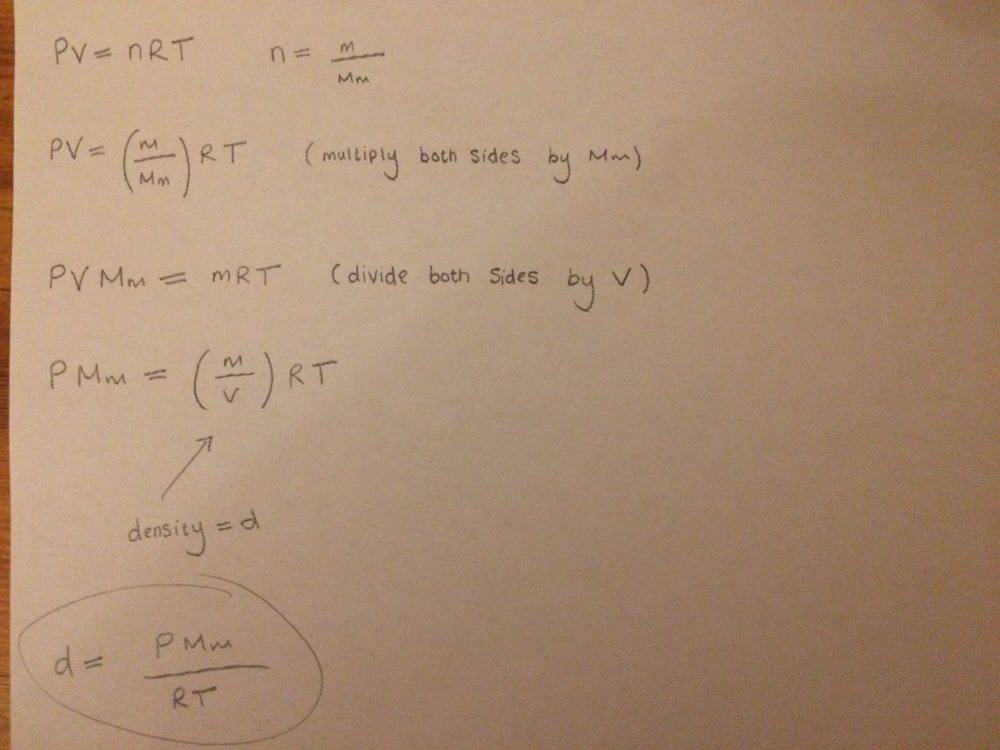
IMG_3547.JPG


Also is there a typo in the question itself? Should it read "Determine the density of air at 25 degrees at one atmosphere pressure" instead of "Determine the density of air at 25 degrees and one atmosphere pressure"?

Any help would be grateful!
 
Physics news on Phys.org
Hello again !

We recommend you learn some ##\LaTeX## to post formulas. It's compact, fairly easy:
$$ pv = nRT $$ becomes $$pV = nRT$$ and ## d = \frac {pM_m}{RT} ## becomes ##d = \frac {pM_m}{RT} ##

SInce ##M_m## (the molar mass) is different for each gas: yes, as written yuor expression works for single-composnent gases. For mixtures you need a mixing rule. FOr that you need to know whether the percentages given are by volume or by mass ...
A little googling establishes that the percentages are mol based, i.e. volume.
So the mixing rule is pretty straightforward, right ?

And you can always check the result with that same search engine...

Bolter said:
Also is there a typo in the question itself?
No typo: the text sums up the conditions, so the word 'and' is appropriate.
 
  • Like
Likes   Reactions: berkeman
BvU said:
Hello again !

We recommend you learn some ##\LaTeX## to post formulas. It's compact, fairly easy:
$$ pv = nRT $$ becomes $$pV = nRT$$ and ## d = \frac {pM_m}{RT} ## becomes ##d = \frac {pM_m}{RT} ##

SInce ##M_m## (the molar mass) is different for each gas: yes, as written yuor expression works for single-composnent gases. For mixtures you need a mixing rule. FOr that you need to know whether the percentages given are by volume or by mass ...
A little googling establishes that the percentages are mol based, i.e. volume.
So the mixing rule is pretty straightforward, right ?

And you can always check the result with that same search engine...

No typo: the text sums up the conditions, so the word 'and' is appropriate.

Are you suggesting that I work out the average molar mass of the mixture? So to do that I take the sum of the mole fractions of each gas multiplied by the molar mass of that gas.
And from that, I substitute that average molar mass value into the density expression that I got prior.

IMG_3550.JPG


And thanks I will definitely have a look into the LaTex guide page so I can start using them on the threads
 
  • Like
Likes   Reactions: Chestermiller
Seems a bit heavy to me ... :smile:
 

Similar threads

  • · Replies 9 ·
Replies
9
Views
2K
  • · Replies 12 ·
Replies
12
Views
2K
  • · Replies 6 ·
Replies
6
Views
2K
  • · Replies 12 ·
Replies
12
Views
1K
  • · Replies 7 ·
Replies
7
Views
2K
Replies
8
Views
2K
Replies
4
Views
2K
  • · Replies 21 ·
Replies
21
Views
3K
  • · Replies 10 ·
Replies
10
Views
6K
Replies
24
Views
3K