Derivative of norm of function w.r.t real-part of function

Click For Summary

Discussion Overview

The discussion revolves around the derivative of a function defined as the norm of a complex matrix-vector product with respect to the real part of the complex vector. Participants explore various methods to derive the expression for the derivative, including matrix calculus and interpretations of the lecturer's approach.

Discussion Character

  • Technical explanation
  • Mathematical reasoning
  • Debate/contested

Main Points Raised

  • One participant presents the function ##h(u)=\frac{1}{2} \left\|Au-b \right\|_{2}^2## and seeks to show that ##\frac {\partial h} {\partial u_1} = Re \left[ A^{\dagger}(Au-b) \right]##.
  • Another participant expresses confusion over the lecturer's method involving a "zero padding" operator ##\zeta## and questions its implications for the function's dimensionality.
  • Several participants derive the derivative using matrix calculus, leading to expressions involving the transpose and conjugate of the product ##(Au-b)##, but note potential errors in handling vector types.
  • One participant suggests that the placement of complex conjugation in the expressions does not affect the outcome if the product is real.
  • Another participant acknowledges the correctness of a derived result but indicates that additional work may be necessary to finalize the calculations.
  • There is a shared sentiment of wanting to understand the lecturer's approach, which some find unclear or overly complex.

Areas of Agreement / Disagreement

Participants express confusion and disagreement regarding the lecturer's method and the handling of complex derivatives. While some participants find the matrix calculus approach promising, there is no consensus on the correctness of the various methods discussed.

Contextual Notes

Participants note potential issues with assumptions about the derivatives and the handling of complex conjugates, indicating that the discussion may be limited by these unresolved mathematical steps.

SchroedingersLion
Messages
211
Reaction score
56
TL;DR
Troubles understanding an "exotic" method of taking a derivative of a norm of a complex valued function with respect to the the real part of the function.
Greetings,

suppose we have ##h(u)=\frac{1}{2} \left\|Au-b \right\|_{2}^2## with ##A## a complex matrix and ##b,u## complex vectors of suitable dimensions. Write ##u=u_1 + iu_2## with ##u_1## and ##u_2## as the real and imaginary part of ##u##, respectively.

Show that ##\frac {\partial h} {\partial u_1} = Re \left[ A^{\dagger}(Au-b) \right]##.

Now there is a straight-forward way to show this: Just rewrite ##h(u)## in terms of the matrix/vector components, take the derivative, and show that the required result is obtained. That, however, takes 2 pages of index and dagger loaded calculations.
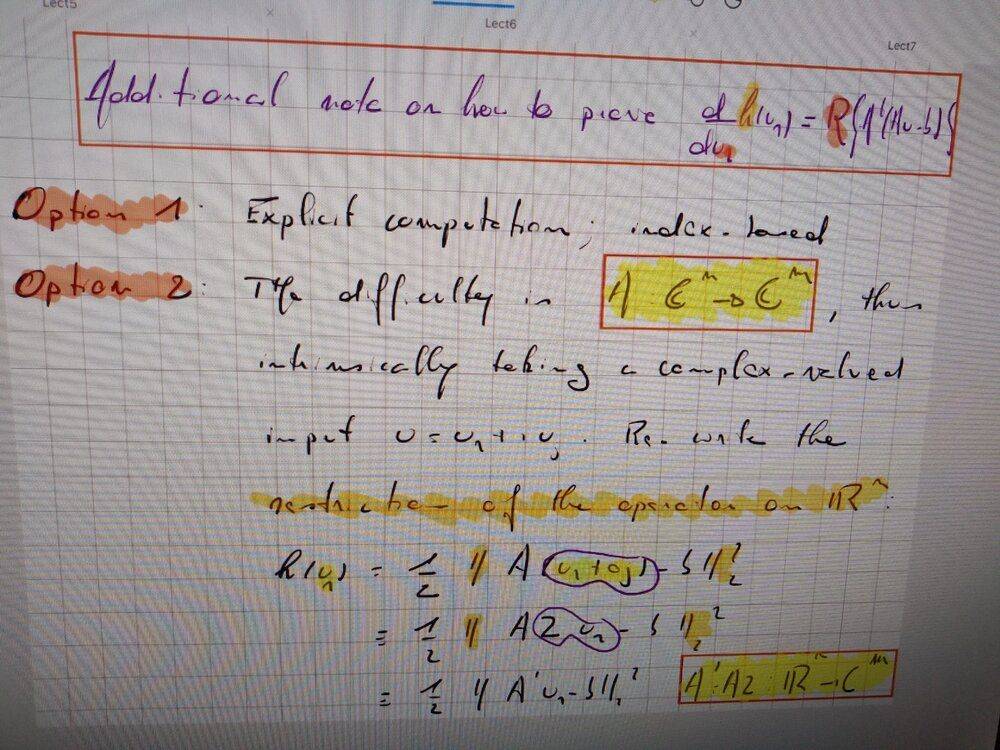
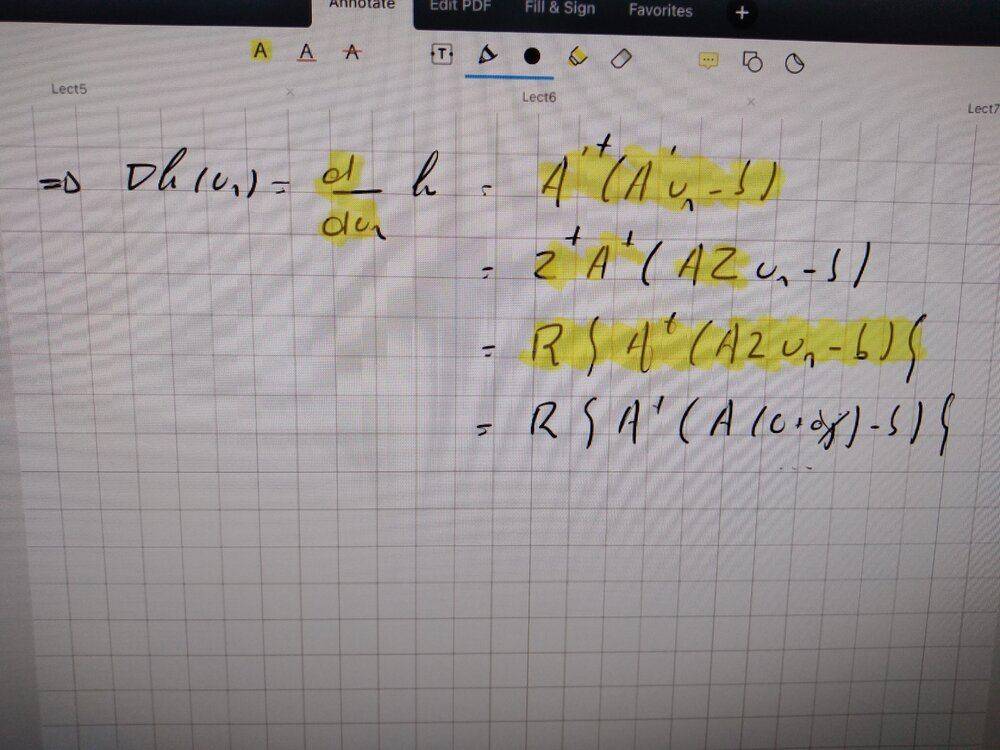
Our lecturer presented a simpler method, but I was unable to follow his logic (there might be errors in there):
IMG_20201005_183950004.jpg

IMG_20201005_184010224.jpg

He seems to interpret ##Au## as a function, and he introduces a "zero padding" operator ##\zeta## (looks like a 2), such that ##\zeta u=u_1 + i0## (?). Though I don't see why that would lead to ##A\zeta## being a function from ##\mathbb{R}^n \rightarrow \mathbb{C}^n##. Also I feel like something is wrong with the indices of ##u## here.

Note that in the case of real-valued ##A,b,u##, the derivative becomes ##A^{\dagger}(Au-b)##, which he seems to have used at the start of image 2.

Can anyone make sense of the notes?SL
 
Physics news on Phys.org
I don't understand what he is doing, but ##h(u)=\frac{1}{2} \left\|Au-b \right\|_{2}^2 = \frac 1 2 (Au-b)^T(Au-b)^*## and therefore
$$\frac {\partial h} {\partial u_1}
= \frac 1 2 (\frac {\partial Au} {\partial u_1})^T(Au-b)^* + \frac 1 2 (Au-b)^T(\frac {\partial Au} {\partial u_1})^* $$
$$= \frac 1 2 \left(\frac {\partial u}{\partial u_1}\right)^T A^T (Au-b)^*+ \frac 1 2 (Au-b)^T A^* (\frac {\partial u} {\partial u_1})^*$$
Now ##\frac {\partial u} {\partial u_1}## and its complex conjugate are simply 1:
$$\frac {\partial h} {\partial u_1}
=\frac 1 2 A^T (Au-b)^*+ \frac 1 2 (Au-b)^T A^* $$
$$=\frac 1 2 \left( A^\dagger (Au-b)\right)^* + \frac 1 2 (A^\dagger(Au-b))^T
\stackrel{?}{=} Re(A^\dagger (Au-b))$$
Hmm... something went wrong mixing up row and column vectors. Probably from assuming ##\frac {\partial u} {\partial u_1} = 1##. But it certainly looks like this approach works.
 
  • Like
Likes   Reactions: SchroedingersLion
mfb said:
I don't understand what he is doing, but ##h(u)=\frac{1}{2} \left\|Au-b \right\|_{2}^2 = \frac 1 2 (Au-b)^T(Au-b)^*## and therefore
$$\frac {\partial h} {\partial u_1}
= \frac 1 2 (\frac {\partial Au} {\partial u_1})^T(Au-b)^* + \frac 1 2 (Au-b)^T(\frac {\partial Au} {\partial u_1})^* $$
$$= \frac 1 2 \left(\frac {\partial u}{\partial u_1}\right)^T A^T (Au-b)^*+ \frac 1 2 (Au-b)^T A^* (\frac {\partial u} {\partial u_1})^*$$
Now ##\frac {\partial u} {\partial u_1}## and its complex conjugate are simply 1:
$$\frac {\partial h} {\partial u_1}
=\frac 1 2 A^T (Au-b)^*+ \frac 1 2 (Au-b)^T A^* $$
$$=\frac 1 2 \left( A^\dagger (Au-b)\right)^* + \frac 1 2 (A^\dagger(Au-b))^T
\stackrel{?}{=} Re(A^\dagger (Au-b))$$
Hmm... something went wrong mixing up row and column vectors. Probably from assuming ##\frac {\partial u} {\partial u_1} = 1##. But it certainly looks like this approach works.

Shouldn't your first line be

##h(u)=\frac{1}{2} \left\|Au-b \right\|_{2}^2 = \frac 1 2 (Au-b)^{*T}(Au-b)## ?
 
Doesn't matter where you put the complex conjugation if you know the product is real. ##ab^* = (a^*b)^* = a^*b##.
 
  • Like
Likes   Reactions: hutchphd
But you end up with a little work to do at the end, yes? Your result is correct I think.
 
mfb said:
I don't understand what he is doing, but ##h(u)=\frac{1}{2} \left\|Au-b \right\|_{2}^2 = \frac 1 2 (Au-b)^T(Au-b)^*## and therefore
$$\frac {\partial h} {\partial u_1}
= \frac 1 2 (\frac {\partial Au} {\partial u_1})^T(Au-b)^* + \frac 1 2 (Au-b)^T(\frac {\partial Au} {\partial u_1})^* $$
$$= \frac 1 2 \left(\frac {\partial u}{\partial u_1}\right)^T A^T (Au-b)^*+ \frac 1 2 (Au-b)^T A^* (\frac {\partial u} {\partial u_1})^*$$
Now ##\frac {\partial u} {\partial u_1}## and its complex conjugate are simply 1:
$$\frac {\partial h} {\partial u_1}
=\frac 1 2 A^T (Au-b)^*+ \frac 1 2 (Au-b)^T A^* $$
$$=\frac 1 2 \left( A^\dagger (Au-b)\right)^* + \frac 1 2 (A^\dagger(Au-b))^T
\stackrel{?}{=} Re(A^\dagger (Au-b))$$
Hmm... something went wrong mixing up row and column vectors. Probably from assuming ##\frac {\partial u} {\partial u_1} = 1##. But it certainly looks like this approach works.
Thanks mfb. I did not try to solve it using matrix calculus like this. I shall try to spot the misstep in the calculation so that it works out in the end. Originally, I started similarly, but I rewrote the scalar product ##(Au-b)^{\dagger}(Au-b) ## in terms of a sum over the components which became a very tedious calculation...

However, I would still like to understand that magic that the lecturer performed...
 

Similar threads

  • · Replies 1 ·
Replies
1
Views
3K
  • · Replies 3 ·
Replies
3
Views
3K
  • · Replies 1 ·
Replies
1
Views
3K
  • · Replies 3 ·
Replies
3
Views
2K
  • · Replies 1 ·
Replies
1
Views
2K
Replies
2
Views
2K
  • · Replies 1 ·
Replies
1
Views
6K
  • · Replies 2 ·
Replies
2
Views
2K
  • · Replies 1 ·
Replies
1
Views
2K
  • · Replies 2 ·
Replies
2
Views
2K