Derivatives in Halliday's physics book?

Click For Summary
SUMMARY

The discussion centers on the differentiation of functions as presented in Halliday's physics book. The derivative of the function f(t) = 72t² is correctly calculated as d(72t²)/dt = 144t, demonstrating the application of basic differentiation rules. Participants emphasize the necessity of understanding calculus fundamentals to grasp these concepts fully. The conversation also highlights the importance of accurately marking the expected response level for clarity in discussions.

PREREQUISITES
  • Basic understanding of calculus, specifically differentiation
  • Familiarity with the notation of derivatives (d/dt)
  • Knowledge of polynomial functions and their derivatives
  • Ability to interpret mathematical expressions in physics contexts
NEXT STEPS
  • Study the rules of differentiation, including power rule and product rule
  • Learn about the definition of the derivative and its geometric interpretation
  • Practice differentiating various polynomial functions
  • Explore calculus resources that bridge physics and mathematics, such as "Calculus for Physics" textbooks
USEFUL FOR

Students of physics, aspiring physicists, and anyone seeking to strengthen their understanding of calculus and its application in physics problems.

kent davidge
Messages
931
Reaction score
56
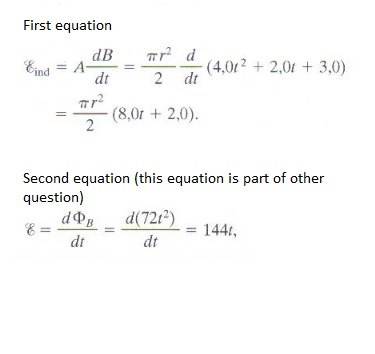
(sorry my bad english). I was reading a Halliday's book of phyisics awhat I found is below.

d(72t²)/dt = 144t

why did the result was 144? It has anything to do with the deltas in the equation (d and dt)?

and second I don't realize why the result of this another equation is this

4t²+2t+3 = 8t+2
5wgs5d.jpg
 
Last edited:
Physics news on Phys.org
These are very simple differentiations. What do you know of differentiating a function ? E.g. the definition of derivative?
The derivative of f(x) = x2 ?
 
well, I know a little bit how to solve an integral by summing all the terms but when I solve it for f(x) = x² I found 72t² and the result is 144t as you can see in the image above.
 
But this is not integration, it is differentiation !
 
This physics text is calculus based. You will need to learn calculus before attacking that text, I'm afraid.
 
I cannot do anything but agree with previous posters. These results are very basic derivatives and you will need to learn calculus properly before you can hope to understand what is going on.

Also, please note that the thread levels are intended for you to mark what level of answer you are comfortable with. The "A" you marked this thread with means that you expect an answer on graduate student level. This is clearly not the case and I have changed the level accordingly.
 
  • Like
Likes   Reactions: CalcNerd
kent davidge said:
d(72t²)/dt = 144t

why did the result was 144?

What did you think it should have been, and how did you arrive at that result?
 

Similar threads

  • · Replies 2 ·
Replies
2
Views
745
  • · Replies 7 ·
Replies
7
Views
416
  • · Replies 8 ·
Replies
8
Views
2K
  • · Replies 19 ·
Replies
19
Views
1K
  • · Replies 3 ·
Replies
3
Views
2K
  • · Replies 4 ·
Replies
4
Views
4K
  • · Replies 3 ·
Replies
3
Views
1K
  • · Replies 4 ·
Replies
4
Views
3K
  • · Replies 1 ·
Replies
1
Views
1K
  • · Replies 3 ·
Replies
3
Views
1K