The surface area of an oblate ellipsoid

Join the discussion
Registration is free. Ask a follow-up in this thread, or start your own.
8 replies · 2K views
Adams2020
Messages
39
Reaction score
3
TL;DR
How to get the surface area of an oblate ellipsoid in terms of ε?
In "An Introduction to Nuclear Physics by W. N. Cottingham, D. A. Greenwood" for the surface area of an oblate ellipsoid, the following equation is written for small values of ε :
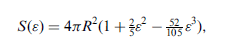
An Introduction to Nuclear Physics  -Cambrid.png

The book has said this without proof.
I found the following formula for the desired shape:
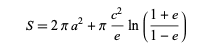
2020-11-23 18_53_30-‪Oblate Spheroid -- from Wolfram MathWorld.png

No matter how hard I tried, I could not get the result of the book with this formula. I used Taylor's expansions in the calculation, but unfortunately my result does not match the book. Help me, please!
 
Physics news on Phys.org
What did you get...it certainly works through order zero.
 
hutchphd said:
What did you get...it certainly works through order zero.
My final result is as follows:
4*pi*R^2 (1+ε+ (7/5)ε ^2+ (36/35)ε ^3 +...)
Which has a bad difference with the result of the book.:oldconfused:
 
There is no term linear in ##\epsilon## because the function is even...remember ##\epsilon=\frac c a ##. How did they define R in the first approximation?
 
hutchphd said:
There is no term linear in ##\epsilon## because the function is even...remember ##\epsilon=\frac c a ##. How did they define R in the first approximation?
My data is as follows:
2020-11-23 22_10_42-W. N. Cottingham, D. A. Greenwood - An Introduction to Nuclear Physics  -C...png
 
What then is c in your formula 2??
 
hutchphd said:
What then is c in your formula 2??
A similar formula was stated by our nuclear professor, but with the difference that there was b instead of c. So I thought in this case b = c
2020-11-23 22_39_06-W. N. Cottingham, D. A. Greenwood - An Introduction to Nuclear Physics  -C...png
 
I suggest double checking the definitions eccentricities (see wikipedia) and if you wish to show your complete calculation (all steps) I can perhaps help. Otherwise there are too many mystery definitions...certainly these should agree through order ##\epsilon^2##
 
  • Like
Likes   Reactions: Adams2020
hutchphd said:
I suggest double checking the definitions eccentricities (see wikipedia) and if you wish to show your complete calculation (all steps) I can perhaps help. Otherwise there are too many mystery definitions...certainly these should agree through order ##\epsilon^2##
ok thanks