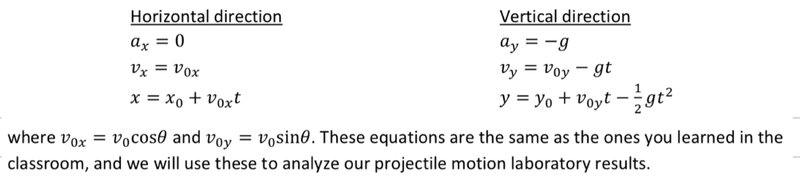
Derive a general expression for range when launch angle=0

aron silvester
1. The problem statement, all variables, and given/known data

problem statement.jpeg


Homework Equations


Relevant equation.jpeg


The Attempt at a Solution


So basically I took vertical direction formula and I solved for "t". I then took the horizontal direction formula and solved for "x" or we can also call x the "Range" since that's what the problem is asking for. Is this right?
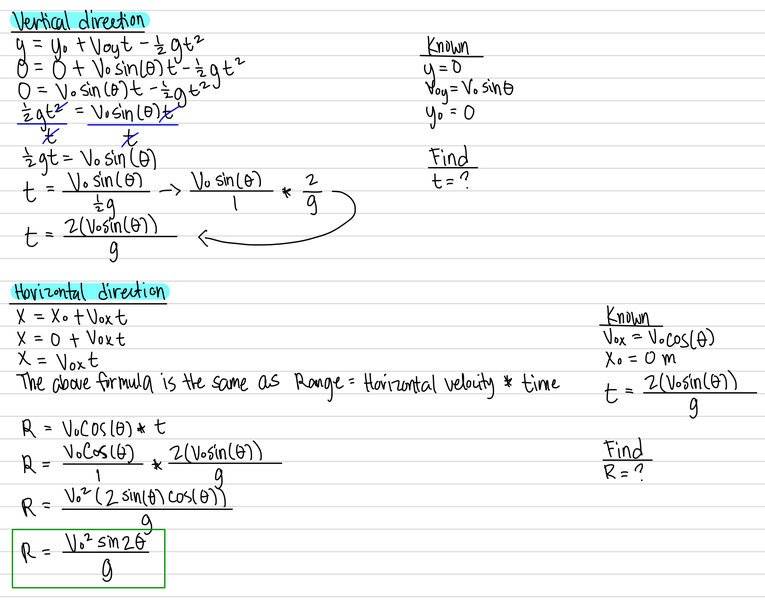
IMG_1689.jpeg
 
Physics news on Phys.org
Correct. Good job!
 
TSny said:
Correct. Good job!
Hey thanks, but my professor got this. The equation that I got is the same as the expression on the left side of the addition sign, and then he's adding an equation inside a square root. Why is that?
IMG_1697.jpeg
 
I haven't looked at your professors solution but I think yours is wrong.

If the launch angle is zero then sin(θ) = 0 and the range will always be zero unless it's fired from some initial height y0. Yet you state y0=0.

The problem statement mentions "h" which I think meant to be the initial launch height eg it's fired from the top of a hill of height h.
 
  • Like
Likes TSny
i mean if you set up theta=0, you will not get the formula. then you get that formula, R=V0*t
= vo*√(2h/g)
 
Last edited:
aron silvester said:
Hey thanks, but my professor got this. The equation that I got is the same as the expression on the left side of the addition sign, and then he's adding an equation inside a square root. Why is that?
View attachment 212478
As @CWatters noted, you solved the problem for firing the projectile with a nonzero angle over level ground, so the projectile returns to the same height as it was fired from. But it looks like you were meant to solve a different problem where the projectile is fired horizontally (##\theta = 0##) off a cliff of height h. I apologize for not catching that earlier.
 
CWatters said:
I haven't looked at your professors solution but I think yours is wrong.

If the launch angle is zero then sin(θ) = 0 and the range will always be zero unless it's fired from some initial height y0. Yet you state y0=0.

The problem statement mentions "h" which I think meant to be the initial launch height eg it's fired from the top of a hill of height h.
TSny said:
As @CWatters noted, you solved the problem for firing the projectile with a nonzero angle over level ground, so the projectile returns to the same height as it was fired from. But it looks like you were meant to solve a different problem where the projectile is fired horizontally (##\theta = 0##) off a cliff of height h. I apologize for not catching that earlier.

I finally solved it, but I have a question. When I used the quadratic formula, why did I have to multiply the inside of the square root by (v^2cos^2(θ))/g^2 and again by (v^2cos^2(θ))/1 ?? The part where I do this is in pink ink.
IMG_1704.jpeg
 
aron silvester said:
I finally solved it, but I have a question. When I used the quadratic formula, why did I have to multiply the inside of the square root by (v^2cos^2(θ))/g^2 and again by (v^2cos^2(θ))/1 ?? The part where I do this is in pink ink.
View attachment 212534
upload_2017-10-7_15-17-32.png


When you bring something into the square root, you have to square it. The something here is ##\frac{v_0^2 \cos ^ 2\theta}{g}##. So, after bringing it into the square root, the ##v_0## and ##\cos{\theta}## are raised to the 4th power.
 

Similar threads

  • · Replies 12 ·
Replies
12
Views
1K
  • · Replies 7 ·
Replies
7
Views
4K
  • · Replies 15 ·
Replies
15
Views
2K
Replies
6
Views
3K
  • · Replies 15 ·
Replies
15
Views
26K
  • · Replies 6 ·
Replies
6
Views
3K
Replies
15
Views
2K
  • · Replies 17 ·
Replies
17
Views
15K
  • · Replies 4 ·
Replies
4
Views
4K
Replies
23
Views
2K